
Is the latest NVIDIA Record rally a sustainable AI boom or a fragile surge built on Codex hype and China risk?

Is NVIDIA Record momentum outpacing AI risks?
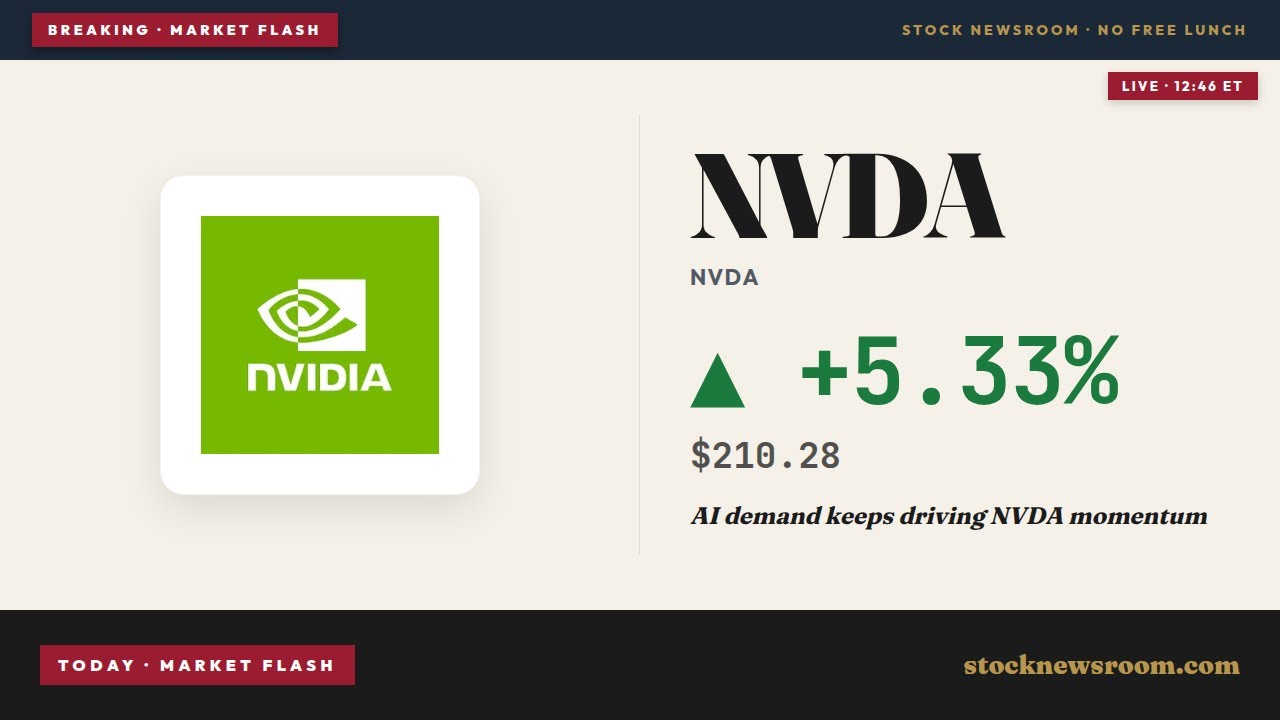
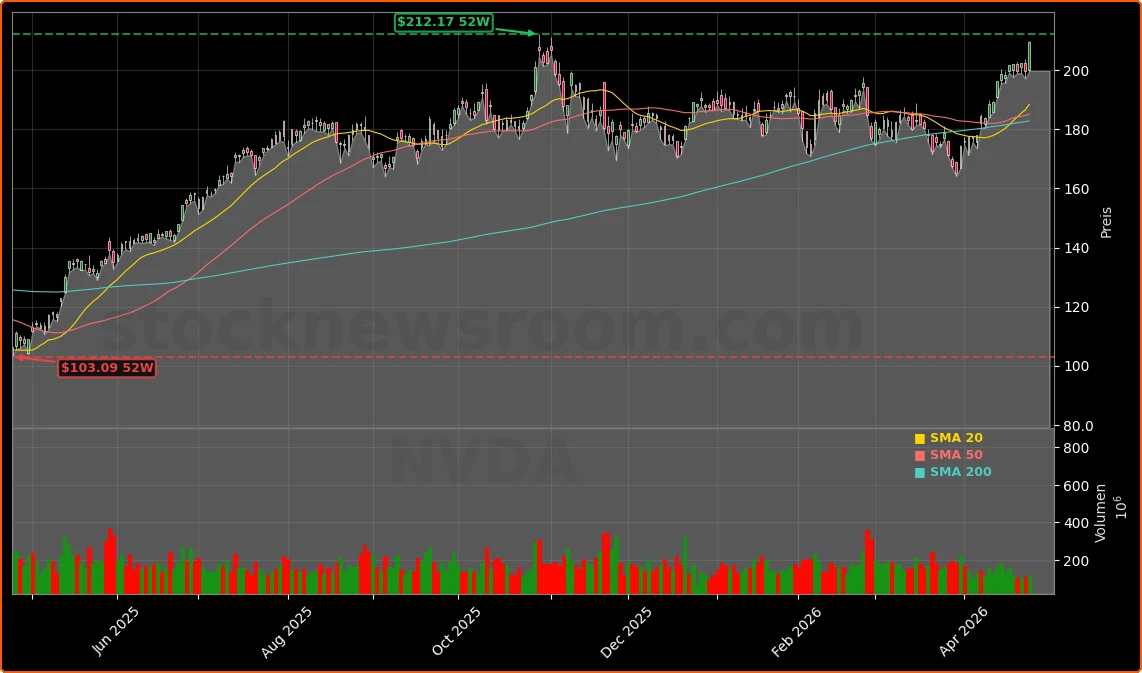
At about $209.60 in late Friday trading, NVIDIA Corporation is up 4.99% on the day and more than 11% year-to-date, marking a sharp acceleration after a choppy start to 2026. Intraday action earlier around $208–$209 put the stock on pace for a fresh NVIDIA Record closing high, surpassing the prior peak near $207 from October 2025. Over the past 12 months, the shares have gained nearly 90%, driven by relentless demand for AI data center hardware and software.
The rally comes despite ongoing profit-taking by some institutions. V Square Quantitative Management, for example, recently trimmed its NVDA stake by roughly 9%, though it still lists the position as a top holding. Overall, institutional investors control more than 65% of the float, and consensus on MarketBeat still points to a “Buy” rating with a blended target price above current levels, even after the powerful run.
On fundamentals, NVIDIA’s latest reported quarter showed revenue growth of about 73% year over year to more than $68 billion, with data center sales contributing the overwhelming share. Management guided for another sequential step up to roughly $78 billion in the current fiscal first quarter, reinforcing the view that AI infrastructure demand remains in a hyper-growth phase.
How does Codex change NVIDIA’s AI narrative?
The latest catalyst for the NVIDIA Record move is internal rather than customer-facing. More than 10,000 NVIDIA employees across engineering, product, legal, finance and marketing now have access to OpenAI’s Codex agent, powered by GPT‑5.5 and running on the company’s GB200 NVL72 systems. Early pilots showed significantly faster debugging and feature deployment, with some tasks shrinking from days to hours.
CEO Jensen Huang framed Codex not as a chatbot but as a true AI co-worker. “Chatbots answer questions. Agents do work,” he told staff, urging them to treat Codex as a teammate and calling this the “age of AI.” For investors, the move is important because it showcases NVIDIA using its own full-stack platform—from GPUs and GB200 systems to software—to drive productivity, potentially setting a template for large enterprises that want to justify multi‑billion‑dollar AI build-outs.
The deployment also deepens NVIDIA’s already tight relationship with OpenAI, where Huang recently indicated that a roughly $30 billion funding round may be the last major private raise before a potential IPO. NVIDIA also holds a sizable stake in Anthropic, further extending its reach across frontier-model providers that in turn drive GPU and system demand.
NVIDIA Record vs. Intel and other AI rivals?
Friday’s chip rally is not happening in a vacuum. Intel stock surged after a stronger-than-expected outlook highlighted a surprising renaissance for CPUs in AI data centers, as agentic AI workloads shift bottlenecks from GPUs to orchestration and data movement. Analysts at firms such as D.A. Davidson and commentary picked up by Gizmodo described CPUs as reemerging as an “indispensable” foundation of the AI stack, an area where Intel remains far ahead of NVIDIA.
At the same time, Taiwan Semiconductor Manufacturing has climbed to its own record highs, riding a wave of AI-capex and policy support in Taiwan. TSMC manufactures advanced chips for major clients including NVIDIA and Apple, meaning its robust guidance indirectly validates NVIDIA’s order book. Design-tool specialist Cadence Design Systems is also benefiting from AI-driven demand, with Rosenblatt Securities reiterating a “Buy” rating and highlighting partnerships with NVIDIA and Google as a long-term growth driver.
Within semiconductors and equipment, NVIDIA still stands out. Recent comparative data show a price-to-earnings ratio near 41—actually below the sector average—alongside a return on equity above 31%, EBITDA exceeding $50 billion and revenue growth far ahead of peers like Analog Devices and Texas Instruments. A Trefis analysis this week concluded that NVIDIA offers better growth, margins and, relative to its prospects, a more attractive valuation than several analog and mixed-signal rivals, even after the latest leg up toward a possible NVIDIA Record.
NVIDIA Record in sight, but what about China?
The biggest strategic overhang remains China. DeepSeek’s newly unveiled V4 model leans heavily on Huawei’s Ascend AI chips, signaling a faster pivot toward domestic hardware following U.S. export curbs on high-end NVIDIA GPUs. While DeepSeek still validates some techniques on NVIDIA graphics processors, Huawei’s full-stack support underscores how quickly Chinese ecosystems can develop alternatives when pushed by geopolitics.
Huang has repeatedly called China a roughly $50 billion annual AI infrastructure opportunity, potentially growing 50% a year. Internal estimates suggest demand for up to 1.5 million H200-class chips annually—equating to around $30 billion in revenue—if regulators allow broad-based sales. Any tightening of export rules or acceleration in domestic rivals like Huawei could clip that upside, an important caveat as the stock flirts with another NVIDIA Record high.
For now, though, NVIDIA still dominates AI accelerators with an estimated 80% market share, while hyperscalers such as Tesla-adjacent data players, Apple and other members of the “Magnificent Seven” continue to pour tens of billions into NVIDIA-powered clusters. ETFs like BlackRock’s tech-heavy IGM, and growth funds benchmarked to the S&P 500 and Nasdaq‑100, remain heavily exposed to the stock, making its swings a key driver of broader U.S. equity performance.
Related Coverage
For a deeper dive into how cloud giants and software partners could turn today’s hardware lead into a lasting platform, see NVIDIA AI Partnerships Boom as $200B Hyperscaler Bet Grows. That analysis looks at collaborations with firms like Adobe and BlackBerry and what they might mean for NVIDIA’s long‑term moat beyond the current cycle of data center build‑outs.
Chatbots answer questions. Agents do work.— Jensen Huang, CEO of NVIDIA
With a potential NVIDIA Record close looming, investors are weighing a powerful combination of internal AI adoption, entrenched data center dominance and rising competition from China and CPUs. The stock’s strength keeps NVIDIA at the center of the S&P 500 and Nasdaq story, but the next few quarters will need to confirm that margins and growth can withstand new rivals and regulatory risk. For long-term portfolios, the unfolding “age of AI” still positions NVIDIA as one of the most important bellwethers on Wall Street.