
Can NVIDIA AI Partnerships with giants like Adobe and BlackBerry turn today’s chip dominance into a long‑term platform monopoly?

How important are NVIDIA AI Partnerships for the AI cycle?
Despite modest weakness in the share price, Wall Street continues to treat NVIDIA Corporation as the prime beneficiary of an AI investment cycle that now runs well beyond a thematic trade. Hyperscale cloud operators are collectively pouring more than $200 billion into AI‑related infrastructure, with NVIDIA estimated to hold roughly 80% market share in high‑end AI accelerators. That spending is increasingly channeled through formal NVIDIA AI Partnerships with software vendors, industrial players and alternative cloud providers that lock in demand and create higher‑margin platform revenue on top of hardware.
Strategists at Goldman Sachs recently argued that investors should tilt toward secular growth names with structural earnings tailwinds from AI infrastructure rather than broad cyclical plays. In their preferred list, NVIDIA sits alongside peers like AMD, Broadcom and Micron, highlighting how central the company has become to the S&P 500’s AI exposure. With NVDA now representing more than 7.5% of the S&P 500, every new partnership announcement has index‑level implications for U.S. portfolios.
What does the BlackBerry deal mean for safety AI?
One of the most concrete recent NVIDIA AI Partnerships is the expanded collaboration with BlackBerry’s QNX unit. QNX will integrate its OS for Safety 8.0 with NVIDIA’s IGX Thor platform and the Halos Safety Stack, creating a safety‑certified AI system designed for robotics, medical and industrial environments. Early access will be offered via the IGX Thor Developer Kit, giving OEMs a path to deploy deterministic, real‑time AI in regulated settings.
BlackBerry expects the combined platform to be adopted by a large majority of medical device manufacturers over time, promising faster certification cycles for AI‑enabled equipment. For NVIDIA, this deepens its footprint in edge computing beyond automotive, where earlier DRIVE AGX collaborations laid the groundwork. The deal also shows how the company is transitioning from a pure chip supplier into a full‑stack safety platform partner, a shift that could support premium pricing and stickier relationships even as rivals like AMD and custom ASIC vendors chase data‑center share.
Market reaction to the BlackBerry news was muted, with NVDA gaining only about 0.2% when the expanded collaboration was first highlighted and slipping again today. But many institutional investors view such partnerships as long‑duration optionality: they may not move the stock on day one, yet they reinforce NVIDIA’s strategic role in mission‑critical AI workloads where reliability matters as much as raw performance.
How does Adobe deepen NVIDIA AI Partnerships in creative cloud?
At Adobe Summit 2026, Adobe CEO Shantanu Narayen and NVIDIA CEO Jensen Huang showcased a closer alignment around generative and “agentic” AI for creative and marketing workflows. Adobe’s Firefly models are scaling on NVIDIA’s full stack, including Omniverse, CUDA, Cosmos and NeMo, with Huang arguing that Adobe’s addressable opportunity has expanded by a factor of “100 to 1,000” as a result.
Huang called Adobe one of the most influential companies in global storytelling and positioned agentic AI as a way to encode Adobe’s decades of creative and marketing expertise into intelligent systems. Narayen, who will transition from CEO to chair of the board once a successor is named, emphasized that NVIDIA’s infrastructure enables Adobe to train and deploy its next generation of models at scale, spanning both digital and increasingly physical content via 3D and simulation.
For investors, this particular strand of the broader web of NVIDIA AI Partnerships illustrates how the company is anchoring itself inside high‑value software workflows, not just selling GPUs into anonymous data centers. That could buffer margins if hyperscalers aggressively push their own chips, because software vendors like Adobe, and potentially others in creative and enterprise SaaS, have powerful incentives to stay aligned with the most mature and benchmarked AI platform.
Where do hyperscalers and rivals like Tesla and Apple fit in?
Hyperscale cloud operators including Amazon, Microsoft and Alphabet are expected to spend well over $100 billion annually on NVIDIA hardware for AI workloads, even as they race to develop in‑house accelerators to trim long‑term costs. Analyst Anurag Rana has highlighted this dual dynamic: hyperscalers seek to reduce dependency on NVIDIA, yet remain among its largest and most committed customers.
Meanwhile, alternative infrastructure models are emerging. Neocloud providers such as CoreWeave and Nebius build AI‑optimized data centers tightly integrated with NVIDIA networking and bare‑metal GPU access. Meta is leaning on such providers to secure high‑end GPUs while it ramps its own custom accelerators. NVIDIA has taken equity stakes in some of these partners, aligning incentives and ensuring priority access to its latest chips.
Outside the cloud, competition is intensifying. AMD is gaining ground in AI accelerators, while TSMC benefits as a key foundry for both NVIDIA and its rivals. In autos, comments from Jensen Huang referencing how some manufacturers’ China strategies backfired were widely seen as a veiled contrast to Tesla, whose CEO has taken a different geopolitical path. In consumer tech, Apple has been criticized for a slower generative‑AI rollout, losing the world’s most‑valuable‑company crown to NVIDIA as the market rewards whoever can monetize AI fastest.
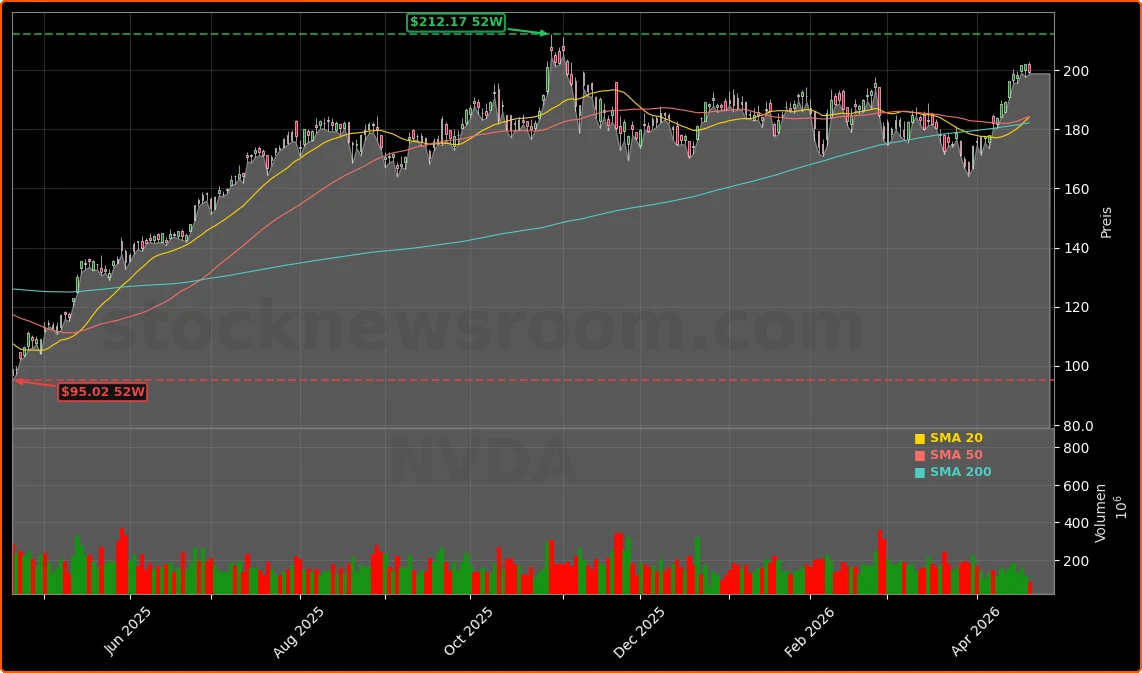
Yet despite rising competitive noise—and even high‑profile skeptics like Michael Burry reportedly buying long‑dated NVDA put options—commentators such as Jim Cramer and Melius Research’s Ben Reitzes argue that strong earnings power still supports the stock. Reitzes sees NVDA trading at what he calls a surprisingly low earnings multiple relative to its growth, while Cramer continues to recommend buying dips ahead of NVIDIA’s next set of numbers.
How do ETFs and stock pickers use NVIDIA AI Partnerships?
NVIDIA’s role in AI‑themed portfolios is growing. The WisdomTree Tech Megatrends ETF, which targets themes like AI and semiconductors, lists NVIDIA among its top holdings, capped below 3% but contributing to a basket whose weighted average EBIT margin sits near 40% and whose two‑year EBIT growth has exceeded 40%—figures heavily driven by AI‑exposed names. Broader small‑cap ETFs such as VTWO deliberately avoid such concentration; no single stock exceeds 1% weight there, in stark contrast to the S&P 500 where NVDA alone accounts for more than 7.5%.
Individual traders continue to treat NVIDIA as a barometer for the entire chip space. Some, like David Prince of T3, have recently taken profits after buying in the $170 range and selling near $200, but still believe the stock can challenge prior highs as the next wave of AI deals materializes. Others use options, including long‑dated protective puts, to hedge against the risk that today’s enthusiasm for NVIDIA AI Partnerships overshoots near‑term fundamentals.
Related Coverage
Investors focused on competitive risks may want to read how custom silicon and rival accelerators could challenge NVIDIA’s dominance in high‑end GPUs. Our in‑depth analysis, “NVIDIA AI Chips Warning as Rivals Challenge Its Lead”, explores whether the company’s current market power is sustainable as hyperscalers, AMD and others push alternative solutions into AI data centers.
There would be no fourth industrial revolution without NVIDIA.— Jim Cramer, Mad Money
In sum, NVIDIA AI Partnerships with BlackBerry, Adobe, hyperscalers and neocloud providers show how deeply the company is embedding itself across the AI value chain, from regulated medical devices to creative software and next‑generation data centers. For U.S. investors weighing NVDA’s recent pullback against its strategic momentum, these alliances suggest that NVIDIA remains at the core of the global AI build‑out. The coming quarters will reveal whether this partnership‑driven ecosystem can sustain earnings growth fast enough to justify the company’s outsized role in Wall Street portfolios.