Are Micron earnings signaling a new AI-driven memory supercycle or just another cyclical spike that will catch late investors off guard?

How do Micron Earnings fit into the AI trade?
Micron’s fundamentals have shifted dramatically over the last year as AI workloads reshaped the memory market. In fiscal Q2 2026 (ended Feb. 26), the company posted revenue of about $23.9 billion, up roughly 196% year over year and 75% sequentially from Q1. Non‑GAAP gross margin expanded toward the mid‑70s, while net profit margin hovered around a striking 41.5%, putting Micron in the same profitability league as elite software and platform names.
Those blockbuster Micron earnings were driven primarily by explosive demand for high‑bandwidth memory (HBM), which is paired with cutting‑edge GPUs from NVIDIA and other AI accelerator vendors. Management has guided for Q3 2026 revenue around $33.5 billion, implying growth of more than 260% versus Q3 2025’s $9.3 billion. With HBM capacity for 2026 effectively sold out under long‑term contracts, every incremental AI cluster being deployed by hyperscalers reinforces Micron’s revenue visibility.
From a valuation angle, Morningstar data show Micron trading at a price/earnings‑to‑growth (PEG) ratio near 0.5, well below the classic “fair value” level of 1. That suggests that, despite the stock’s huge rally, the market may still be underestimating the durability of the earnings ramp tied to AI infrastructure.
Why is Micron rising with Intel and the SOX?
The latest leg higher in MU has come alongside powerful sector tailwinds. Intel shares soared after reporting pro forma earnings of $0.29 per share versus expectations of just $0.01, with revenue of $13.6 billion and guidance calling for sequential growth in Q2 and a return to GAAP profitability. As Intel talks up a shift in AI workloads from training to inference and “agentic” use cases, investors are extrapolating even more demand for the high‑bandwidth memory Micron supplies for both Intel and GPU leaders.
On the index level, the Philadelphia Semiconductor Index (SOX) recently crossed the 10,000 mark for the first time, with Micron topping quantitative rankings among chip stocks. MU has also participated in broad ETF‑driven flows, with funds like Invesco’s large‑cap growth products and factor ETFs adding to positions as AI hardware plays keep outperforming the S&P 500 and Nasdaq 100.
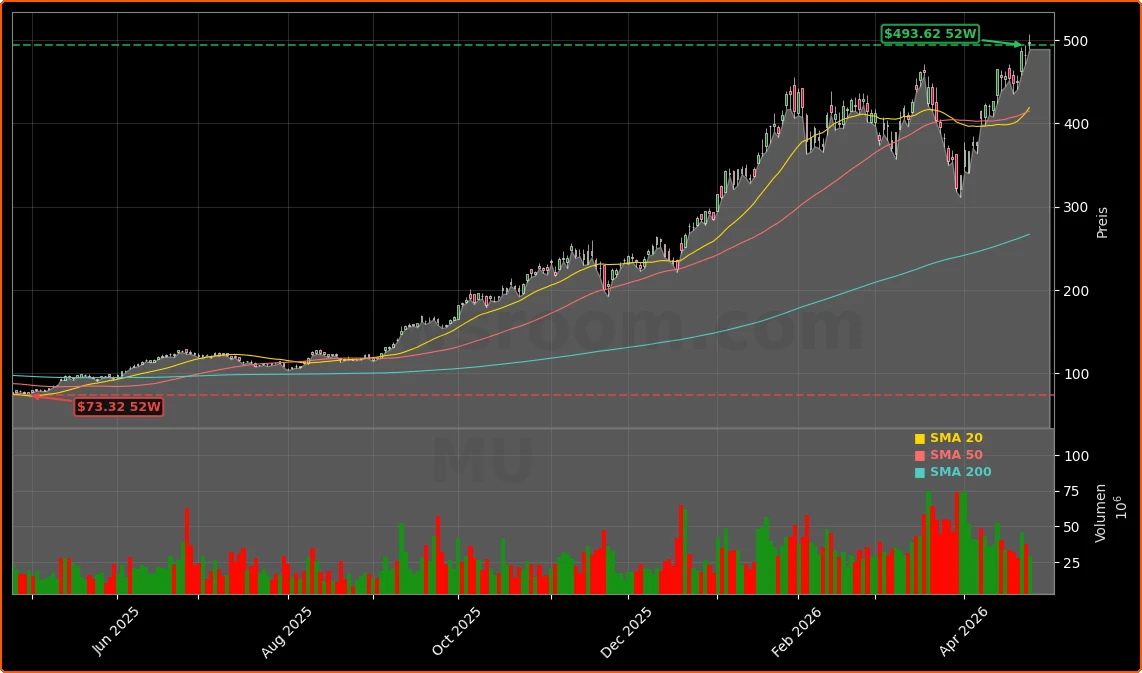
Shorter‑term traders are watching order‑flow signals as well. A recent “Power Inflow” alert highlighted heavy buying early in the session when MU traded near $478, before it spiked above $490 intraday. This combination of strong Micron earnings momentum and technical strength has made the stock a favorite for both long‑only managers and tactical trading desks.
How sustainable is Micron’s memory supercycle?
Structurally, Micron sits in a tight oligopoly with Samsung and SK Hynix in DRAM and HBM, giving the group meaningful pricing power as AI data centers consume unprecedented amounts of memory. Industry leaders expect supply to remain constrained for several years, even as new fabs ramp, because AI compute is increasingly limited by memory bandwidth and capacity rather than raw processing alone.
Micron has doubled down on this trend by exiting lower‑margin consumer PC memory and committing more than $100 billion to a new mega‑fab in New York, alongside expansions in Idaho. As the only major DRAM producer headquartered and primarily manufacturing in the U.S., Micron is benefiting from domestic semiconductor incentives as well as a “sovereign premium” from hyperscalers looking to derisk their AI supply chains from geopolitical tensions.
That said, bears note that memory has historically been one of the most cyclical corners of semiconductors, prone to boom‑and‑bust pricing as capacity comes online. Skeptics warn that aggressive investments by Samsung and SK Hynix could eventually tip the market back into oversupply once AI demand normalizes. Any sign that future Micron earnings are peaking, or that HBM pricing is rolling over, could trigger sharp corrections from current levels.
How does Micron stack up against other AI leaders?
For U.S. investors building AI baskets, Micron now sits alongside names like NVIDIA, Tesla and Apple as a core way to gain exposure to the infrastructure layer of the AI economy. While GPU vendors capture more headlines, Micron’s role is increasingly seen as “structural” rather than merely cyclical, as HBM content per accelerator and per rack keeps rising with each AI generation.
Analyst commentary has turned broadly positive. Large Wall Street firms such as Goldman Sachs, Morgan Stanley, Citigroup and Bank of America have highlighted Micron as a key beneficiary of the AI build‑out, often citing its leadership in HBM4, which is slated to power NVIDIA’s Vera Rubin platform, and its improving capital intensity thanks to government subsidies. Some value‑oriented strategists also point out that Micron’s forward P/E, closer to high single‑digits based on 2026 earnings estimates, looks undemanding relative to many AI software names trading at 30–40 times earnings.
Micron’s inclusion in value‑tilted ETFs that are beating the S&P 500 underscores how the stock straddles growth and value styles. With YTD gains north of 60% and a 12‑month move of several hundred percent, position sizing and risk management are becoming as important as the bullish fundamental story for U.S. investors.
Related Coverage
For a deeper dive into how AI demand has already driven a record move in MU shares, readers can review Micron Record: Stock Soars +9.3% as AI Memory Demand Explodes, which examines whether the recent surge marks the start of a multi‑year memory supercycle or just another cyclical peak.