Can the Adobe AI Strategy turn fresh product momentum and new partnerships into a lasting recovery for a stock still far below its highs?

Can Adobe Inc. turn AI momentum into stock returns?
On the business side, Adobe Inc. just posted solid fundamentals. In its latest reported quarter (Q1 FY 2026), revenue climbed 12% year over year to $6.4 billion, and operating cash flow hit a record near $3 billion. Management says recurring revenue from AI products has tripled versus the prior year, underscoring how central the Adobe AI Strategy has become to the company’s growth narrative.
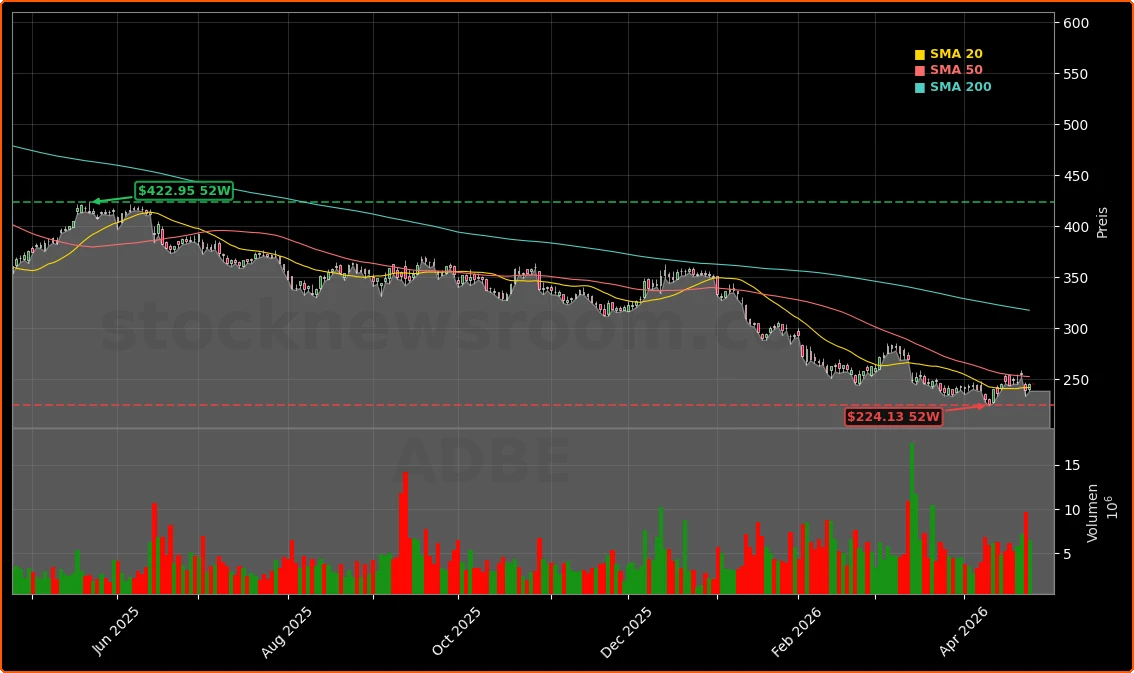
Wall Street, however, remains conflicted. The stock has dropped roughly 28% in EUR terms since the start of the year and still trades well below its 52-week high of $422.95, even after Friday’s bounce. With ADBE changing hands around $245 in the U.S. market and about 205 EUR in Germany, the valuation reflects both skepticism about long-term growth and rising concern that generative AI could erode Adobe’s historic pricing power.
Options activity signals an elevated tug-of-war between bulls and bears. Trading volume reached more than 24,000 contracts recently, around 46% of the stock’s average daily share volume, with notable interest in calls around the $242.50 strike expiring in 2026. That positioning suggests investors are actively betting on a multi-year recovery but remain wary of near-term volatility.
How is the Adobe AI Strategy changing the business?
The Adobe AI Strategy centers on embedding AI “agents” and copilots across creative and marketing workflows, rather than trying to compete head‑on as a standalone foundation-model provider. At the recent Adobe Summit in Las Vegas, the company showcased a broad alliance spanning global ad agencies, system integrators and hyperscale cloud platforms.
Agency networks like WPP and Omnicom are standardizing key content and campaign processes on Adobe’s platform, while integrators such as Accenture and IBM are packaging Adobe’s AI tools into vertical solutions for industries from retail to healthcare. On the cloud side, Adobe is deepening links with Microsoft, Google and OpenAI: its new “Marketing Agent” is now generally available inside Microsoft 365 Copilot, and beta integrations are underway in environments like ChatGPT Enterprise and Claude.
In consumer-facing deployments, Adobe’s AI agents are already visible. Dick’s Sporting Goods, for example, is rolling out AI-powered “digital coaches” in its app, using Adobe Brand Concierge, Experience Platform and GenStudio to deliver sport-specific advice and product recommendations. These kinds of use cases illustrate the company’s ambition to become the orchestration layer for AI-assisted marketing and commerce, a vision that has drawn vocal support from NVIDIA’s CEO Jensen Huang, who has called Adobe a key player in the future of marketing.
Why are analysts split on Adobe Inc.?
Despite the momentum behind the Adobe AI Strategy, analysts are far from unanimous. Morgan Stanley’s Keith Weiss recently cut his price target from $425 to $365 while maintaining an Equal Weight (Hold) rating, citing uncertainty about how AI will reshape the creative ecosystem, and the risk that margins could come under pressure as competition intensifies. RBC Capital’s Matthew Swanson lowered his target from $400 to $350 but kept a Buy rating, arguing that the company’s rapid rollout of new AI capabilities still supports meaningful upside.
Other firms land in the bullish camp. Stifel reiterated a Buy rating with a $400 target, emphasizing Adobe’s pace of AI innovation and the potential of its rebranded CX Enterprise platform. D.A. Davidson’s Gil Luria has also affirmed a Buy stance with a $300 target, pointing to attractive risk-reward after the stock’s sell-off. Meanwhile, Jefferies has warned that AI may favor platform players like Microsoft and Oracle while putting software vendors such as Adobe and DocuSign under more structural pressure.
There are also near-term overhangs beyond AI. New business in annual recurring revenue (ARR) has come in weaker than the prior year, and management now guides to only low double-digit ARR growth of just above 10% for the full year. In addition, long-time CEO Shantanu Narayen plans to step down, raising the possibility that a new chief executive could reset guidance for fiscal 2026, a risk Oppenheimer has flagged in its Perform rating.
Is Adobe Inc. stock oversold or broken?
Technical indicators underscore how aggressively investors have sold ADBE. In European trading, the relative strength index reportedly dipped toward extremely low single digits, signaling a heavily oversold condition. At the same time, Adobe’s board authorized a massive $25 billion share repurchase program running through 2030, which, combined with robust free cash flow, provides a sizable support mechanism for the stock over time.
Insider activity has been mixed. EVP and CFO Daniel Durn sold about $331,000 worth of stock in April, but still holds more than 42,000 shares. While any insider sale can raise eyebrows in a falling stock, the position size suggests routine portfolio management rather than an outright vote of no confidence.
Strategically, the Adobe AI Strategy is designed to defend and extend the company’s moat by embedding AI deeply into existing Creative Cloud and Experience Cloud subscriptions. If the company can sustain around 10% top-line growth while leveraging AI to expand margins, the narrative may shift from disruption fears back to cash generation and buyback-driven EPS growth. But if generative AI tools from competitors start to commoditize content creation faster than Adobe can differentiate, multiple compression could persist despite operational strength.
Related Coverage
Investors who want a deeper dive into how the buyback interacts with the Adobe AI Strategy can read our recent analysis “Adobe Buyback +3.7% Surge: Is a $25B Bet Enough?”, which examines whether the repurchase program alone can repair sentiment after months of underperformance. That piece also explores how AI partnerships and valuation reset might create a multi-year entry opportunity for long-term holders.
Adobe’s AI agents aim to sit inside the workflows that marketers and creators already trust, not to replace them.— Jensen Huang, NVIDIA CEO (paraphrased summary of public remarks)
In the end, the Adobe AI Strategy is both the company’s biggest risk and its clearest path forward: it deepens integration with partners and customers, but it also exposes Adobe to a rapidly evolving competitive field. For U.S. investors, the stock now offers a classic high-quality, high-uncertainty setup where execution on AI agents, recurring revenue and the CEO transition will likely determine returns. The next few quarters of adoption data and margin trends will show whether today’s oversold conditions are a contrarian entry point or a warning sign that the market still doubts Adobe’s ability to stay at the center of the AI creative stack.