

Can the massive Adobe Buyback program really rewrite the narrative for a stock that has badly lagged its software peers?

Does Adobe Buyback shift the market narrative?
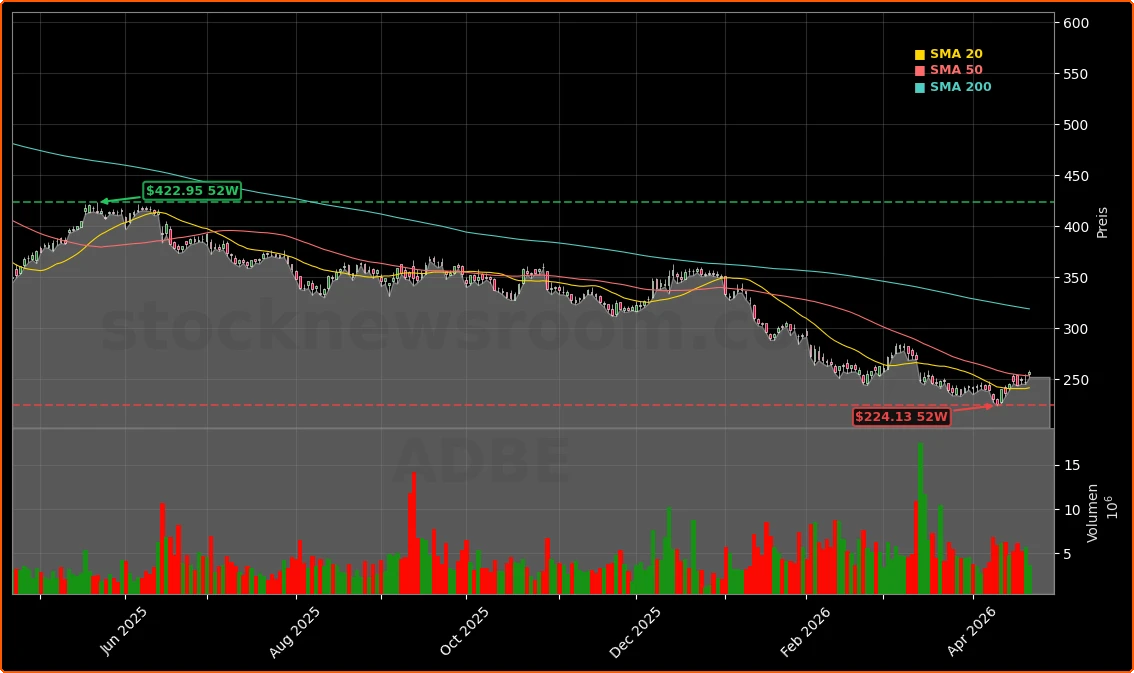
On Wednesday afternoon in New York, Adobe Inc. (ADBE) traded around $256.31, up roughly 3.7% from Tuesday’s close of $251.90, as traders reacted to the $25 billion authorization. The move comes after a difficult 12 months in which the stock has dropped close to 30%, sharply underperforming the S&P 500 and the broader NASDAQ software cohort. The Adobe Buyback is intended to counter that weakness by reducing share count over time and offsetting dilution from stock-based compensation.
Management framed the buyback as a vote of confidence in Adobe’s resilient cash flows and ability to monetize its creative and digital experience platforms in an AI-driven world. For US investors, the signal is clear: rather than hoard cash or pursue large, risky acquisitions, the company is opting to channel a substantial portion of its balance sheet strength back to shareholders at a time when sentiment is fragile.
Technically, the stock remains in recovery mode. It sits about 5.6% above its 20-day simple moving average but still roughly 12% below its 100-day SMA, underscoring that the rally following the Adobe Buyback news is meaningful yet far from a full trend reversal. Key resistance is clustered near $285.50, while support has been forming around $244.50.
How strong is Adobe Inc. versus software peers?
Despite market skepticism, Adobe stands out positively on several core financial metrics when compared with other US-listed software names such as Salesforce, Intuit and Autodesk. The company trades on a price-to-earnings ratio of about 14.4, below an industry average near 88.6, and sports a price-to-sales multiple of 4.25 versus roughly 13.7 for peers. Its price-to-book ratio of 8.74 also screens lower than the sector average, suggesting the market is assigning a discount relative to its fundamentals.
Profitability is a key differentiator. Adobe’s return on equity of 16.39% is more than double the industry average of 6.87%, signaling efficient use of capital. EBITDA of approximately $2.66 billion and gross profit of $5.73 billion are multiple times above the typical software peer, highlighting strong operating leverage in the business model. The trade-off is growth: at roughly 11.97%, recent revenue expansion lags an industry average north of 26%, as fast-scaling players like AppLovin, Synopsys, Datadog and HubSpot post far higher top-line gains.
From a balance sheet perspective, Adobe carries a moderate debt-to-equity ratio of about 0.58. That level of leverage suggests a balanced capital structure, which in turn supports the feasibility of sustaining the Adobe Buyback while continuing to invest in AI capabilities and cloud-based services. For portfolio managers in US tech and growth funds, the combination of relatively modest valuation multiples and strong profitability metrics is increasingly hard to ignore after the drawdown.
What are analysts saying about Adobe Inc.?
Wall Street research houses broadly maintain a constructive stance. Consensus still points to a Buy rating, with an average price target near $335.65, implying meaningful upside from current levels if execution holds. Among named recent calls, UBS rates the stock Neutral and recently trimmed its price target to $260, effectively bracketing the current price zone and signposting limited near-term upside in its base case.
RBC Capital remains more optimistic, keeping an Outperform rating with a target of $350, reflecting confidence that Adobe can stabilize growth and monetize new AI-driven offerings. William Blair, by contrast, downgraded the shares to Market Perform in late March, mirroring investor doubts about the pace at which AI enhancements and new product initiatives will translate into accelerating revenue.
Looking ahead to Adobe’s next update, the Street expects Q2 earnings per share of about $5.40 on revenue of roughly $6.46 billion, up from $5.06 EPS and $5.87 billion revenue a year ago. Delivery against those numbers will play a critical role in determining whether the Adobe Buyback is seen primarily as financial engineering or as a reinforcement of a still-growing, high-quality franchise.
How does AI risk factor into Adobe Buyback?
One reason the stock has de-rated is concern that generative AI could undercut demand for traditional creative tools or invite new competition from both Big Tech and specialized startups. Names like NVIDIA and Apple dominate the AI hardware and ecosystem narrative, while cloud and enterprise players including Salesforce and Tesla-like innovators in other industries show how quickly incumbents can be challenged when technology shifts.
Adobe is pushing back against that narrative by rolling out agent-based AI features across its product suite and inking high-profile enterprise deals. Recent partnerships with Dick’s Sporting Goods, Xfinity (Comcast’s consumer brand) and International Business Machines aim to embed Adobe’s AI-driven marketing and experience tools deeply into large customer workflows. These relationships not only support near-term revenue but also validate Adobe’s relevance in the next wave of AI-powered content and customer engagement solutions.
Importantly for US ETF investors, Adobe remains a sizable holding in vehicles such as the iShares Expanded Tech-Software Sector ETF and the SmartETFs Advertising and Marketing Technology ETF, as well as buyback-focused funds. That positioning means any sustained re-rating driven by the Adobe Buyback and improved AI perception could have spillover effects across software and capital-return factor strategies.
Related Coverage: How do AI agents fit into the story?
For a deeper dive into how Adobe’s AI pipeline and customer wins could reshape sentiment, readers can explore Adobe AI Agents Boom: 12% Growth and Big-Name Deals. That analysis looks at whether the company’s new agent-based features and blue-chip partnerships can shift the debate from disruption fears to growth acceleration, complementing the capital return focus of today’s Adobe Buyback announcement.
Our new $25 billion repurchase plan reflects strong confidence in Adobe’s cash generation and long-term shareholder value.— Dan Durn, Executive Vice President and CFO of Adobe Inc.
In sum, the **Adobe Buyback** marks a decisive step by management to harness its balance sheet and robust cash generation in support of a stock that has fallen out of favor. For US and global investors, the combination of discounted valuation metrics, strong profitability and a multi-year capital return plan offers a potentially attractive risk-reward profile. The next few quarters of AI execution and earnings delivery will determine whether the Adobe Buyback becomes the turning point that anchors a sustained recovery in both fundamentals and market confidence.