
Can the deepening Oracle Google Cloud Partnership turn Oracle’s entrenched database footprint into a durable AI advantage for investors?

How does the Oracle Google Cloud Partnership change AI access?
The latest phase of the Oracle Google Cloud Partnership centers on making it easier for enterprises to operationalize AI directly on top of their most sensitive data. The new Oracle AI Database Agent is now available via the Google Cloud Marketplace and plugs into Gemini Enterprise, Google’s flagship AI productivity and agent platform. Instead of writing complex SQL queries, business users can ask everyday questions like how revenue trends differ by region or product line and receive immediate, governed answers drawn from Oracle AI Database.
Under the hood, the agent interprets natural‑language requests, generates the necessary SQL, and queries Oracle’s in‑database AI capabilities. Because the data stays in the Oracle AI Database@Google Cloud environment, organizations avoid the security and compliance headaches of duplicating or exporting information into separate AI tools. For U.S. investors comparing cloud AI strategies across the S&P 500, this is Oracle’s answer to the data‑gravity problem that also drives demand for NVIDIA accelerators in hyperscale data centers.
What is the strategic logic for Oracle and Google Cloud?
For Oracle Corporation, the Oracle Google Cloud Partnership fits a broader multicloud play that already includes similar tie‑ups with AWS and Microsoft Azure. Oracle’s distributed cloud strategy is built on running the same Exadata and Autonomous AI Database stack in its own regions, on‑premises via Dedicated Region and Exadata Cloud@Customer, and now inside other hyperscalers’ data centers. That gives enterprises more flexibility to modernize legacy Oracle workloads without a disruptive re‑architecture.
Google Cloud gains deeper access to Oracle’s entrenched base in verticals like healthcare, telecommunications, media, and payments processing. European payments giant Worldline, for example, is using Oracle Exadata Database Service on Oracle AI Database@Google Cloud to modernize its payment platform while maintaining low latency and high throughput for billions of global transactions. By combining Google’s Gemini Enterprise layer with Oracle’s database and Exadata performance, both companies are targeting mission‑critical workloads where security and compliance have historically limited AI deployments.
How do new features strengthen Oracle AI Database@Google Cloud?
Alongside the Oracle AI Database Agent, Oracle is rolling out additional capabilities that reinforce the economics of keeping data close to the database layer. OCI GoldenGate will soon be generally available to support real‑time migration of Oracle databases into Oracle AI Database@Google Cloud and to set up high‑availability configurations with low‑impact data replication. GoldenGate also connects with Google BigQuery to stream operational data into near real‑time analytics, reducing the latency between transactional systems and dashboards.
Oracle is also integrating Oracle Autonomous AI Lakehouse with Google BigQuery, allowing direct access to BigQuery Iceberg tables without data duplication. That means customers can build a unified lakehouse architecture spanning Oracle and Google Cloud, an increasingly important consideration as AI models grow more data‑hungry. Regional availability is expanding as well: Oracle AI Database@Google Cloud now runs in 15 regions across North America, Europe, Asia, and Australia, with further locations in Turin and Mexico planned within the next year. For multinational clients, this geographic spread helps address data‑sovereignty and latency requirements that are central to regulated industries.
What does this mean for Oracle’s AI moat and stock risk?
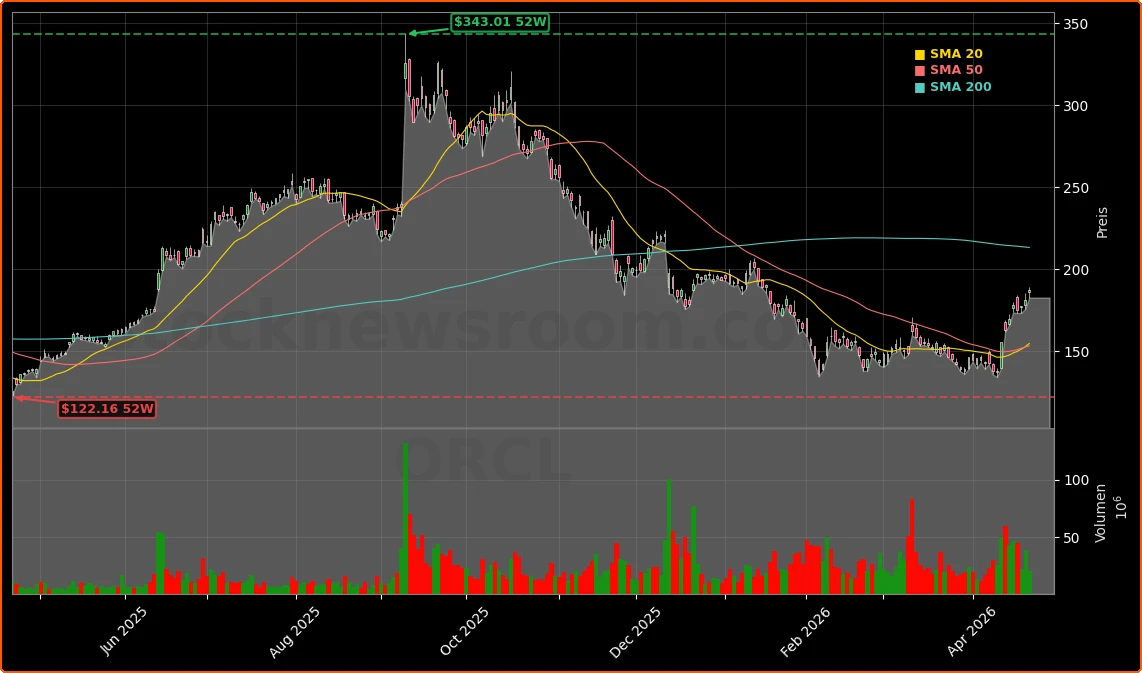
On Wall Street, ORCL is trading near $187.31, up about 3.4% on the day, and recovering from prior lows but still more than 60% below its 52‑week high, underscoring how volatile sentiment around AI infrastructure names can be. Some institutional investors view Oracle Corporation as a wide‑moat software and infrastructure vendor thanks to its deep vertical focus and long‑term relationships in areas like healthcare and media. That positioning has been bolstered by strategic ties to major AI players, including a complex, partly “frenemy”‑style relationship with frontier‑model companies such as Anthropic, and exposure to OpenAI demand via AI data‑center projects using leading‑edge chips from NVIDIA.
However, the AI narrative also brings concentrated risk. A portion of the upside case for ORCL hinges on whether key partners like OpenAI and Anthropic maintain leadership in the AI ecosystem and continue to scale workloads on Oracle infrastructure. If those players lose momentum or pivot architectures away from Oracle’s stack toward rivals tied more closely to hyperscalers like Apple or Tesla in their own AI build‑outs, the payoff from massive data‑center investments could fall short. That is why some analysts emphasize that Oracle’s AI strategy must diversify across multiple model providers and workloads, with the Oracle Google Cloud Partnership serving as one pillar rather than a single point of dependence.
How are enterprises actually using agentic AI?
Real‑world adoption is starting to emerge. AI Shift, a Japanese CyberAgent subsidiary focused on agentic AI solutions for customer service, marketing, and sales, currently runs its platform on Oracle Autonomous AI Database on OCI. The company plans to extend customer deployments to Oracle AI Database@Google Cloud and to use the Oracle AI Database Agent with Gemini Enterprise so clients can design agents that operate on governed Oracle data with natural‑language prompts. Early feedback highlights faster development cycles, better‑grounded answers, and improved governance.
This agentic approach mirrors a broader trend on NASDAQ and S&P 500 earnings calls, where management teams across software and internet names are emphasizing AI “co‑pilots” and task‑specific agents rather than generic chatbots. By offering an agent that is natively aware of Oracle schemas, policies, and security controls, Oracle is trying to lock in database customers before they shift sensitive workloads into less governed AI stacks hosted elsewhere.
Related Coverage
Investors looking to dig deeper into the valuation debate around ORCL can review StockNewsroom’s analysis in “Oracle Forecast +2.8% Rally: Can AI Cash Flows Justify $400?”. That piece examines whether aggressive AI‑driven cash‑flow projections, including expected demand from OpenAI and large data‑center projects, can plausibly support a long‑term price target near $400 per share and what assumptions would need to hold.
By applying AI directly to enterprise data at the database layer, customers can improve accuracy, strengthen controls, and use models more efficiently without exposing sensitive data or adding complexity.— Nathan Thomas, SVP Product Management, Oracle Cloud Infrastructure
Overall, the expanded Oracle Google Cloud Partnership underscores Oracle’s ambition to sit at the intersection of trusted enterprise data and next‑generation AI platforms. For investors, the combination of natural‑language access, multicloud distribution, and deep vertical penetration keeps ORCL in the conversation as a key AI infrastructure play despite its stock still trading far below past highs. The next few quarters of customer wins and cloud‑AI revenue disclosures will show whether this partnership translates into durable, higher‑margin growth that can justify a higher multiple for Oracle shares.