Can Oracle’s AI-fueled stock surge outrun a towering debt load, negative cash flow and a risky bet on OpenAI demand?

Is Oracle’s AI-fueled rally ignoring the balance sheet?
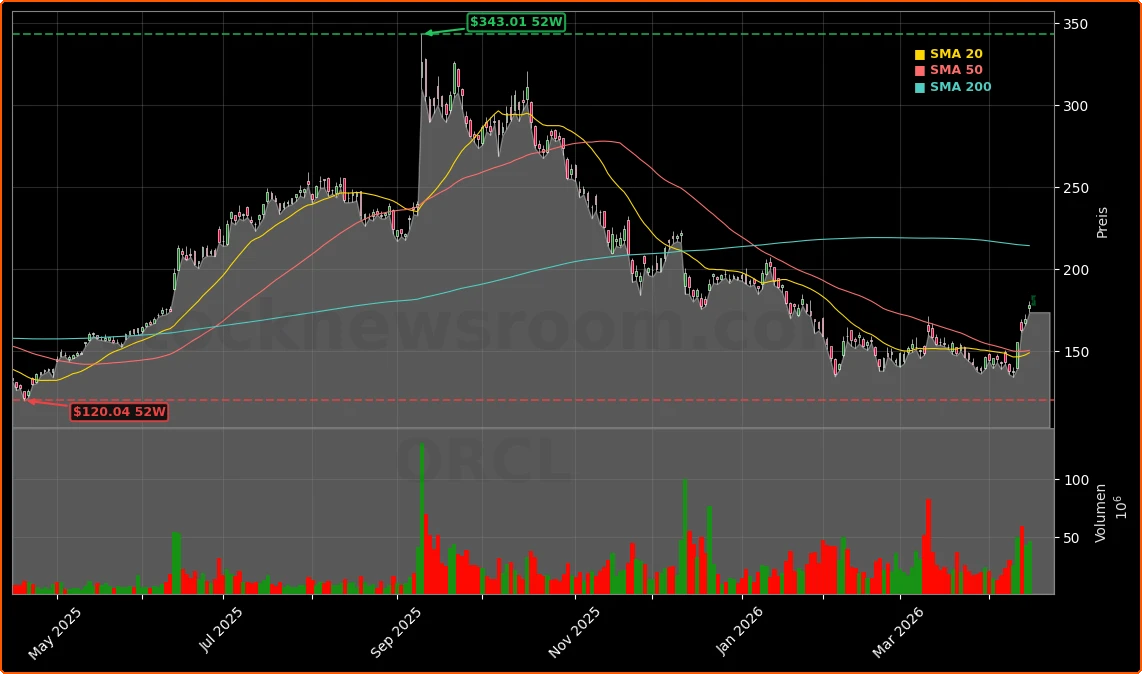
After a weak stretch since September, Oracle stock has staged an impressive comeback, gaining roughly one-third from its April low while the S&P 500 and NASDAQ hover near record territory. Bulls point to surging demand for AI data centers and cloud capacity, where Oracle is pitching itself as an alternative to hyperscale rivals. Yet the core Oracle AI Risks are not about near-term revenue growth, but about how that growth is being financed and how fragile the underlying assumptions may be.
On the balance sheet, Oracle Corporation is carrying over $125 billion in debt. In addition, the company has committed to approximately $248 billion in long-term off-balance-sheet lease obligations tied to data centers and related infrastructure. When those obligations are included, the economic leverage picture looks far more stretched than standard debt metrics suggest, and it directly amplifies Oracle AI Risks for equity holders if the AI boom slows.
Valuation also looks demanding against that backdrop. The stated book value per share is about $13, but once the lease obligations are effectively capitalized, the economic book value flips to roughly negative $72 per share. That means today’s market capitalization is being supported almost entirely by expectations of future AI-driven cash flows rather than existing net assets.
How dependent is Oracle on OpenAI and AI data center demand?
Oracle AI Risks are magnified by the company’s concentrated bet on the generative AI wave. Management has aligned its strategy closely with hyperscale AI workloads, with a particular emphasis on infrastructure for OpenAI. Market commentators estimate that Oracle is counting on as much as $300 billion in future revenue commitments from OpenAI-related deals over time, a staggering figure considering the company’s current revenue base.
This dependence becomes hazardous if OpenAI’s competitive position erodes. OpenAI’s market share in the generative AI space has already slipped from above 80% to just over 60% as rivals from NVIDIA-backed ecosystems to Apple and other big tech players accelerate their own models and platforms. Any meaningful loss of share or pricing power could ripple straight into Oracle’s long-dated revenue assumptions and undermine the justification for its massive data center build-out.
Financing that build-out is getting tougher. Specialized infrastructure lenders such as Blue Owl have reportedly pulled back from some data center financing, a signal that credit markets are becoming more cautious about the AI capex boom. For Oracle, which is already levered and guiding for negative free cash flow, tighter financing could mean higher borrowing costs, slower capacity expansion or both—all of which feed directly into Oracle AI Risks if expected AI volumes fail to materialize.
What do cash flow forecasts say about Oracle’s runway?
Perhaps the starkest red flag is the outlook for free cash flow. Current projections point to negative free cash flow at least through 2029, with an aggregate cash burn of roughly $100 billion expected between 2025 and 2029. That is the opposite of the cash-generating profile investors typically like to see when a stock is priced for high growth.
The implication is that AI infrastructure investments must ramp quickly enough to cover both operating needs and heavy capital commitments. If AI demand grows more slowly, or if competition from cloud rivals like NVIDIA-aligned platforms or Tesla’s and other firms’ custom AI compute makes pricing less favorable, Oracle could find itself forced to refinance on weaker terms or scale back its ambitions. In that scenario, equity holders would be exposed to both valuation compression and potential dilution, a central element of Oracle AI Risks that some momentum traders may be underestimating.
Wall Street research desks are divided. Some brokers highlight the upside of Oracle’s AI pipeline and its improving technical chart picture after the recent rebound, while more cautious analysts emphasize leverage, off-balance-sheet obligations and the dependence on a handful of AI customers. Firms such as Goldman Sachs, Morgan Stanley and Citigroup have all stressed in recent tech sector notes that AI infrastructure plays need to demonstrate a credible path to sustainable positive free cash flow, a benchmark Oracle has yet to clear based on current forecasts.
How does Larry Ellison’s Paramount bet factor into risk?
Governance is another underappreciated angle in Oracle AI Risks, centered on founder and chairman Larry Ellison. Ellison has reportedly pledged to back his son David Ellison’s proposed Paramount–Warner Bros. transaction with up to $40 billion of personal financing support. While the precise structure is not public, the sheer size of that commitment raises questions about how Ellison might source liquidity if market conditions worsen.
One obvious avenue would be selling Oracle shares. A large secondary sale by Ellison—still one of the company’s largest shareholders—could be interpreted as a loss of confidence and potentially trigger a sharp rerating in the stock. Income and growth investors alike should recognize that this “Ellison overhang” adds another layer to Oracle AI Risks on top of the already aggressive financial profile.
Veteran dividend and value analyst Mark Lichtenfeld has pointed to Ellison’s financing pledge as a key reason for caution, alongside Oracle’s negative economic book value and projected cash burn. His view is that if the AI financing environment tightens or if Oracle’s major AI clients fail to deliver on their spending commitments, the stock could face outsized downside relative to more diversified tech peers.
How does Oracle compare to other AI plays?
For U.S. investors, the context matters. Chipmakers and platform leaders like NVIDIA have so far produced strong positive cash flow from AI, while software and infrastructure providers such as Oracle are taking on heavy leverage to catch up. In that sense, Oracle looks less like a defensive blue chip and more like a high-beta AI cyclical: highly sensitive to any shift in sentiment about the durability of the AI capex cycle.
Citigroup and other large banks have highlighted that, across the technology sector, the stocks most vulnerable in a potential AI bubble scenario are those with stretched balance sheets, high capex commitments and concentrated customer exposure—three boxes Oracle arguably ticks. If the AI build-out pauses or re-prices, those names could be the first to see funding stress and valuation resets.
Related Coverage
For a deeper dive into how the company is trying to balance growth and leverage, readers can explore detailed analysis of the Oracle cloud strategy and its AI boom versus debt warning, which examines whether Oracle’s cloud expansion can translate into durable shareholder value before the debt load bites. In the broader AI hardware ecosystem, coverage of the Advanced Micro Devices AI strategy and its recent rally looks at how AMD is positioning itself against entrenched data center leader NVIDIA and what that means for competitive dynamics in AI infrastructure.
If the AI financing environment tightens or key customers pull back, Oracle could become one of the first high-profile casualties of an overextended AI build-out.— Mark Lichtenfeld
In sum, Oracle AI Risks stem from a powerful mix of heavy leverage, large off-balance-sheet obligations, negative projected free cash flow and concentrated exposure to a still-volatile AI demand curve. For investors, that means treating the recent share price strength as a high-risk, high-beta AI wager rather than a classic defensive software holding. The next few quarters of AI infrastructure spending and any moves by Larry Ellison around the Paramount–Warner deal will be critical signals for whether Oracle’s aggressive bet pays off or tests the limits of Wall Street’s risk appetite.