Is the Advanced Micro Devices AI Strategy strong enough to justify a double-digit surge against Nvidia’s entrenched data center dominance?

Is AMD’s AI rally getting ahead of itself?
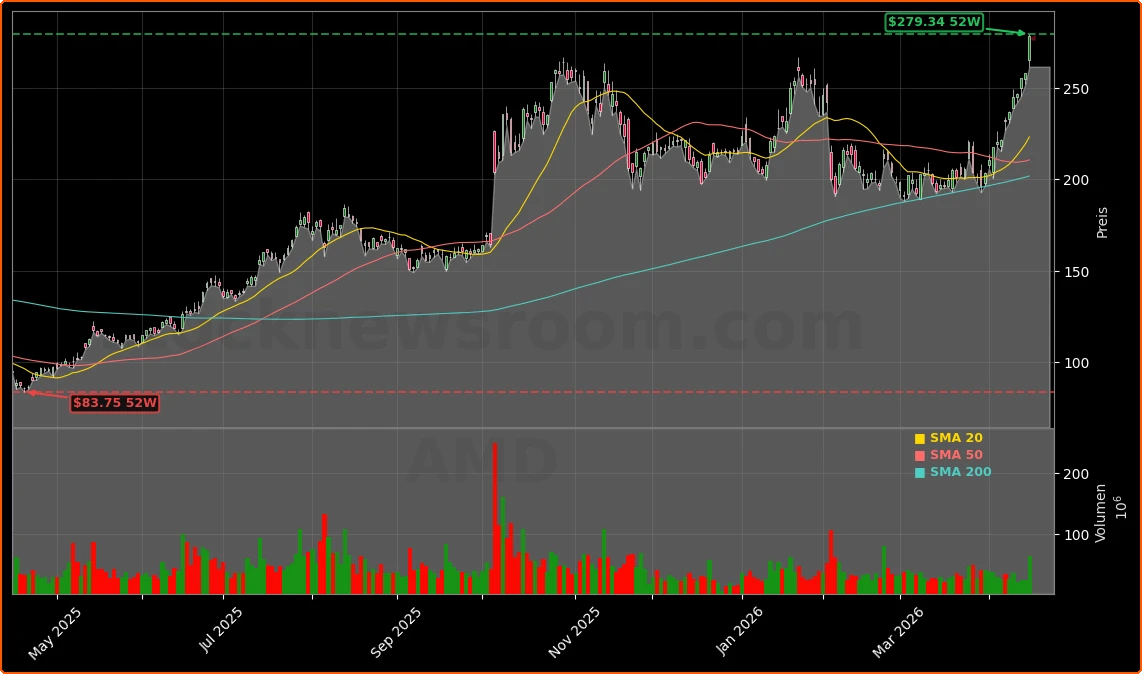
AMD’s latest surge comes with the stock changing hands at $278.26 after closing the prior session at $277.35, putting the move well above the broader S&P 500 and NASDAQ. Pre-market indications around $276.30 (-0.70%) on Friday suggest some profit-taking, but the underlying narrative has strengthened. At the core is the Advanced Micro Devices AI Strategy, which is rapidly shifting the company’s mix away from traditional PC CPUs toward higher-margin server and accelerator products used in AI data centers.
The current upswing is supported by a powerful backdrop: hyperscale cloud and social media platforms are expected to invest more than $200 billion into AI infrastructure over the coming years. AMD is positioning its Instinct accelerator line and EPYC server processors directly in this spending wave, aiming to win sockets in AI training and inference clusters that were previously dominated by NVIDIA. This pivot toward data center compute is central to how investors are now valuing the stock.
How is the Meta partnership reshaping AMD?
One of the clearest validations of the Advanced Micro Devices AI Strategy is the new deal with Meta Platforms. Mark Zuckerberg’s company is integrating AMD’s Mi450 accelerators into its next-generation AI systems, a notable design win in a market where NVIDIA has long been the default choice. For US investors, Meta’s endorsement signals that AMD’s technology and software stack are now credible alternatives for hyperscalers that want to diversify away from a single supplier.
Beyond headline prestige, the Meta deal could translate into multi-year volume for AMD’s data center segment, reinforcing expectations of a portfolio shift away from lower-margin PC processors. The company’s GPUs and CPUs are already used in advanced industrial and medical systems, enabling factory robots with micrometer precision, infrastructure inspection platforms, and less invasive surgical tools that shorten recovery times. These real-world applications give AMD an additional edge as enterprises and governments seek proven AI hardware for mission-critical workloads.
What are analysts saying about AMD now?
Wall Street has started to reflect this transformation. Bernstein analyst Stacey Rasgon upgraded AMD, boosting the price target from $235 to $265 while emphasizing the ongoing transition toward server and data center products. Rasgon expects AMD’s revenue mix to tilt more heavily toward higher-margin AI and cloud offerings, which could support both earnings growth and multiple expansion if execution remains solid.
The upgrade comes as investors compare AMD not only to NVIDIA but also to Intel (INTC), which has enjoyed a strong rebound. In the past month, Nvidia has gained roughly 15%, but AMD is up about 38% and Intel roughly 56%, driven by excitement about CPUs and alternative accelerators in AI servers. Oppenheimer analyst Rick Schafer still lists Nvidia (NVDA) as a top pick with an Outperform rating and a $265 price target, while assigning Perform ratings to both AMD and Intel. Schafer argues Nvidia’s Blackwell Ultra (GB300) racks remain two generations ahead in performance per watt, underscoring that AMD’s challenge is far from over even if its stock has outpaced Nvidia’s recently.
Advanced Micro Devices AI Strategy vs. Nvidia’s moat
The Advanced Micro Devices AI Strategy focuses on attacking Nvidia’s data center moat on several fronts: price, availability and ecosystem. AMD can lean on Taiwan Semiconductor Manufacturing’s expanding chip-on-wafer-on-substrate capacity to offer more attractive pricing and shorter lead times, which matters for cloud operators racing to deploy AI clusters at scale. While Nvidia’s CUDA ecosystem remains the gold standard, AMD’s open software tools are gradually gaining traction as large customers seek flexibility and bargaining power.
France has added another twist by integrating AMD into its national AI strategy, championed by President Emmanuel Macron as a deliberate signal against overreliance on Nvidia hardware. For international investors, this illustrates how governments may increasingly treat AI compute as strategic infrastructure, potentially favoring multi-vendor setups in national supercomputing projects. That in turn could help AMD win high-profile installations that raise its global profile and validate its technology stack.
What does this mean for broader AI chip portfolios?
For US-based portfolios, the intense duel between AMD and NVIDIA is reshaping how investors think about AI exposure. Instead of a pure-play bet on Nvidia’s GPUs, many allocators are now considering a basket that includes AMD for accelerators and CPUs, Intel for alternative server chips, and select AI software names. The Philadelphia Semiconductor Index has logged 12 straight positive sessions and a fresh record high, though leadership has begun to rotate slightly toward software in recent days.
That said, chipmakers remain central to the AI buildout, and the Advanced Micro Devices AI Strategy is one of the most direct plays on hyperscaler capex. The real test will be whether AMD can convert design wins at Meta, in European supercomputing and across industrial applications into sustained revenue and margin expansion over multiple quarters, not just a single news-driven spike.
Related coverage on AI chip momentum
For a deeper dive into how the Advanced Micro Devices AI Strategy evolved alongside France’s supercomputer plans and what that earlier move meant for AMD’s last big price surge, investors can revisit this analysis of AMD’s AI strategy and its France supercomputer deal. It offers more background on the political and technological drivers behind Europe’s push to include AMD in its national AI roadmap.
Investors comparing AMD’s trajectory with smaller AI-exposed chip names may also want to read this look at record insider selling at Marvell Technology. That piece discusses whether heavy executive selling in another AI beneficiary is a red flag or simple profit-taking, an important lens when weighing how aggressively to add high-flying semiconductor stocks alongside core positions in AMD, NVIDIA or even AI-adjacent names like Tesla and Apple.
The real question for investors isn’t whether AMD can participate in the AI boom, but how much data center real estate it can wrestle away from Nvidia over the next hardware cycle.— Maik Kemper, Editor in Chief
In conclusion, the Advanced Micro Devices AI Strategy has clearly entered a new phase, underpinned by a Meta Platforms design win, national-level AI projects and a supportive analyst backdrop. For investors, AMD now offers a more diversified and higher-margin AI data center story that directly challenges Nvidia’s long-standing dominance. The next few quarters of hyperscaler orders and data center revenue growth will determine whether this momentum turns AMD into a lasting pillar of AI infrastructure portfolios on Wall Street.