
Can AMD AI demand stay red-hot even as a fresh TSMC warning sends the stock sharply lower?

Why Is AMD AI Demand Still Strong Despite the Pullback?
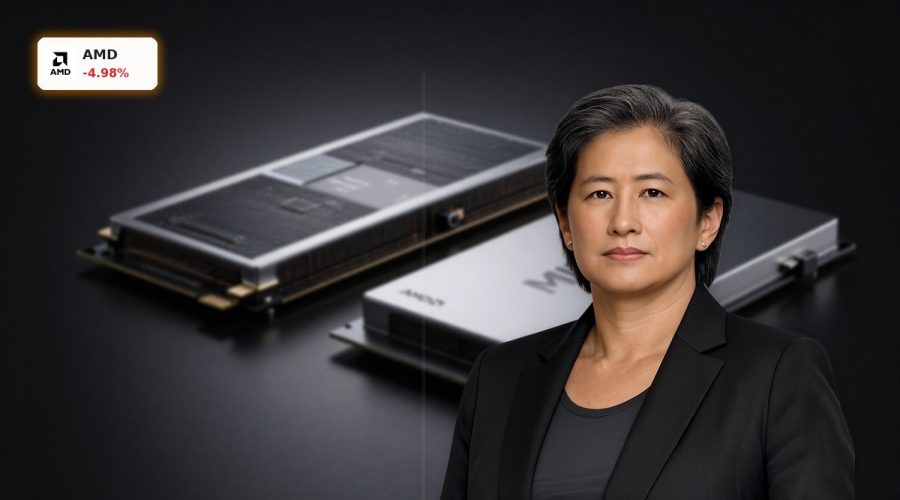
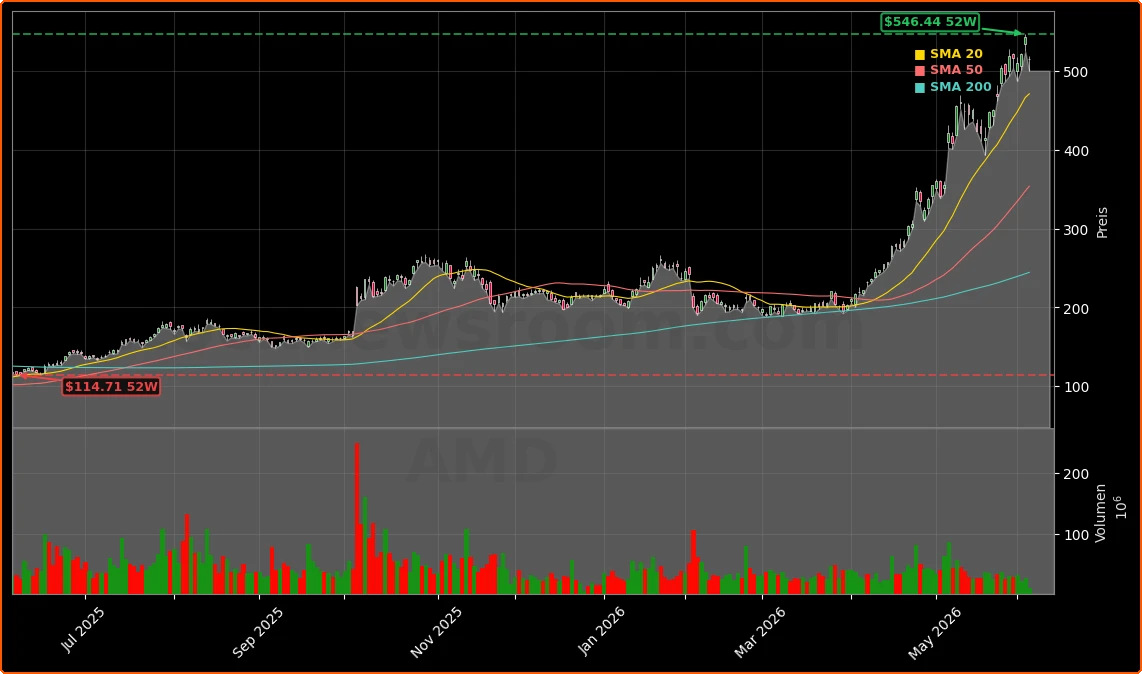
Despite Thursday’s 4.98% intraday decline, AMD’s underlying AI momentum remains unbroken. Q1 2026 revenue hit $10.25 billion — up 38% year over year — with Data Center revenue surging 57% YoY to $5.8 billion. The company’s MI300, MI350, and upcoming MI450 Instinct accelerators are now deployed at scale with Meta (up to 6 GW), OpenAI (6 GW), and Oracle — all driving genuine, non-speculative order flow. Crucially, AMD AI demand is broadening beyond GPU-centric training into CPU-intensive agentic AI workloads, where AMD’s EPYC processors are gaining traction. Analysts at Barclays, TD Cowen, and Mizuho all raised price targets on June 1 — to $665.00, $600.00, and $615.00 respectively — citing accelerating design wins and the shift toward 1:1 CPU-to-GPU ratios in next-gen AI infrastructure.
How Is TSMC’s Warning Reshaping the AI Supply Chain?
Taiwan Semiconductor Manufacturing Company’s CEO C.C. Wei stated plainly at its annual shareholders’ meeting: ‘It will take years before we can fulfill customer demand.’ With TSMC controlling 72% of the global advanced foundry market — and producing chips for NVIDIA, Apple, Broadcom, and AMD on nodes running at near-capacity — the bottleneck isn’t theoretical. Hyperscalers plan to spend $725 billion on AI in 2026 alone, but TSMC’s expansion in Arizona and Japan won’t close the gap soon. Wei reaffirmed >30% sales growth for 2026 — a forecast raised just weeks ago — underscoring that demand vastly outpaces even aggressive capacity buildouts. For AMD AI demand, this means continued pricing power, supply prioritization from TSMC, and extended lead times that benefit incumbents with deep foundry relationships.
What Does Broadcom’s Guidance Mean for AMD?
Broadcom’s decision to reaffirm — not raise — its fiscal 2027 AI semiconductor revenue target of ‘in excess of $100 billion’ triggered a sector-wide selloff, with AMD down 4.3%, Intel down 4.1%, and Micron down 6.4% in premarket trading. Yet CEO Hock Tan emphasized visibility now ‘runs all the way to 2028’ and confirmed plans to ship ‘10 gigawatts in 2027’. That long-term clarity reinforces AMD AI demand indirectly: if Broadcom’s customers (including cloud giants and AI labs) are committing to multi-year capacity plans, AMD’s own design wins with those same customers gain credibility. The short-term pain reflects profit-taking after AMD’s 153% YTD gain — not weakening fundamentals.
Is AMD’s Valuation Justified Amid Rising Competition?
AMD trades at a forward P/E of 73x — well above the S&P 500 IT sector average of 24.4x — and its 204x trailing P/E reflects extraordinary growth expectations. Critics point to NVIDIA’s Vera CPU threat and new entrants like Nvidia’s RTX Spark Superchip targeting the PC market. Yet AMD’s competitive moat remains strong: switching costs in data centers are high, EPYC holds leadership in AI-optimized server CPUs, and the company’s integration of Xilinx FPGAs and ZT Systems rack-scale AI infrastructure creates a vertically differentiated stack. Institutional investors like CIBC Asset Management (up 53.5% stake in Q4) and Marble Wealth LLC continue to accumulate shares — even amid insider selling — signaling confidence in the AMD AI demand thesis over the medium term.
How Are Agentic AI and Quantum-AI Shaping AMD’s Next Chapter?
It will take years before we can fulfill customer demand.— C.C. Wei, CEO of Taiwan Semiconductor Manufacturing Company
AMD AI demand is evolving beyond inference and training. The company’s collaboration with Oxford Quantum Circuits (OQC) and JPMorgan Chase on a quantum-AI data center in London — combining OQC’s GENESIS quantum system with AMD-powered classical compute — signals a strategic pivot toward hybrid AI infrastructure. AMD Chief Technology Officer Mark Papermaster stressed that ‘quantum-AI research needs integrated platforms’ — a vision that positions AMD as a foundational compute provider, not just a chip vendor. Meanwhile, the agentic AI shift is driving CPU demand to levels not seen since GPUs exploded in 2023. With AMD’s EPYC processors gaining share across hyperscalers and enterprises, this transition could be the next leg of AMD AI demand — one that benefits AMD more than Intel in the near term.