Can the Advanced Micro Devices AI Strategy and a bold France supercomputer deal really justify today’s explosive rally in AMD shares?

Why are AMD shares surging today?
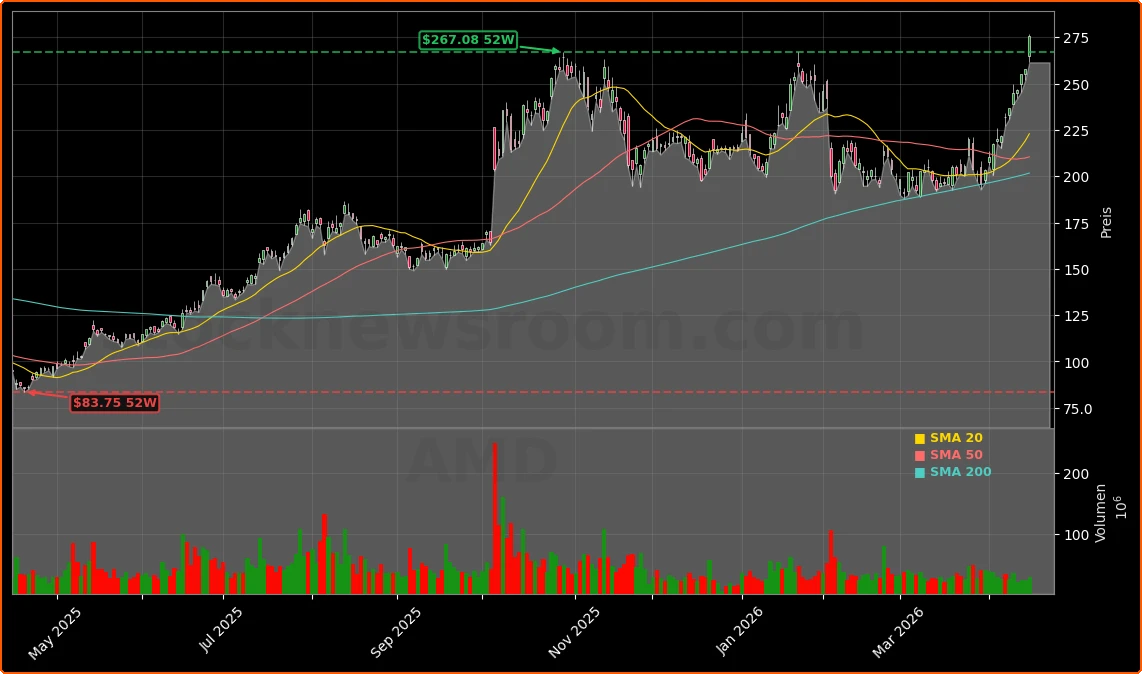
AMD stock climbed from a previous close of $258.28 to $275.56 in early Thursday trading on Wall Street, a gain of 6.76%. The move builds on a powerful uptrend that already had the stock up more than 20% since late March and over 20% year-to-date, putting AMD among the stronger performers in the S&P 500 technology cohort. The breakout comes as the stock pushes through the $267 area that previously marked its 52-week high, a level many technical traders were watching for confirmation of a new leg higher.
Momentum has been fueled by a combination of fundamental and technical tailwinds. On the chart, AMD recently completed a consolidation phase after a long advance and has now broken above a short-term downtrend line, a pattern many traders interpret as a bullish continuation signal. Options markets underline the volatility: implied volatility in AMD often runs in the 40–50% range, compared with roughly 18–20% for the S&P 500 ETF (SPY), meaning sharper swings in both directions and richer premiums for options sellers, but also higher risk.
On the fundamental side, investors are reacting to fresh catalysts that reinforce the Advanced Micro Devices AI Strategy around high-performance compute, national-scale AI infrastructure and key verticals like autonomous driving, where long-duration compute demand is expected to stay robust.
What does the France AI deal mean for AMD?
The centerpiece of today’s news is a Letter of Intent between AMD and the French government to expand AI innovation, research and an open ecosystem in France. A core element is support for the “Alice Recoque” exascale supercomputer project, designed to deliver cutting-edge AI and high-performance computing capabilities into France’s national infrastructure. AMD will provide AI compute resources and training support for researchers, effectively embedding its hardware and software stack into a major European AI hub.
This agreement is strategically important for the Advanced Micro Devices AI Strategy on several levels. First, it validates AMD’s AI accelerators and CPUs at a sovereign level, not just with commercial cloud providers. Second, it positions AMD as a diversification option for governments and enterprises looking to reduce dependence on NVIDIA-centric stacks. Third, it should deepen AMD’s relationships with European research institutions, where open-source frameworks and multi-vendor support are highly valued.
Market reaction extended beyond AMD. Shares of NVIDIA dipped about 1% amid the headlines, reflecting investor sensitivity to any sign that AMD might chip away at its dominance in AI accelerators. While NVIDIA’s lead in software ecosystems and installed base remains significant, national projects like France’s exascale system show that AMD is winning meaningful share in next-generation deployments.
How does this fit the wider Advanced Micro Devices AI Strategy?
Alongside the France deal, AMD revealed it has joined Arm and Qualcomm in a $60 million investment round for UK-based self-driving specialist Wayve, extending the startup’s Series D funding. This move highlights another pillar of the Advanced Micro Devices AI Strategy: embedding its compute solutions in AI-heavy verticals such as autonomous vehicles, where demand for low-latency, power-efficient processing is expected to compound for years.
Under CEO Lisa Su, AMD has already shown strong AI-driven momentum in its core data center business. In Q4 2025, AMD delivered $10.27 billion in total revenue, up 34% year over year and ahead of consensus estimates around $9.72 billion. Earnings per share of $1.53 also beat expectations of roughly $1.32. The Data Center segment led the charge with $5.38 billion in revenue, a 39% year-over-year jump and a record for the company.
Su highlighted “accelerating adoption” of EPYC and Ryzen CPUs and “rapid scaling” of AMD’s data center AI franchise. Hyperscale customers, including large internet platforms like Meta Platforms, are ramping AI infrastructure spending, which supports AMD’s growth outlook. Industry research firms now project global semiconductor revenue could top $1.3 trillion in 2026, with AI chips accounting for roughly 30% of that total, underscoring why Wall Street is intensely focused on which vendors capture that pie.
What are analysts watching into Q1 2026 earnings?
Wall Street’s stance on AMD remains largely constructive. Bernstein recently reiterated its “Market Perform” rating but raised its price target to $265, signaling rising confidence that partnerships such as the France supercomputer initiative will translate into broader revenue streams beyond traditional data center CPUs. Across the Street, around three dozen analysts rate AMD as Buy or Strong Buy, with no major firm currently assigning a Sell rating, and the consensus price target sits just below $290.
Valuation reflects those expectations. AMD trades at a forward P/E of about 38x versus a trailing P/E near 99x, implying investors expect a sharp ramp in earnings as AI and data center sales scale. For many growth-oriented U.S. portfolios, that multiple looks reasonable when compared with other high-multiple AI leaders, though more conservative investors may see limited margin for error if growth slows or export controls tighten further.
Next up is AMD’s Q1 2026 earnings report on May 5. Management has guided for approximately $9.8 billion in revenue (plus or minus $300 million), implying roughly 32% growth year over year and a non-GAAP gross margin near 55%. Analysts expect a 33% rise in EPS. One ongoing watchpoint is exposure to China: guidance includes only about $100 million of Instinct MI308 sales into that market, reflecting U.S. export restrictions that have already constrained some upside.
How does AMD compare to sector peers?
For U.S. investors benchmarking against the NASDAQ-100 and broader S&P 500, AMD’s performance sits within a cluster of AI beneficiaries that also includes Apple in devices and on-device AI, and Tesla in autonomous driving and data-heavy mobility. Taiwan Semiconductor Manufacturing Company remains a critical upstream enabler, fabricating many of the most advanced chips for both NVIDIA and AMD and reporting surging earnings on the AI boom even as its own stock sometimes pulls back on valuation concerns.
The near-term question is whether the Advanced Micro Devices AI Strategy can close more of the performance and ecosystem gap with NVIDIA, particularly in high-end training accelerators, while maintaining strong CPU momentum. Today’s France supercomputer deal and the Wayve investment suggest AMD is deliberately targeting both the highest-performance data center workloads and long-duration verticals like autonomous driving, which may help smooth cyclicality compared with a pure-play GPU approach.
Related Coverage
For a deeper dive into how AMD’s data center ambitions stack up against its main rival, investors can read “AMD AI Forecast: 60% Data Center Boom vs. Nvidia”, which analyzes growth assumptions and valuation risks in detail. To understand the manufacturing backbone behind this AI surge, including AMD’s and NVIDIA’s dependence on advanced foundry capacity, see “TSMC Earnings +58%: AI Boom Meets -2.6% Stock Plunge”, which looks at how the world’s leading chip producer is navigating soaring demand and volatile investor sentiment.
In summary, the Advanced Micro Devices AI Strategy is gaining visible traction through national infrastructure wins in France, strong data center growth and targeted bets in autonomous driving. For U.S. investors, AMD now offers a more diversified AI exposure that complements, rather than simply follows, NVIDIA’s trajectory. The upcoming Q1 2026 earnings and further updates on large-scale AI deployments will show whether AMD can sustain this momentum and turn today’s strategic wins into long-term market share gains.