TSMC Earnings are soaring on the AI boom, but can the stock keep rallying as investors suddenly hit the brakes?

How do TSMC Earnings reshape the AI trade?
Taiwan Semiconductor Manufacturing Co. delivered another blockbuster quarter, with net income rising about 58% year over year to roughly 572.5 billion Taiwan dollars (about $18.2 billion). Revenue climbed around 35%, and the company reported a gross margin in the mid‑60% range, comfortably ahead of prior guidance and market expectations. High‑performance and AI chips now dominate its mix, with management indicating that AI accelerators already account for well over half of total sales and are set to grow further in the current quarter.
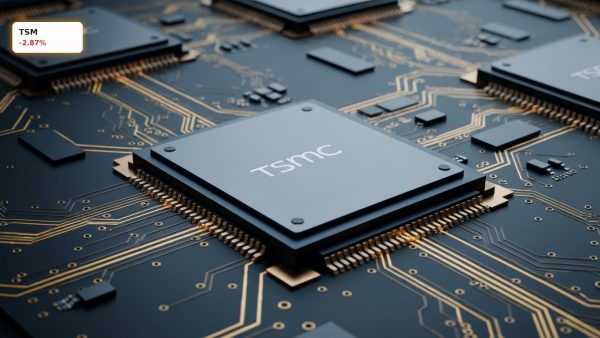
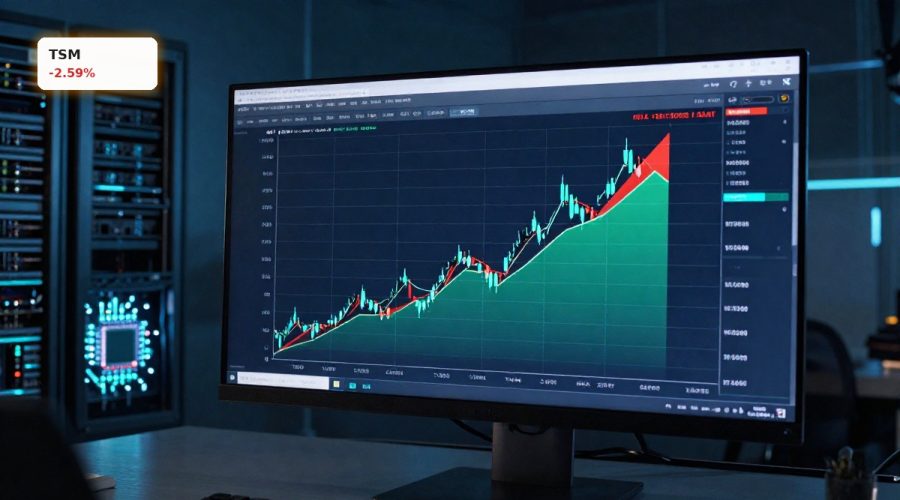
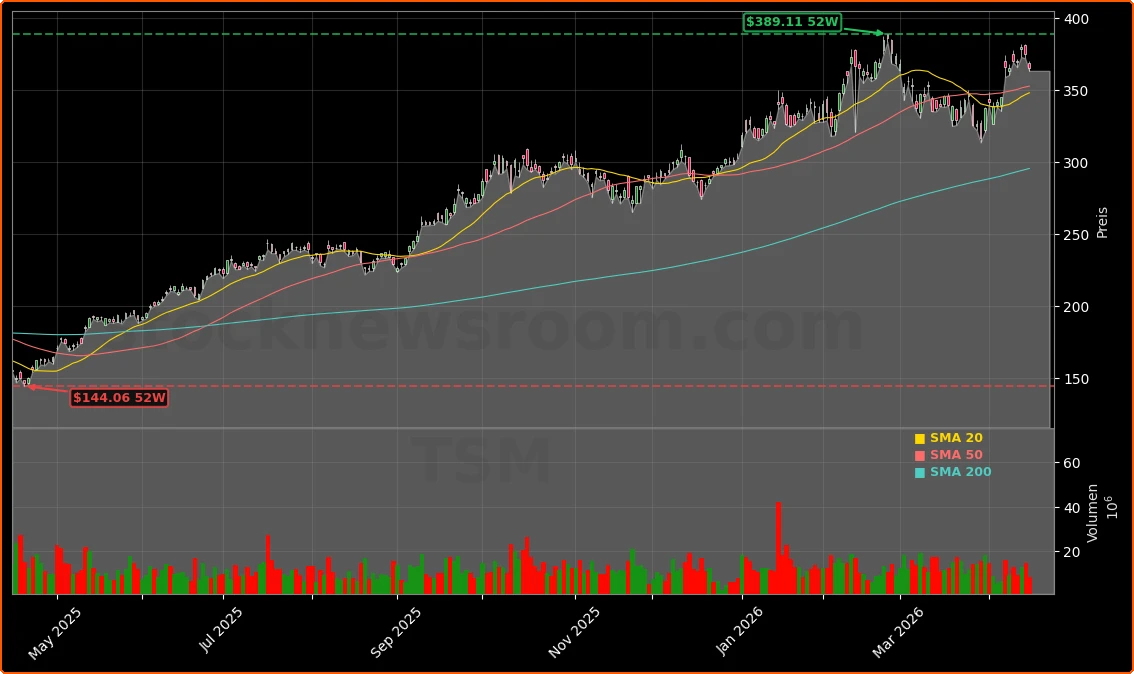
The latest TSMC Earnings are especially important for U.S. investors because the company fabricates the most advanced processors used by NVIDIA, Apple, Advanced Micro Devices (AMD) and other mega‑cap tech names driving the S&P 500 and NASDAQ 100. Management guided for second‑quarter revenue of $39 billion to $40.2 billion, above consensus, and signaled that AI‑related demand remains “extremely robust” despite macro headwinds and elevated energy and logistics costs. The stock, however, is trading around $365.50 in New York, down about 2.6% from the prior close of $376.95, reflecting some profit‑taking after a powerful rally and an all‑time‑high run‑up over the past year.
On the call, executives framed the current environment as a modern gold rush in computing power, with TSMC playing the role of the shovel seller. They reiterated that the company now manufactures close to 90% of the world’s AI accelerators and that its most advanced factories contribute more than a quarter of overall revenue. Despite the pullback in the ADRs, the earnings numbers underline that capacity remains tight and pricing power solid, and that supply constraints in leading‑edge nodes could last into 2027.
What did guidance and capex reveal for Wall Street?
Beyond headline beats, the core message from the latest TSMC Earnings is a meaningfully higher trajectory for the next few years. Management lifted its full‑year outlook to revenue growth of more than 30%, up from a previously more cautious stance. For 2026, the company also raised its growth forecast, with some commentary suggesting upside potential toward 40% if AI demand and hyperscaler capex stay at current levels. This stands in sharp contrast to pockets of weakness in legacy consumer electronics, where smartphone‑related revenue fell double‑digits sequentially.
Capital expenditure is being pushed to the top end of the prior range. TSMC now expects to spend roughly $52 billion to $56 billion this year on new capacity and technology, including its much‑watched Arizona fabs and new sites in Europe and Japan. In some discussions, a multi‑year capex envelope around $200 billion has been floated as the company races to keep up with global AI infrastructure needs. Morgan Stanley has highlighted the raised guidance and resilient margins as validation that the foundry can still deliver 30%‑plus top‑line growth on a trillion‑dollar valuation base, while keeping gross margins in the mid‑60s.
Analysts at Morgan Stanley also emphasized that TSMC’s stronger‑than‑expected numbers help counter investor jitters following more cautious tools and equipment commentary from ASML. With AI capex from cloud providers and large language model players still ramping, Wall Street is increasingly using TSMC’s order book as a real‑time barometer for the health of the broader AI ecosystem, from data center GPUs to networking and memory.
How exposed is Taiwan Semiconductor Manufacturing to risks?
Management acknowledged that geopolitical risks are not trivial. Executives pointed to the ongoing conflict in the Middle East and its potential to disrupt supplies of critical gases like helium and neon, as well as to raise logistics and energy costs. For now, they see limited direct impact on operations or demand, but they warned that a prolonged crisis could put some pressure on margins over time. The company is accelerating its geographic diversification, building six fabs across three continents, but that creates its own execution challenges, particularly around engineering talent and cost control.
Despite these issues, the earnings beat and guidance raise have had a clear spillover effect across global chip stocks. European names rallied after TSMC’s update, and U.S. investors pushed the Philadelphia Semiconductor Index to one of its strongest monthly gains since the early 2000s. Foundry peers and equipment suppliers such as ASML, Lam Research and Applied Materials benefitted from read‑across that capacity constraints are likely to persist.
Retail enthusiasm in Taiwan remains intense as well. The number of small shareholders owning fewer than 1,000 shares has surged, and local ETFs with heavy TSMC weightings continue to see steady inflows. That domestic base has helped cushion the stock during bouts of foreign investor profit‑taking, particularly when geopolitical headlines turn negative.
What does this mean for NVIDIA, Apple and Tesla?
For U.S. portfolios, the strategic takeaway from the latest TSMC Earnings is their importance as a leading indicator for mega‑cap tech and AI beneficiaries. NVIDIA works hand in glove with TSMC, routing essentially all of its advanced GPU production through the Taiwanese foundry. Jensen Huang has stressed that NVIDIA’s demand forecasts directly influence TSMC’s capex plan, highlighting how dependent the AI supply chain is on one company’s ability to ramp leading‑edge capacity. If TSMC sees no slowdown in AI orders, that supports the bullish revenue trajectories currently embedded in NVIDIA’s valuation.
Smartphone‑related softness is more nuanced for Apple, but even there TSMC’s commentary suggests that high‑end devices and AI‑capable processors are holding up better than the broader consumer electronics market. Auto and edge‑AI demand provide another leg of support; management explicitly flagged both Intel and Tesla as important customers in new nodes, reinforcing the view that AI chips will permeate vehicles and industrial applications, not just hyperscale data centers.
For diversified U.S. investors in the NASDAQ and S&P 500, TSMC’s ability to post strong earnings, lift AI guidance and maintain premium margins offers reassurance that the current AI investment cycle is far from over. While the ADRs may consolidate after a huge run‑up, the operational message points to years of elevated capex and revenue growth across the broader AI hardware stack.
Related Coverage
Investors who want a deeper dive into how this quarter fits into the broader trend can read Taiwan Semiconductor Earnings Record as AI Boom Intensifies, which analyzes whether record‑high TSMC results can keep pace with Wall Street’s lofty expectations as the AI supercycle matures. For a complementary view on the downstream beneficiaries of TSMC’s capacity build‑out, Broadcom AI Inference Supercycle: How Custom ASICs Drive the Next Leg of Growth explains how custom accelerators from Broadcom fit into the shift from AI training to large‑scale deployment in data centers.
In conclusion, the latest TSMC Earnings confirm that the world’s most important foundry is still in hyper‑growth mode, with AI demand more than offsetting pockets of consumer weakness and geopolitical noise. For investors in U.S. tech and AI bellwethers, TSMC’s raised guidance and aggressive capex plan strengthen the case that the AI build‑out has multiple strong years ahead. The next set of quarterly results from TSMC and its key customers will show whether this momentum can continue to power both the stock and the broader semiconductor complex higher.