Can PepsiCo’s surprise margin rebound and snack price cuts really justify the latest earnings-driven surge in the stock?

How did PepsiCo Earnings beat expectations?
PepsiCo, Inc. (PEP) opened 2026 on a strong note. For the first quarter, net revenue rose 8.5% year over year to about $19.44 billion, ahead of Wall Street’s roughly $18.9 billion consensus. Adjusted earnings per share climbed to $1.61, up from $1.48 a year ago and above estimates of $1.55. Reported EPS increased to $1.70 from $1.33 as net income attributable to the company reached roughly $2.32 billion.
The real surprise came on profitability. Core operating profit jumped about 24% to approximately $3.2 billion, pushing the group operating margin up from 14.4% to around 16.5%. Organic revenue growth of 2.6% was solid but unspectacular; the upside in this PepsiCo Earnings report was largely about margins and operating discipline rather than a top‑line surge.
Management reaffirmed its 2026 outlook for organic revenue growth of 2%–4% and core EPS growth of 4%–6%, signaling confidence that productivity programs and mix management can sustain earnings momentum even if global consumption stays choppy.
Are snack price cuts paying off for PepsiCo?
A critical question heading into this PepsiCo Earnings release was whether January and February price cuts on flagship snack brands would hurt margins or unlock new volume. PepsiCo had pledged reductions of up to roughly 15% on chips such as Lay’s, Doritos and Cheetos while keeping bag sizes unchanged, a clear move to win back cost‑conscious shoppers after multiple years of inflation‑driven hikes.
The strategy appears to be working. North America Foods returned to volume growth of around 2%, with the company citing improving trends in salty snacks and a better reception for innovation and value packs. Net and organic revenue in the foods segment both accelerated versus Q4, and management highlighted roughly 300 million additional consumption “occasions” year over year.
Internationally, snacks remained a bright spot, helped by stronger execution and, in some markets, a more resilient supply chain than rivals. That matters for U.S. investors because it diversifies PepsiCo away from the slowing U.S. consumer and supports more defensive cash‑flow visibility than many discretionary names in the S&P 500.
How do beverages and health trends reshape PepsiCo?
Beyond snacks, beverages remain a second profit engine. North America beverages delivered about $6.4 billion in sales, modestly topping expectations, while international beverage revenue also edged ahead of forecasts. Growth was supported by category diversification: zero‑sugar colas, functional drinks, advanced hydration and energy offerings all gained traction.
PepsiCo is leaning into health and wellness more aggressively than in prior cycles. The company is expanding functional and fiber‑enhanced drinks (including via the poppi acquisition), reshaping its protein portfolio with reformulated Muscle Milk, and deepening its energy footprint through partnerships with brands like Celsius. Hydration platforms such as Gatorade and Propel are being refreshed for more health‑conscious and GLP‑1‑using consumers, including a new lower‑sugar, electrolyte‑rich Gatorade variant announced alongside the quarter.
That multi‑category beverage strategy provides a contrast to Coca‑Cola and helps position PepsiCo against broader consumer shifts that have already challenged legacy names like Apple in wearables health tracking and NVIDIA in AI‑powered health analytics from a different angle: PepsiCo’s route to the wellness dollar is still in the fridge and on the shelf.
What does this mean for the PepsiCo stock narrative?
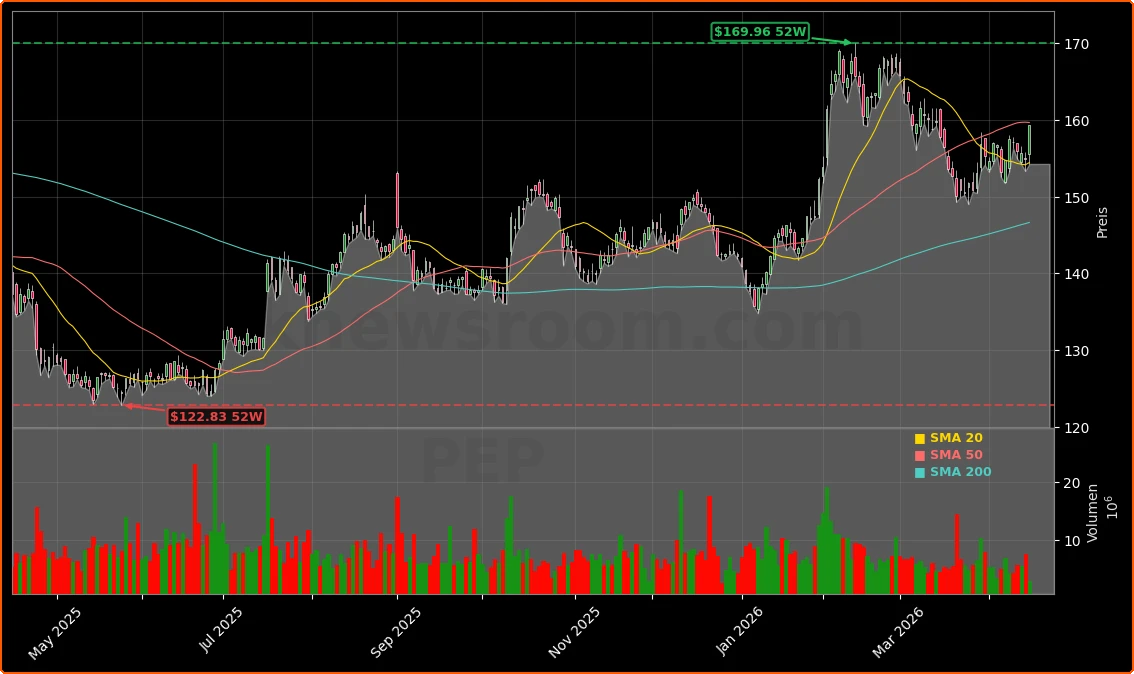
On Wall Street, PepsiCo shares reacted positively. The stock’s move to about $159 in regular trading puts it well below typical 52‑week highs for global consumer staples leaders, leaving room for upside if margins hold and volume trends improve further. The modest pre‑market pop of around 1% after the results, followed by broader gains, indicates investors view this PepsiCo Earnings beat as confirmation that the 2025 slowdown in snacks was cyclical rather than structural.
Large U.S. asset managers continue to use PepsiCo as a core defensive holding next to mega‑caps like Tesla and Apple in diversified portfolios. While not a hyper‑growth story, the combination of mid‑single‑digit organic sales, high‑single‑digit EPS growth and a steadily rising dividend remains attractive versus many S&P 500 companies navigating earnings downgrades.
Activist pressure from Elliott Management, which has pushed for bolder actions including sharper pricing moves and portfolio optimization, is another factor supporting the bull case. Investors typically assign higher multiples to consumer franchises that show willingness to adjust strategy quickly, and the snack price cuts that underpinned this PepsiCo Earnings beat are one tangible outcome of that pressure.
How are dividends, guidance and peers shaping sentiment?
PepsiCo also nudged its dividend higher, reinforcing its status as an income stock for U.S. retirees and long‑term investors. In an environment where Treasury yields remain volatile, a reliable and growing cash return from a consumer staple with global scale compares favorably to more cyclical payers. While specific Wall Street price‑target changes were limited immediately after the report, houses such as Goldman Sachs, Morgan Stanley and Citigroup are likely to focus on the sustainability of margin gains and the volume response to pricing as they update models.
Relative to sector peers, PepsiCo now looks better positioned than many discretionary names and increasingly competitive even within staples. Where Nike has been punished — its stock recently sold off sharply on concerns about innovation execution and turnaround risk — PepsiCo is being rewarded for consistent delivery and clear communication. Tech leaders like NVIDIA still dominate performance tables, but defensive compounders such as PepsiCo offer ballast when market sentiment swings.
Related Coverage
Investors who want to dig deeper into the longer‑term story can review the earlier analysis of PepsiCo’s cash strategy and Rockstar impairment in “PepsiCo Earnings +1.5% Surge and Record Cash Strategy Shift”, which examines whether recent balance‑sheet moves justify renewed upside momentum. For a contrasting view within consumer‑facing names, the article “Nike Innovation -3.4% Plunge Raises Turnaround Warning” explores how execution risk in a global brand can quickly translate into share‑price pressure, a useful comparison when assessing the relative resilience of PepsiCo.
Innovation and affordability initiatives began to take hold, and we see clear progress in both our North America foods business and our international operations.— Ramon Laguarta, CEO of PepsiCo
In sum, the latest PepsiCo Earnings underline that disciplined price cuts, healthier product innovation and strong international execution can coexist with expanding margins and steady dividend growth. For U.S. investors looking to balance exposure to high‑beta growth stories with durable cash generators, PepsiCo remains a credible core holding. The next few quarters will show whether snack volumes and beverage innovation can keep this momentum intact and support further stock gains.