Can the revamped Alibaba AI Strategy turn today’s stock surge into a lasting rerating driven by cloud, world models and automation?

Is Alibaba’s AI pivot finally moving the stock?
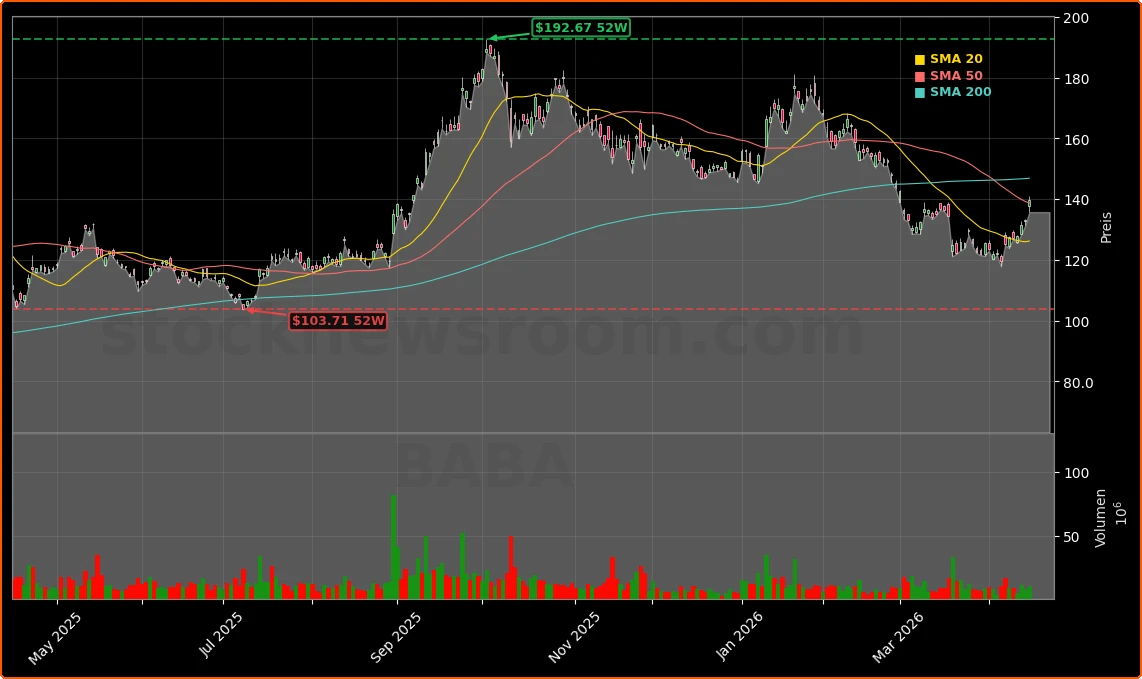
Alibaba’s U.S.-listed ADRs traded around $139.62 in afternoon trading, up from a prior close of $134.00, extending a multi-day uptrend that has outperformed parts of the NASDAQ but still leaves the stock well below its 52‑week high near $192. With Chinese macro sentiment improving and AI headlines dominating Wall Street, investors are reassessing how the Alibaba AI Strategy fits into global portfolios that already hold U.S. AI leaders like NVIDIA and Apple.
The latest leg higher follows a series of AI announcements and price actions inside Alibaba Cloud and Cainiao, reinforcing the narrative that management is prioritizing high-margin digital infrastructure over low-growth legacy commerce. Barclays recently reiterated an “Overweight” rating on BABA while trimming its price target from $190 to $186, arguing that near-term margin pressure from AI capex is acceptable given triple-digit growth in AI-related cloud revenues. Other commentators, including some value-oriented services, still flag the stock as somewhat overvalued versus certain intrinsic-value models, underscoring the split view on Alibaba’s risk-reward profile.
How does Happy Oyster change the Alibaba AI Strategy?
At the center of the new Alibaba AI Strategy is Happy Oyster, a so‑called “world model” designed to generate immersive 3D environments and interactive videos for films, virtual worlds and games. Developed by the newly formed Alibaba Token Hub unit, Happy Oyster can create virtual scenes of up to around three minutes, while continuously adjusting to user prompts instead of just spitting out one‑off short clips.
The model offers two modes: a “directing” mode that builds worlds from text and image prompts, and a “wandering” mode that lets users navigate and explore those AI-generated environments. This pushes Alibaba squarely onto gaming and content turf long dominated by Tencent, whose game portfolio has been one of the most profitable franchises in China’s tech sector. For U.S. investors familiar with Tesla’s use of world models in autonomous driving or NVIDIA’s Omniverse simulations, Happy Oyster signals that Chinese platforms are racing to develop similar foundational technologies, not just basic chatbots.
Management has articulated an ambitious target to grow annual revenue from cloud and AI businesses to about $100 billion within five years. That would transform the Alibaba AI Strategy from a narrative driver into a core earnings engine, potentially reducing the group’s dependence on more cyclical Chinese consumer spending.
Will cloud price hikes boost margins or risk customers?
Beyond the headline-grabbing world model, Alibaba Cloud is testing its pricing power in its home market. The company recently raised base cloud prices by up to roughly 34% and has now announced steep hikes for its DDoS protection services from July 15. DDoS Native 2.0 will rise from 82 to 98.5 yuan per Mbps per month (about a 20% jump), while DDoS High Defense China will climb from 100 to 150 yuan (around 50%).
These moves are justified internally by higher hardware costs and surging demand for AI workloads, particularly large-model training and inference. Unlike Amazon Web Services and Microsoft Azure, which are engaged in a visible price war in several markets, Alibaba appears confident enough in its domestic market share to push through increases. This aligns with the broader Alibaba AI Strategy of prioritizing premium, compute-heavy services over low-margin infrastructure.
For global investors, the key risk is whether customers will accept higher prices or shift incremental AI workloads to rivals once cross-border options mature. On the flip side, if churn remains limited, the higher pricing could translate quickly into improved profitability and reinforce the bullish case advanced by banks such as Barclays and other optimistic Wall Street firms.
How do logistics robots fit into Alibaba’s AI narrative?
Alibaba’s AI push extends beyond the cloud into the physical world via its logistics arm Cainiao. The unit has unveiled ZeeBot, a shelf-climbing warehouse robot that combines horizontal movement with vertical scaling. ZeeBot can climb five-story racks in about ten seconds, and Cainiao claims it can lift warehouse space utilization by roughly 40%. More than 100 units are already deployed in a warehouse in Guangdong, with rollouts in Europe and North America planned next.
AI-driven automation has become a central theme for the logistics industry, where U.S. investors have watched companies like Tesla experiment with humanoid robots and industrial players adopt robotics to cut labor costs. Cainiao’s ZeeBot fits the broader Alibaba AI Strategy by embedding machine vision, navigation and optimization algorithms directly into operations, raising the company’s moat in e‑commerce fulfillment and cross‑border shipping.
If ZeeBot scales internationally, it could provide Alibaba with a differentiated logistics story versus other Asian e‑commerce platforms, while potentially partnering with Western brands that want access to more efficient, AI-enabled warehouses.
Related Coverage
For a deeper look at how AI video has already been moving the stock, see “Alibaba AI Video Surge: BABA’s +1.9% Rally Shocks Wall Street”, which examines whether earlier breakthroughs in Alibaba’s video models were enough to justify that rally in light of capex and margin concerns. Investors interested in broader sector context can read “Advanced Micro Devices AI Strategy +6.8% Rally on France AI Deal”, which shows how U.S. chipmakers like AMD are also leveraging AI infrastructure deals to excite the market.
In conclusion, the evolving Alibaba AI Strategy—spanning the Happy Oyster world model, assertive cloud price hikes and Cainiao’s ZeeBot robots—signals that Alibaba is determined to monetize its AI stack across both digital and physical infrastructure. For U.S. investors, the stock’s latest move suggests growing confidence that these bets can offset regulatory and macro risks tied to China. The next catalysts will likely be clearer AI revenue disclosures and adoption metrics, which will show whether this Alibaba AI Strategy can sustain a durable re-rating on Wall Street.