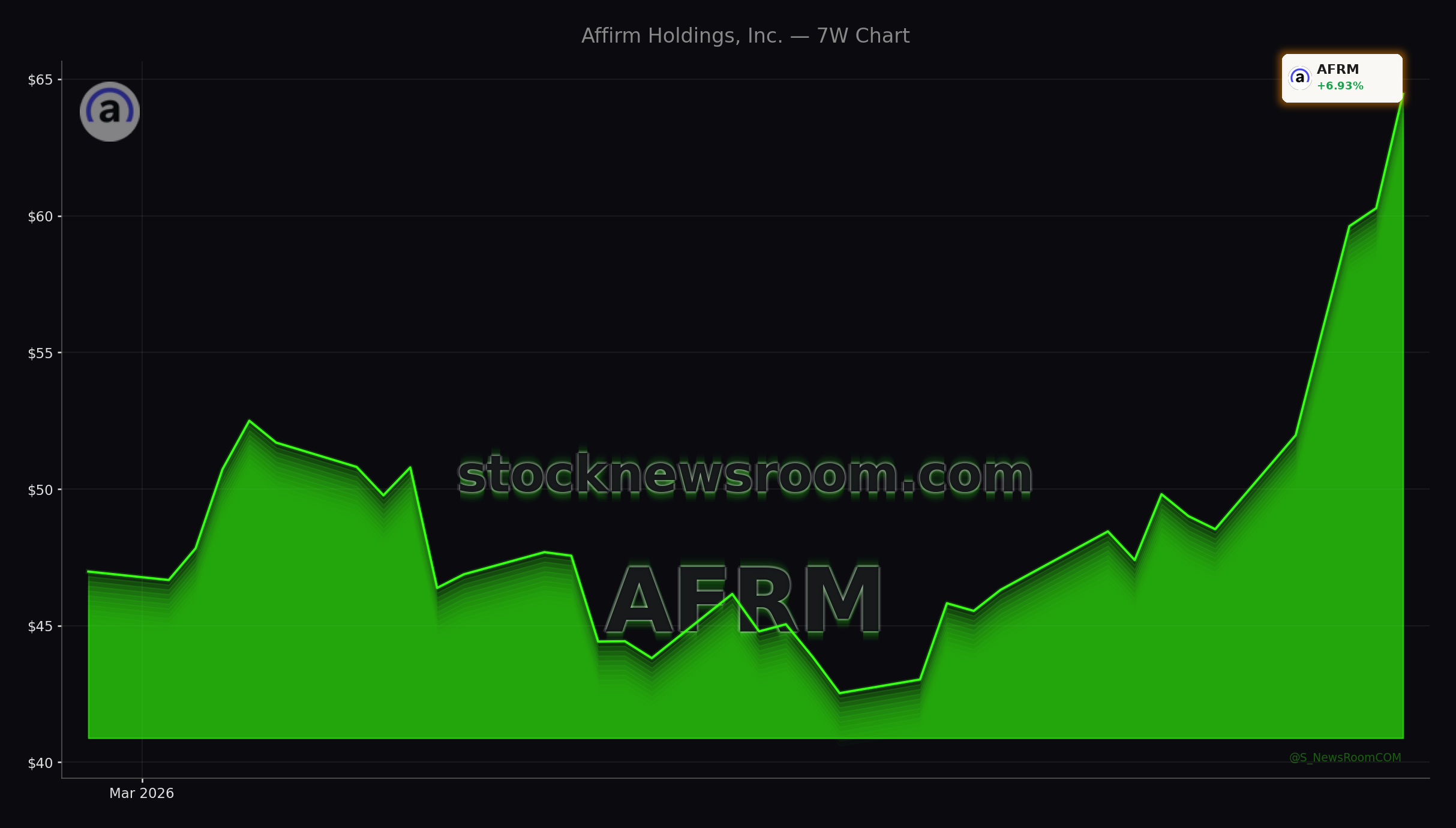

Can Morgan Stanley’s new Top Pick call and Investor Forum catalyst push the Affirm Forecast even higher after today’s sharp rally?

What does Morgan Stanley’s call signal?
Wall Street’s stance on Affirm has turned more constructive as Morgan Stanley analyst James Faucette elevated the stock to his firm’s Top Pick list, reiterating Overweight and setting a $76 price target. With AFRM up about 7% on the day to $64.55, the target still implies roughly 18% additional upside, even after a strong year-to-date run that has outpaced many high‑growth fintech names on the NASDAQ.
Faucette’s thesis rests on three main pillars: room for upward estimate revisions, private credit fears that appear overstated, and a clear near‑term catalyst in the company’s upcoming 2026 Investor Forum on May 12. For investors trying to refine their own Affirm Forecast, that combination of valuation gap and defined catalysts is central to the bullish case.
Importantly, Morgan Stanley argues that the market continues to misprice Affirm’s funding risk. Despite concerns around the broader private credit and ABS markets, Affirm’s most recent securitization was reportedly six times oversubscribed, while average funding costs have already declined from about 7% in Q3 FY2025 to 6% in Q2 FY2026.
How strong is Affirm’s operating momentum?
Under the hood, Affirm is leaning on accelerating fundamentals to support a more optimistic Affirm Forecast. In Q2 FY2026, revenue climbed 30% year over year to $1.123 billion, beating consensus estimates by roughly 6%. Gross merchandise volume (GMV) surged 36% to $13.8 billion, demonstrating that consumer demand for installment payments remains robust even as traditional credit conditions tighten.
Profitability has also inflected. Operating income jumped to $117.6 million, up more than 2,800% year over year, reflecting scale benefits in both the core BNPL business and newer products like the Affirm Card. CEO Max Levchin has emphasized that Affirm’s growth has been multiples of the broader U.S. credit card and e‑commerce markets, suggesting the company is still gaining share from incumbents like Apple Card, PayPal’s Pay in 4, and traditional card issuers.
Affirm’s own full‑year FY2026 guidance calls for GMV in the range of $48.3–$48.85 billion and adjusted operating margins of 27%–28%. Morgan Stanley expects those targets could be revised higher at the May forum, a key reason it believes consensus earnings forecasts are too low.
What role does the Affirm Forecast Investor Forum play?
The May 12 Investor Forum has emerged as the central event for the short‑term Affirm Forecast. Morgan Stanley anticipates that management will raise medium‑term targets for GMV, margins, and EPS, potentially triggering a wave of upward revisions from other research desks. That would align with the already bullish stance from several tech‑focused analysts who have highlighted Affirm alongside names like NVIDIA in recent roundups of high‑growth technology plays.
Beyond the numbers, investors will focus on the durability of Affirm’s funding model and the trajectory of credit performance. The company recently onboarded AB CarVal, adding roughly $600 million in forward flow capacity, and expects equity capital requirements to remain below 5% of its total platform portfolio. That low equity slice is a key data point for anyone concerned that tightening private credit markets could choke off growth.
At the same time, Affirm is diversifying beyond its classic checkout button. Affirm Card GMV nearly tripled year over year to $2.2 billion in Q2 FY2026, with active cardholders more than doubling to 3.7 million. That card‑based expansion increases engagement and helps Affirm compete more directly with embedded consumer finance ecosystems from Apple and Tesla’s in‑house financing for vehicle purchases.
What risks could derail the bullish case?
No Affirm Forecast is complete without a closer look at risks. On the credit side, 30‑plus‑day delinquencies excluding Peloton rose 18 basis points year over year to about 3%, a reminder that BNPL is still exposed to consumer stress if unemployment ticks higher or stimulus fades. While that level remains manageable compared with subprime card portfolios, any sharp deterioration could pressure margins and spark renewed skepticism from the market.
Concentration risk is another factor. Affirm’s top five merchant partners account for about 46% of GMV, leaving results vulnerable to contract changes, renegotiations, or competitive bids from rivals such as PayPal, Shopify’s Shop Pay Installments, or even big‑tech players like Apple expanding more aggressively into installment plans.
Insider transactions have also been in focus. In recent weeks, an Affirm director sold a modest 2,000 shares under a Rule 10b5‑1 trading plan, while several executives reported routine RSU vesting and tax‑related share sales. So far, these moves look more like normal compensation events than a coordinated bearish signal, but short‑term traders often treat any insider selling as a reason to tread carefully.
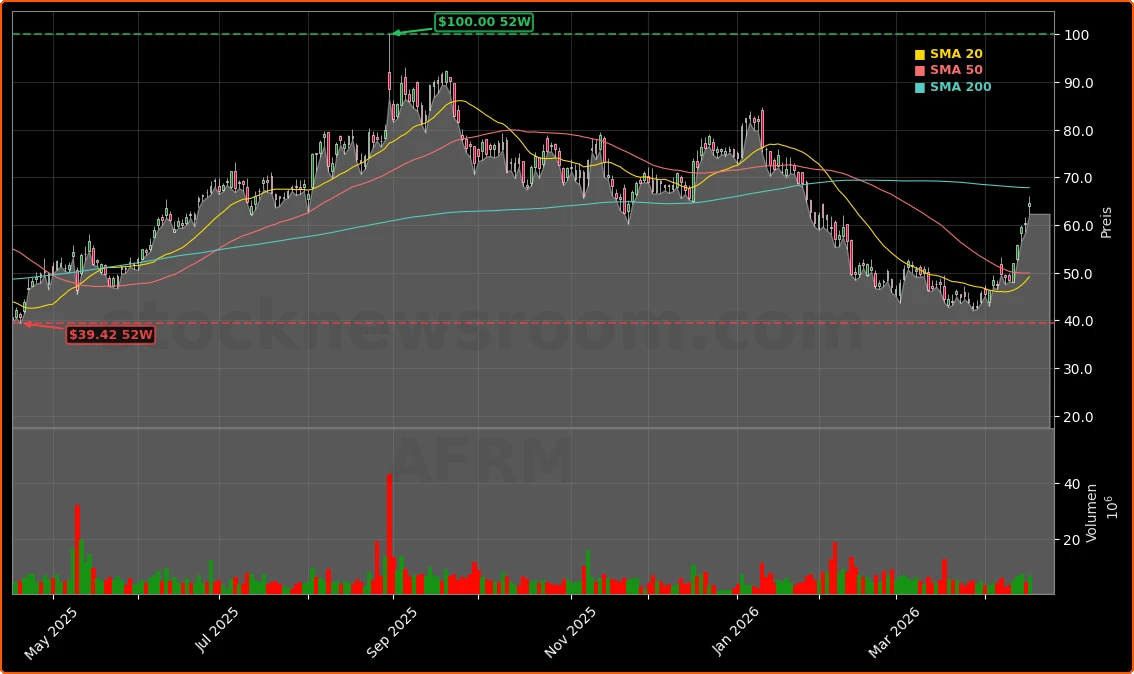
Finally, valuation is no longer cheap. With AFRM nearly tripling from its lows and now trading in the mid‑$60s, the stock embeds high expectations relative to traditional financials in the S&P 500. If the May Investor Forum fails to deliver the guidance upgrades implied in the current Affirm Forecast, multiple compression could follow, even without a deterioration in fundamentals.