Can record TSMC Earnings and an AI supercycle still move the stock higher when investors are already priced for perfection?

How do TSMC Earnings move Wall Street?
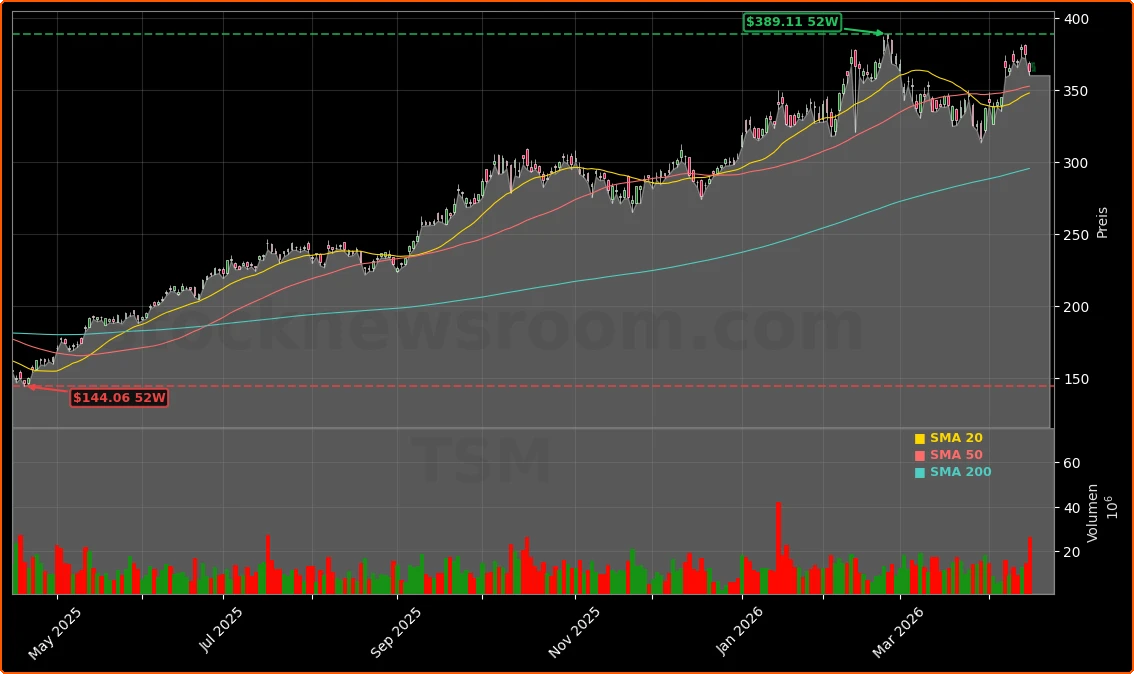
Taiwan Semiconductor Manufacturing Co. (TSMC) has become one of the most important swing factors for global risk sentiment. The stock, which trades in New York under the ticker TSM, closed the last session at $363.35, down about 3.1% from the previous close, even though pre‑market indications around ET point to a modest rebound near $368.81. That pullback follows a powerful run in recent months and looks like classic profit‑taking after a blockbuster quarter rather than a fundamental shift in the story.
TSMC recently reported its strongest financial quarter on record, with revenue climbing roughly 35% year over year to just under $36 billion. Net income surged by more than 50% to nearly $18 billion, and the company’s gross margin of about 66.2% beat expectations. EBITDA margin north of 72% puts TSMC in rarefied air, approaching the profitability profile of leading GPU designer NVIDIA. These TSMC Earnings confirm that the most advanced semiconductor manufacturing capacity remains heavily supply‑constrained.
The twist for Wall Street: despite the numbers, TSMC’s Taipei‑listed shares dropped more than 2%, dragging regional tech peers lower. The reaction illustrates how elevated expectations and concentration risk can overshadow even record results when valuations are rich and headlines are dominated by AI optimism.
What is TSMC’s AI‑driven growth outlook?
Beyond the headline TSMC Earnings, guidance is what has really energized the global chip trade. Management expects full‑year revenue growth of more than 30%, and internal guidance for the current quarter implies an annualized revenue growth rate of roughly 46%. That trajectory is well above the roughly 30% growth that many bullish analysts had penciled in for 2026 at the start of the year.
Chief executives at TSMC have historically been known for conservative guidance rather than promotional forecasts. Before updating its outlook, the company went back to its largest customers to verify multi‑year capital spending plans for AI infrastructure. Those hyperscalers, primarily in the United States, reaffirmed record budgets for high‑performance computing and data center build‑outs, supporting TSMC’s decision to lean into higher capacity.
As a result, capital expenditures are expected to land toward the upper end of the company’s existing range, approaching $56 billion. A significant portion of that is earmarked for leading‑edge 3‑nanometer and future‑node capacity tailored to AI accelerators and advanced CPUs. Management also lifted its 2026 revenue forecast, which in turn sparked a sector‑wide rally in chipmakers from AMD to Intel on Wall Street, as investors extrapolated sustained AI demand across the stack.
Why are investors nervous despite strong TSMC Earnings?
The main concern clouding the TSMC Earnings narrative is concentration risk. Management has acknowledged that AI‑related demand now accounts for more than 60% of total revenue and is heavily skewed toward a small handful of U.S. hyperscaler and GPU customers. TSMC fabricates critical chips for partners including Apple, NVIDIA, AMD, Broadcom, Qualcomm and others, but a disproportionate share of incremental growth is tied to AI accelerators for a few large cloud players.
That dependence raises questions about what happens if even one hyperscaler slows capex or shifts more design or production in‑house. Wall Street is already watching experimenters like Elon Musk, who is pushing his companies toward developing their own chip manufacturing capabilities. Most experts still see TSMC as the most logical manufacturing partner for such efforts, at least over the next several years, given the enormous cost, complexity and time needed to build competitive fabs.
Geopolitics add another layer of risk. TSMC sits at the center of global supply chains and relies heavily on lithography equipment from ASML in the Netherlands. The company has begun diversifying production into the United States and Europe, but its largest advanced‑node footprint remains in Taiwan, leaving investors attentive to cross‑strait tensions with China and to disruptions such as the recent Middle East tensions that briefly raised concerns about specialty gas supplies.
How do TSMC and U.S. chip names compare?
For U.S. investors, the key question is how TSMC stacks up against domestic chip leaders on valuation and growth. While detailed price‑target moves were not the focus of this latest reporting cycle, major Wall Street houses such as Goldman Sachs, Morgan Stanley and Citi continue to highlight TSMC as a central beneficiary of the AI capex boom. Recent commentary from Asia‑focused analysts like Simon Wu at BFA Global Research and others underscores that, despite geopolitical risk, Asian foundries are well positioned as long as U.S. cloud spending remains robust.
Unlike fabless peers, TSMC bears the full capital intensity and cyclicality of manufacturing, but it also captures the lion’s share of value at the cutting edge. Its 20‑year track record of average annual growth above 20% and its dominance in leading‑edge process technology give it a strategic profile that is difficult for lagging competitors to replicate. Intel’s own challenges in ramping foundry services are a reminder that even well‑capitalized U.S. incumbents face a steep climb.
In the short term, investors must balance that strategic strength with the reality of a stock that has more than doubled over the past year and recently tested all‑time highs above the $390 mark before pulling back toward the mid‑$300s. With the average analyst price target still sitting roughly high‑teens percent above current levels, sentiment remains generally constructive, but the easy money in the AI trade may have already been made.
Related Coverage
For a deeper dive into how the latest TSMC Earnings shaped short‑term stock performance, including the unusual combination of a 58% profit jump and a sudden share price drop, read this detailed look at TSMC’s AI boom and stock pullback. It examines whether investors should treat the recent weakness as a buying opportunity or a warning sign after such a powerful run.
AI‑driven spending isn’t limited to chip manufacturers. Investors interested in how downstream software and cloud vendors are financing their AI ambitions should consider this analysis of Oracle’s AI rally, debt load and cash burn risks. Together with the latest TSMC Earnings narrative, it offers a broader picture of how the AI build‑out is reshaping balance sheets across the tech ecosystem.
TSMC Earnings underscore that the AI hardware cycle is still in full swing, even as markets occasionally react with “sell the news” fatigue. For U.S. and global investors, TSMC remains a core proxy for hyperscaler capex and the durability of the AI supercycle. The next few quarters will show whether management’s upgraded growth outlook through 2026 can be met without stretching customer concentration and geopolitical risks too far, keeping TSMC at the center of every serious long‑term tech portfolio discussion.