Is the latest wave of Roku Insider Selling a routine cash-out or a warning signal just as the stock starts to rally again?

Is Roku Insider Selling accelerating at the top?
The newest disclosure shows that on April 16, founder and chairman Anthony Wood sold 25,000 Class A shares of Roku, Inc. at an average price of $110.19, for proceeds of about $2.75 million under a Rule 10b5‑1 trading plan. After this transaction, Wood still controls roughly 14,228 shares directly and about 580,753 shares indirectly, leaving him with a substantial economic stake despite the steady sales. On the same day, senior officer Charles Collier disposed of 3,431 shares at $110.17, raising approximately $378,000 and reducing his combined direct and indirect holdings to just over 8,300 shares.
The day before, on April 15, chief operating officer Dan Jedda sold 7,000 shares at $107.00, realizing about $749,000 in proceeds and retaining 78,115 shares. These trades follow earlier April activity in which Wood sold 50,000 shares at about $100.45 on April 10, while Collier exited more than 200,000 shares at $105 on April 8, partly tied to option-related exercises. Taken together, the cadence of Roku Insider Selling in 2026 suggests a deliberate program of monetization at price levels near or above $100, even as the stock remains well below its historical peaks from the pandemic streaming boom.
How extensive is the recent selling pattern at Roku?
Regulatory filings over the past several months show a near-monthly rhythm of sales by multiple insiders at Roku, Inc.. Wood alone has repeatedly sold 50,000‑75,000‑share blocks on the 10th of several recent months, including February and March, typically around psychologically important price thresholds of $90–$110. Jedda has executed frequent smaller disposals in the 3,000–15,000‑share range, while Collier and several vice presidents, including Matthew Banks and Christopher Handman, have also taken money off the table through both direct and option-related transactions.
Importantly for portfolio managers trying to interpret the data, many of these trades are marked as conducted under Rule 10b5‑1 plans, suggesting they were pre‑scheduled rather than opportunistic reactions to short‑term news. Nonetheless, the sheer consistency of Roku Insider Selling — with multiple executives participating almost every month since late 2025 — stands out in a sector where peers such as Apple, NVIDIA and Tesla often show more mixed activity, including occasional insider purchases. For risk‑aware investors, the pattern reinforces the view that management is actively diversifying away from a stock that remains highly sensitive to advertising trends and cord‑cutting cycles.
What does this mean for Wall Street’s Roku thesis?
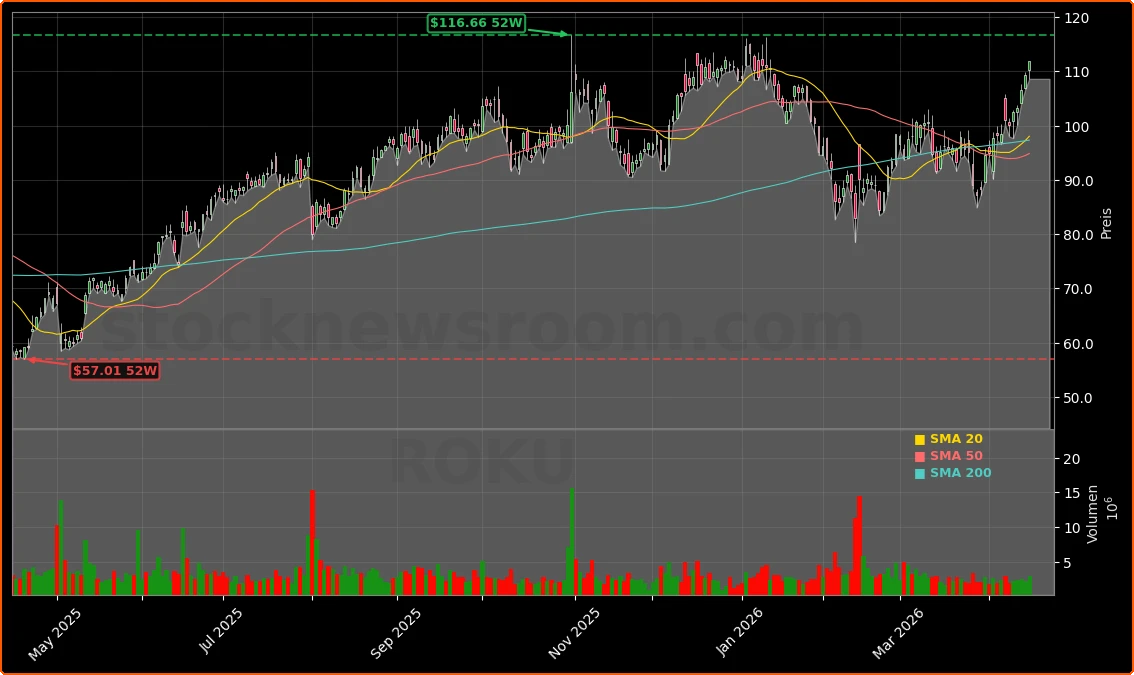
On Wall Street, Roku (ROKU) remains a polarizing streaming and connected‑TV play on the NASDAQ, with analysts divided over whether recent cost cuts and adtech partnerships can sustain a durable profit ramp. Some firms, including names like Citigroup and Morgan Stanley, have in recent months highlighted Roku’s leverage to connected‑TV ad recovery but also flagged competition from platforms integrated into smart TVs and devices from giants like Apple and Amazon. For now, the latest wave of Roku Insider Selling has not derailed the stock’s recovery attempt: at $111.87, shares trade modestly higher on the day and remain well above their late‑2025 lows, though still far below prior cycle highs.
For institutional investors benchmarking against the S&P 500 and NASDAQ Composite, the key question is whether insider behavior undermines the bullish case built on margin expansion and platform growth. Serial sales by founders can be benign — as seen at high‑fliers such as NVIDIA or Tesla — when accompanied by strong execution and rising earnings. But given Roku’s history of profit volatility and intense competition in streaming hardware and ad‑supported content, the optics of recurring stock disposals may make some allocators more cautious at current valuation levels, especially after the recent rebound.
How should investors interpret Roku Insider Selling now?
For U.S. retail traders and fund managers alike, context is crucial when interpreting Roku Insider Selling. The fact that the majority of transactions are conducted through 10b5‑1 plans means these trades were generally scheduled in advance and can continue even if executives later receive material non‑public information, limiting the signaling power of any single sale. Moreover, Wood still holds a meaningful stake, aligning him to some extent with outside shareholders. At the same time, the broad participation across the C‑suite — from the chairman and COO to multiple officers and directors — reinforces the impression of a leadership team systematically monetizing equity compensation as the share price recovers.
For investors debating position sizing, the pattern argues for disciplined risk management. Those bullish on Roku’s ad‑platform expansion and international growth may see the selling as normal diversification after years of stock‑based pay. More cautious investors may decide to wait for either a clearer profit track or for insider activity to moderate before committing new capital, especially in a market where mega‑cap platforms like Apple and other streaming‑adjacent tech names offer more predictable free‑cash‑flow profiles.
Related Coverage
Investors looking for a deeper dive into the fundamental story behind the stock’s recent rebound can review the detailed analysis in Roku Forecast Surge as Profit Boom Lifts Wall Street Targets. That article explores how a potential profit boom and new adtech alliances could reshape Roku’s long‑term streaming narrative and influence future analyst price targets.
In summary, the latest wave of Roku Insider Selling underscores that Roku’s top leadership continues to lock in gains as the stock trades above $100, even while maintaining sizable residual stakes. For investors, the serial sales are a reminder to balance optimism about platform growth with awareness of insider behavior when sizing positions. With Wall Street still split on Roku’s long‑term earnings power, upcoming quarters and any change in insider activity will be pivotal in determining whether the stock can sustain its recovery.