
Is the latest PayPal Forecast reset a value opportunity for PYPL or a warning that the fintech giant’s best days are behind it?

Is the PayPal Forecast breaking down?
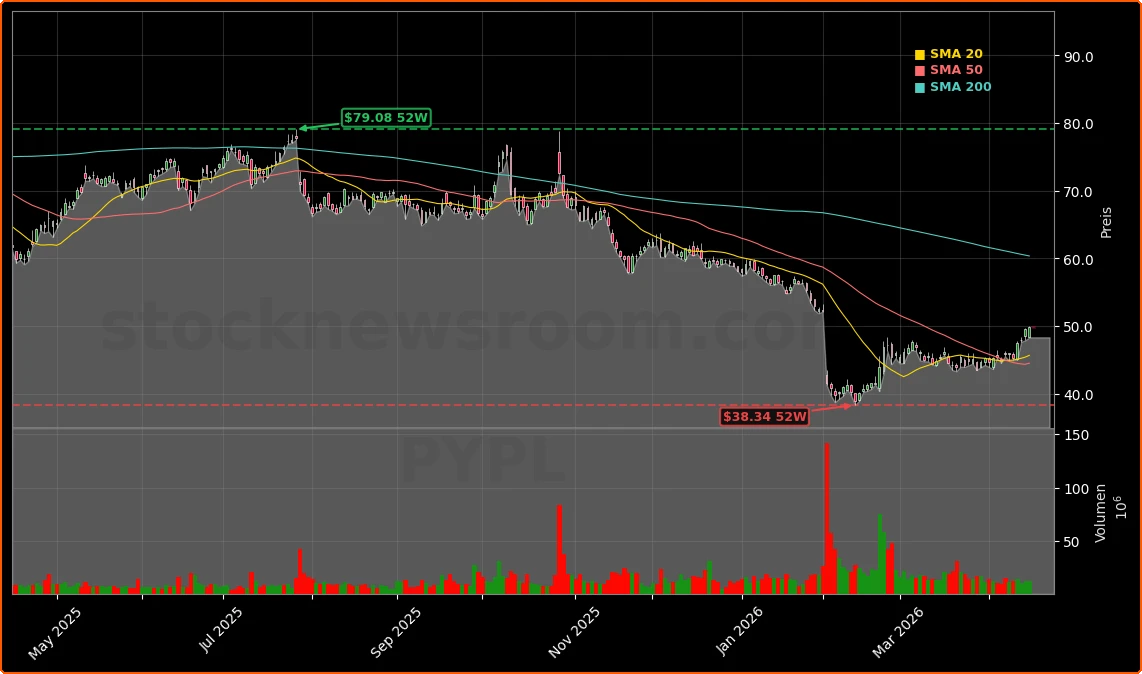
Wall Street sentiment around PayPal Holdings, Inc. has turned more cautious. Mizuho moved PYPL to “Neutral” from “Outperform” and trimmed its price target to $50 from $60, effectively pinning fair value right around where the stock now trades in after-hours action near $49.79. The downgrade follows a year-to-date decline of roughly 16%, leaving shares well below their 200-day moving average of about $60.74.
Mizuho’s revised PayPal Forecast highlights “rising competitive and fundamental headwinds” for both PayPal and its Venmo franchise. The call lands just weeks after management withdrew long-term growth targets and acknowledged weaker-than-expected performance in branded checkout, the company’s core profit engine. At the current price, PYPL trades at roughly 9x trailing earnings, a level that suggests investors are increasingly pricing in structural, not just cyclical, challenges.
The shift also contrasts with a still-mixed analyst backdrop. Across Wall Street, PYPL holds a consensus “Hold” rating with an average price target in the high-$60s, but several firms have been cutting their numbers following the latest earnings and guidance reset. The new Mizuho stance effectively signals that the near-term PayPal Forecast may have less upside than many bulls had hoped.
How much damage can X do to PayPal and Venmo?
The core of Mizuho’s downgrade is competitive risk from X’s push into peer‑to‑peer payments and social commerce. Venmo has long dominated P2P payments among younger U.S. users, but X is targeting those same digital wallet entry points, creating what Mizuho calls the “most direct substitution risk” in PayPal’s ecosystem. If users begin shifting everyday transfers and small-ticket payments to X, Venmo’s engagement and monetization could suffer.
The second front is even more strategic: branded checkout. PayPal’s long-standing advantage has been its button at online checkout, especially for small and mid-sized merchants. X’s ambition to embed native payments and shopping inside its social platform could weaken those merchant relationships over time by keeping users within its own commerce loop. For a company already wrestling with slowing account growth — rising from about 435 million accounts in 2022 to just 439 million in 2025 — any erosion in relevance at checkout would deepen concerns about long-term growth.
While other large-cap tech names like Apple and its Apple Pay ecosystem also pressure PayPal, X presents a new, socially integrated threat that could pull user attention and transactions away from PayPal’s network. This is particularly important for U.S. investors comparing PYPL with faster-growing fintech or AI plays such as NVIDIA, where competition appears to be bolstering, not compressing, valuations.
What else is weighing on the PayPal Forecast?
Beyond competition, the fundamental PayPal Forecast has become more muddied by execution stumbles and legal risk. Recent quarterly results included a slight EPS miss despite roughly 4% year-over-year revenue growth, alongside management’s decision to scrap previously touted 8–10% total payment volume growth targets. Multiple shareholder lawsuits now allege that prior statements around revenue outlook and growth strategy were misleading, with lead-plaintiff deadlines around April 20, 2026, adding overhang for the stock.
Interim leadership has acknowledged that “execution has not been where it needs to be, particularly in branded checkout,” while the company transitions to new CEO Enrique Lores. Current guidance calls for non‑GAAP EPS in 2026 to be flat to slightly down versus FY25’s $5.31, leaving little margin for error if competitive or legal pressures intensify. That profile looks modest when compared with higher-growth software or fintech peers and helps explain why some investors see PYPL as a value trap despite its single-digit earnings multiple.
Still, the balance sheet and cash generation offer a partial cushion. PayPal generated about $5.56 billion in free cash flow in FY25 and continues to return capital via buybacks and a modest $0.14 quarterly dividend. There has also been notable insider activity over the past months, signaling that some executives view the current valuation as too pessimistic relative to the longer-term PayPal Forecast.
How should U.S. investors position around PayPal now?
For American portfolios, PYPL has shifted from a high-growth fintech favorite to a controversial value and turnaround story within the NASDAQ landscape. Investors comparing it to other large-cap platforms like Tesla or diversified tech ecosystems such as Apple must weigh slower expected compound annual growth rates — around 4% for revenue and 6% for EPS from 2025 to 2028 — against the possibility that competition from X and other wallets permanently caps PayPal’s margin power.
In the near term, key catalysts for revising any PayPal Forecast will include updated commentary from incoming CEO Enrique Lores, trends in branded checkout share, and concrete evidence that Venmo can defend its user base despite X’s expansion. Any resolution or narrowing of the various class actions, as well as stabilization in EPS guidance, could also remove some of the legal and sentiment overhang that has weighed on PYPL versus the broader S&P 500 and NASDAQ benchmarks.
Related Coverage
Investors following PYPL may also want to revisit recent takeover speculation. Earlier this year, a sharp rally in the shares was driven by rumors of a potential deal with Stripe; our coverage in “PayPal Acquisition +6.7%: Rally Driven by Stripe Speculation and CEO Change” breaks down how realistic that megadeal looks and what it could mean for long-term holders. For a broader view of financial-sector sentiment and how big-bank earnings shape risk appetite for fintech names like PayPal, our deep dive “JPMorgan Earnings Record: Q1 Profit Surge and Outlook Shock” analyzes JPMorgan’s latest results and their implications for Wall Street valuations.
Execution has not been where it needs to be, particularly in branded checkout.— Interim PayPal management on recent quarterly results
Overall, the latest moves around the PayPal Forecast underline a company at a crossroads: cheap on traditional metrics, but with a business model facing sharper questions than in the past. For investors, PYPL remains a stock to watch closely, as upcoming quarters will determine whether today’s discount reflects opportunity or accurately prices in lasting competitive damage.