Is the latest IonQ Quantum Breakthrough a speculative hype spike or the moment quantum computing finally becomes a strategic asset?

How big is the IonQ Quantum Breakthrough for markets?
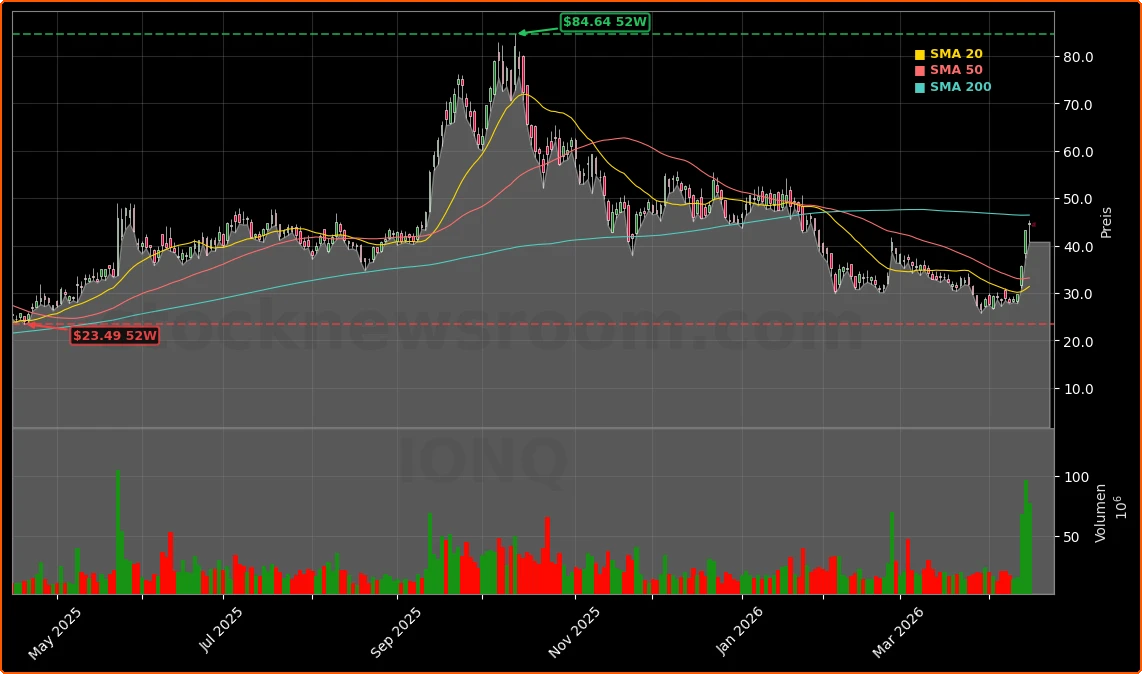
IONQ shares finished regular trading on Thursday at $44.68, up 3.31% on the day, before slipping to $44.05 (-1.41%) after hours. That leaves the stock up more than 25% over the past week and roughly 41% over the last 12 months, but still well below its recent high near $84.64. With a beta close to 3, IonQ trades more like a leveraged call option on quantum computing sentiment than a typical Nasdaq growth stock.
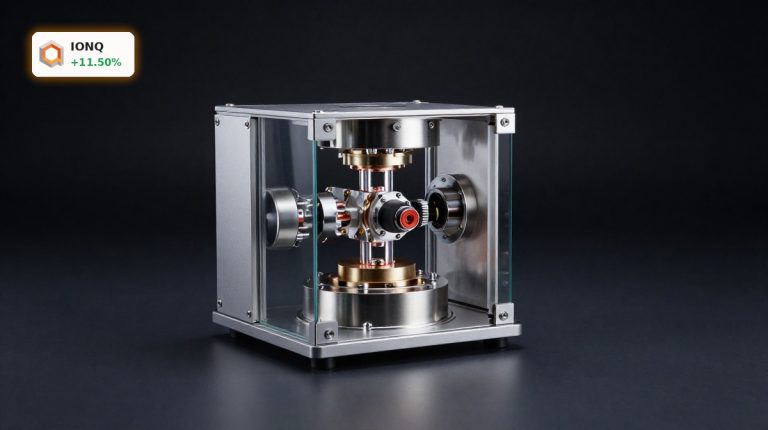
The core of the current IonQ Quantum Breakthrough story is technical, not just narrative. On April 14, the company demonstrated photonic entanglement between two separate commercial trapped‑ion quantum systems – effectively linking two quantum computers. This is a foundational step toward scalable quantum networks and, eventually, a quantum internet, a theme that has helped lift not only IonQ but also peers like Rigetti and D‑Wave, especially after NVIDIA unveiled new quantum‑focused Ising model tools that reignited sector enthusiasm.
That same day, IonQ disclosed participation in DARPA’s Heterogeneous Architectures for Quantum (HARQ) program, focusing on quantum memories and high‑speed interconnects for defense and national security applications. The combination of cutting‑edge networking progress and a prestigious government program has shifted the conversation on Wall Street from “interesting lab project” to “potentially strategic national asset.”
Is IonQ’s growth surge sustainable?
Behind the IonQ Quantum Breakthrough headlines, the company’s fundamentals are changing rapidly. IonQ became the first publicly traded pure‑play quantum firm to exceed $100 million in annual GAAP revenue in 2025. In Q4 2025, revenue jumped to $61.89 million, up about 429% year over year and more than 50% above consensus expectations near $40 million. Management now guides full‑year 2026 revenue to a range of $225 million to $245 million, excluding any contribution from the pending SkyWater Technology acquisition.
IonQ’s remaining performance obligations total roughly $370 million, giving some visibility into future revenue as enterprise and government customers ramp early‑stage quantum workloads. The company also holds a world‑leading position in trapped‑ion hardware, reporting two‑qubit gate fidelities around 99.99%, ahead of many rivals still struggling to reach 99.9%. That accuracy advantage underpins the bull thesis that trapped‑ion systems will win in high‑value applications where reliability matters more than raw speed.
Still, profitability remains distant. Management projects 2026 adjusted EBITDA losses of $310 million to $330 million, widening from 2025, with operating cash outflows already at about $283 million last year and set to increase. At roughly 101x trailing sales, IONQ’s valuation bakes in years of nearly flawless execution and sustained market leadership, leaving little room for disappointment as interest rates and risk appetite on Wall Street remain in flux.
How does IonQ stack up against U.S. tech peers?
For U.S. investors used to mega‑cap compounders like Apple and AI beneficiaries like NVIDIA, IonQ sits at the opposite end of the risk spectrum. It has real revenue and government contracts, but no profits and a business model still heavily tied to research spending and pilot projects. The stock’s high beta means any broader risk‑off move in the S&P 500 or Nasdaq 100 could hit IONQ disproportionately hard.
By contrast, established growth names such as Tesla or the hyperscale cloud players are increasingly integrating quantum and quantum‑adjacent capabilities into larger AI and HPC stacks, spreading risk across many cash‑generating lines of business. IonQ offers a much purer way to play quantum infrastructure – and potentially the “picks and shovels” of the quantum internet – but also embodies the sector’s execution risk in a single, relatively small‑cap name.
Longer‑term, consulting estimates suggest that the quantum computing market could reach as much as $72 billion annually by 2035. If IonQ could capture just 10% of that market and convert 30% of resulting revenue into net income, its earnings power could support a market capitalization several times higher than today’s roughly $10 billion. That type of multibagger upside is what keeps speculative capital engaged despite ongoing insider selling from some executives and the integration risks tied to acquiring SkyWater.
What are the next catalysts for IonQ, Inc.?
Over the next 12 months, the stock’s trajectory will hinge on a handful of clear milestones. First, the next earnings report must show that Q1 2026 revenue lands within the guided range of $48 million to $51 million. A miss would raise doubts about the depth of demand behind the IonQ Quantum Breakthrough narrative and could send shares back toward the low‑$20s seen in February. A beat, in contrast, would support bullish Wall Street models that point toward a medium‑term price target around the mid‑$60s and beyond.
Second, investors will watch closely to see whether the SkyWater deal closes smoothly and whether IonQ can execute on integrating a specialized semiconductor foundry into its quantum hardware roadmap. Any regulatory hiccups or cultural clashes could sap management focus at a time when competitors are accelerating. Third, ongoing work in DARPA’s HARQ program and new academic collaborations with institutions like the University of Maryland, Cambridge, and Chicago should translate into a richer technology and talent pipeline, potentially reinforcing IonQ’s leadership in quantum networking, memory, and error correction.
Related Coverage
For a deeper dive into how the DARPA contract reshaped investor perception, readers can explore IonQ DARPA Program Soars 16.5% After Defense-Backed Quantum Breakthrough, which analyzes whether defense spending can turn IonQ from a speculative bet into a mainstream growth story. Broader tech investors weighing quantum versus cloud AI exposure may also want to read Oracle Cloud Strategy +4.9%: AI Boom Meets Debt Warning, which contrasts the upside of hyperscale AI infrastructure with balance‑sheet risks at mature enterprise software players.
The IonQ Quantum Breakthrough and DARPA win have undeniably changed the company’s profile, putting real technological achievements behind an already powerful growth narrative. For aggressive U.S. investors, IonQ offers rare exposure to a potential new computing paradigm, but at a price that assumes continued flawless execution and resilient market sentiment. The coming quarters – especially the next earnings print and SkyWater integration – will show whether this quantum rally has more room to run or whether patience on the sidelines proves the smarter move.