Is IonQ’s DARPA HARQ win and photonic interconnect breakthrough the moment its quantum roadmap finally starts to justify the hype?

Why is IonQ jumping today?
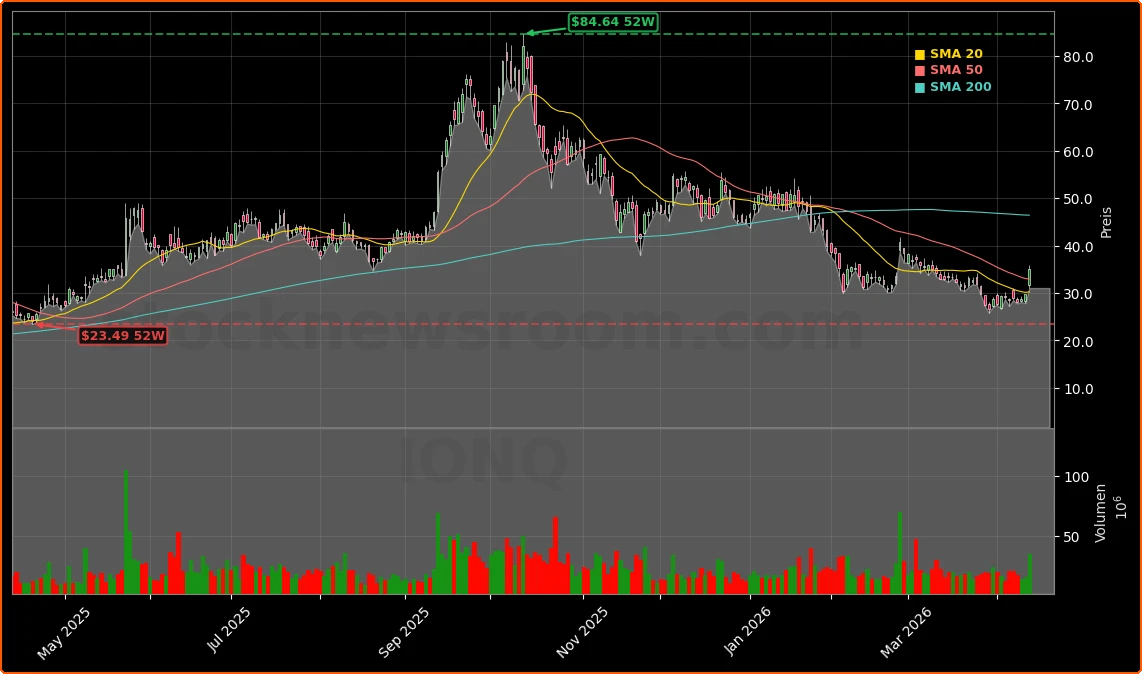
IonQ stock rallied after the company disclosed a contract under the Defense Advanced Research Projects Agency’s Heterogeneous Architectures for Quantum initiative, commonly referred to as the IonQ DARPA HARQ program, and separately announced a key photonic interconnect milestone with the U.S. Air Force Research Laboratory (AFRL). The move pushed the stock to about $35.09, up 17.91% on the day, even though IonQ remains well below its 52‑week highs, meaning the spike is powerful but not yet a breakout to new records.
From an equity perspective, the news hits two themes the market likes: recurring, strategically valuable U.S. government work and tangible technical progress on scaling quantum hardware. Both factors may help justify rich growth multiples in a sector where revenues are still small but long‑term addressable markets are estimated in the trillions of dollars.
What is the IonQ DARPA HARQ program about?
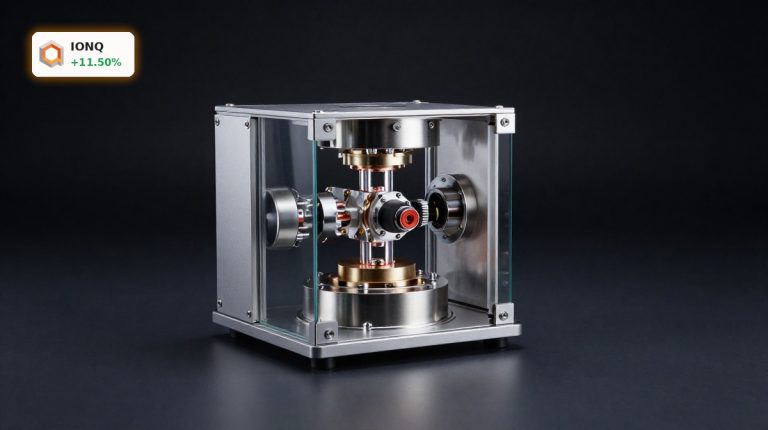
The IonQ DARPA HARQ award puts the company at the center of a push to build heterogeneous quantum architectures that can combine multiple qubit modalities—trapped ions, neutral atoms, and superconducting qubits—into a single networked system. IonQ’s role focuses on high‑speed quantum interconnects and quantum memories, which act as the core chips of its networking stack and are fabricated in quantum‑grade synthetic diamond.
These memories are designed to support demanding speed and fidelity targets, enabling communication across diverse quantum processors without destroying fragile quantum states. The goal is a modular, plug‑and‑play quantum backbone that can interconnect future systems built by different vendors, similar to how standardized networking allowed classical data centers to link servers, GPUs, and accelerators at scale. If successful, that architecture could make IonQ’s networking technology a critical layer in broader quantum ecosystems dominated today by cloud players such as NVIDIA and Apple partners on the hyperscaler side.
How big is the photonic interconnect milestone?
In parallel with the IonQ DARPA HARQ contract, IonQ announced it has photonically interconnected two independent trapped‑ion quantum systems in collaboration with AFRL. This is billed as the first demonstration of connected, commercial quantum computers, using photons to generate entanglement between remote IonQ machines while maintaining coherence for advanced operations.
The achievement goes beyond lab‑scale physics experiments by validating that IonQ’s commercial hardware stack can support networked operation in real‑world environments. CEO Niccolo de Masi called it a “pivotal moment” as the roadmap shifts from isolated processors toward distributed quantum architectures and, eventually, a quantum internet. For investors, the long‑term implication is that IonQ’s upside may not be limited to selling stand‑alone systems like its Tempo and forthcoming 256‑qubit machines, but could extend to interconnects, quantum memories, and network services that sit alongside classical cloud infrastructure from firms like NVIDIA.
How does this fit into IonQ’s broader roadmap?
Operationally, IonQ is coming off a strong 2025 in which it grew quarterly revenue to about $61.9 million in Q4, up 429% year over year, while still posting a net loss of $0.20 per share. The company reached a world‑record 99.99% two‑qubit gate fidelity and achieved its #AQ 64 milestone on the Tempo system three months ahead of schedule, underscoring a performance‑over‑qubit‑count strategy.
IonQ has also been pushing an application‑centric benchmarking framework that measures metrics like time‑to‑solution and energy‑to‑solution across optimization, chemistry, and cryptography workloads. That approach aims to differentiate trapped‑ion systems from gate‑count marketing by competitors and resonates with cloud customers evaluating real‑world performance versus superconducting and neutral‑atom offerings. On the commercial side, a deal to place a 256‑qubit system at Horizon Quantum Holdings brings IonQ’s sixth‑generation machine into a hardware‑agnostic platform where it can be directly compared against rivals and integrated into enterprise workflows.
Strategically, expanded collaborations with the University of Maryland’s QLab and new deployments of quantum memory nodes further cement College Park as a U.S. quantum hub. The latest IonQ DARPA HARQ work and AFRL project extend that footprint deeper into federal and defense networks, where long contracting cycles can translate into durable, high‑margin revenue once platforms are embedded.
How is Wall Street positioned on IonQ?
Analysts remain broadly constructive but flag valuation risk. Jefferies analyst Kevin Garrigan rates IonQ a Buy with a $90 price target, implying substantial upside from current levels if the company executes on its plan to deliver a 256‑qubit system by late 2026 and continues broadening commercial demand across compute, networking/security, and sensing. Other institutions, including Carnegie Investment Counsel, have been adding to positions, citing over $100 million in annual revenue and meaningful state support as reasons to stay invested despite ongoing losses.
At the same time, some research shops warn that IonQ trades at a high forward‑revenue multiple and remains dependent on heavy R&D spending to preserve its advantage over larger technology companies that may scale into quantum over time. Investors comparing IonQ to more mature innovators like Tesla in EVs or Apple in consumer tech should keep in mind that quantum remains earlier stage, with greater regulatory and technical uncertainty. The ultimate test will be whether DARPA, AFRL, cloud hyperscalers, and enterprise customers continue to convert pilots and milestones into recurring contracts and system sales.
Related coverage
For a deeper look at how previous catalysts have moved the stock, including a Romania infrastructure project and a nearly 20% rally around earnings, readers can review this detailed breakdown of IonQ’s quarter and 19.9% share surge. To put high‑beta innovation names like IonQ in broader context alongside other disruptive bets, such as autonomous driving partnerships, it’s worth comparing with coverage of mobility plays in this analysis of Uber’s $500 million robotaxi partnership, which explores how big technology shifts can reprice both opportunity and risk across the growth spectrum.
Achieving this photonic interconnect milestone is a pivotal moment in our roadmap as we move from individual quantum processors to distributed, networked architectures.— Niccolo de Masi, CEO of IonQ
In sum, the combination of the IonQ DARPA HARQ contract and the first photonic link between commercial quantum computers reinforces IonQ’s position at the intersection of defense, cloud, and next‑generation networking. For U.S. investors willing to tolerate volatility, the stock offers leveraged exposure to a potential quantum infrastructure leader as government and enterprise demand scale up. The next few quarters of contract wins, technical milestones, and system deployments will show whether IonQ can translate today’s headlines into a sustainable competitive moat.