Will the Uber Robotaxi Partnership and its $500 million Lucid bet truly transform Uber’s growth story or just reprice its risks?

How big is Uber’s new Lucid robotaxi bet?
On Tuesday, Uber and Lucid Group unveiled a major expansion of their autonomous mobility collaboration. Uber lifted its purchase commitment to at least 35,000 Lucid EVs, including the Lucid Gravity SUV and a coming midsize platform, all dedicated to its future global robotaxi service. Every vehicle will be equipped with Nuro’s autonomous driving stack, extending a three-way alliance that began in 2025.
Alongside the larger vehicle order, Uber pledged an additional $200 million investment in Lucid, bringing its total equity exposure to $500 million. Ayar Third Investment, an affiliate of Saudi Arabia’s Public Investment Fund (PIF), is injecting a further $550 million via convertible preferred stock, reinforcing the capital base behind Lucid’s software-defined EV strategy. Including Lucid’s separate $300 million common-stock offering, the combined capital raise tied to today’s announcements approaches $1.05 billion.
The Uber Robotaxi Partnership is positioned to move from concept to commercialization later in 2026, with an initial launch in the San Francisco Bay Area before rolling out to dozens of global markets over roughly six years. Early test rides of Lucid Gravity robotaxis with Nuro autonomy for Uber employees are already under way, with safety drivers on board as the companies validate performance and rider experience.
What does this mean for Uber’s stock story?
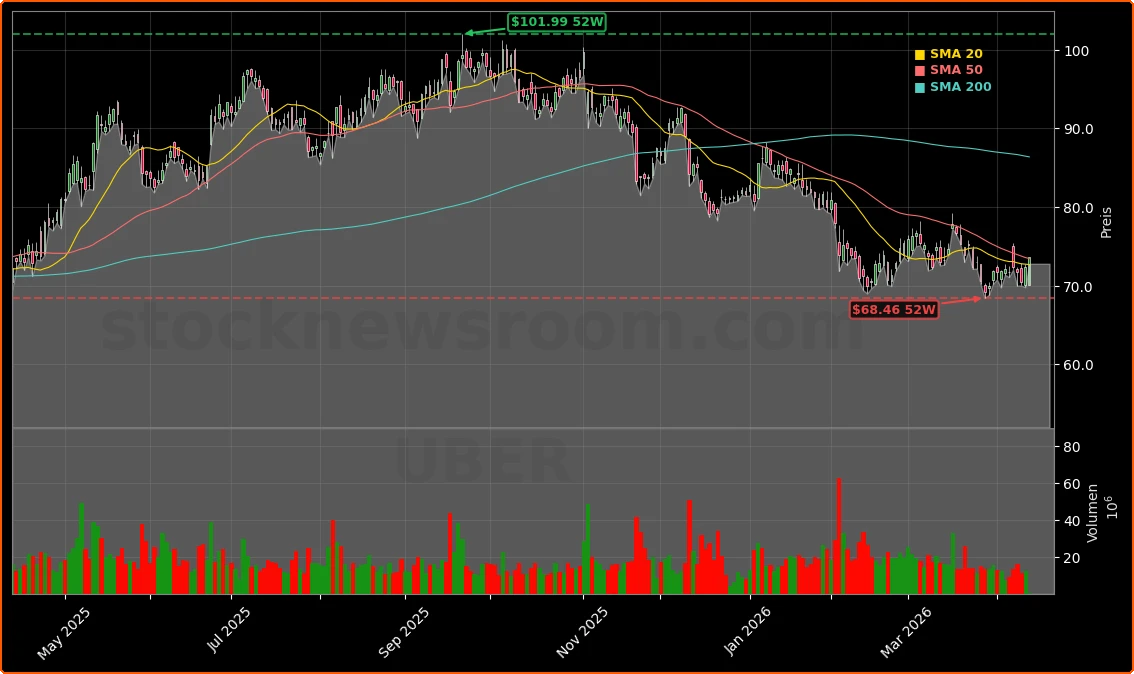
Uber shares trade around $73.64 in Tuesday’s session, up about 1.8% from the prior close, leaving the stock well off its 52‑week highs but far above the pandemic-era lows that once defined its risk profile. After turning consistently profitable in late 2024, Uber has seen its trailing P/E compress to roughly 14.9, while a forward P/E near 21 still embeds meaningful expectations for earnings growth.
Wall Street remains constructive. Recent research tracked by Benzinga shows a consensus price target near $106.62, implying sizeable upside from current levels. Evercore ISI has one of the more aggressive views with a $150 target, while Wedbush sits closer to the low end at $75, effectively bracketing Uber between modest and high-growth scenarios. Wells Fargo and BTIG both maintain Buy or Outperform ratings, with the latest three targets averaging about $98.33.
For analysts, the Uber Robotaxi Partnership is part of a broader narrative: Uber is evolving from a pure gig marketplace into an asset-light orchestrator of mobility, logistics and autonomy. That shift could unlock high-margin platform revenues, from AV fleet operations to in-car advertising and data services, if execution matches the roadmap.
How does autonomy fit alongside Uber Eats and freight?
While robotaxis grab headlines, Uber’s core investment case is still grounded in scaled cash generation from ride-hailing and Uber Eats. In the delivery space, Uber competes head‑to‑head with DoorDash, which some on Wall Street currently view as the higher‑conviction growth play due to faster topline expansion and improving margins. Even so, Uber has been steadily broadening its delivery universe beyond restaurants, striking deals with retailers such as Ace Hardware and others to turn its app into a same‑day convenience gateway.
On the mobility side, Uber is running parallel autonomous efforts. Beyond the Lucid–Nuro collaboration, the company is already operating fully driverless fare‑charging robotaxis in Dubai with WeRide, underscoring its ambition to be an AV integrator globally rather than a one‑bet player. This multi‑partner strategy mirrors what NVIDIA has done in chips and what Apple did in smartphones: build a central platform that others plug into, rather than owning every layer of the stack.
Freight and logistics remain earlier-stage contributors but are strategically important. If robotaxis scale, the data, routing and demand-forecasting capabilities Uber has honed in freight could support more efficient AV fleet utilization, amplifying unit economics.
Is Lucid the right EV partner for Uber?
For Lucid, whose stock recently set a new 52‑week low amid cautious analyst sentiment at firms like RBC, the Uber deal is a crucial validation and funding lifeline. The Gravity SUV and upcoming midsize EVs are designed as software‑defined platforms, with spacious interiors, high charging speeds and competitive range, but with smaller battery packs to keep costs down — a profile tailor‑made for high‑utilization fleets.
Uber’s commitment to at least 35,000 vehicles, combined with Nuro’s Level 4 autonomy technology, offers a pathway to scale that could help Lucid spread fixed manufacturing costs and accelerate learning curves. For Uber, meanwhile, partnering with a premium EV maker allows it to differentiate its robotaxi experience against both incumbent ride‑hailing rivals and legacy automakers experimenting with AV fleets.
Still, the partnership is not risk‑free. Investor skepticism lingers over whether robotaxis can reach regulatory approval and economic viability as fast as bullish scenarios assume, especially in tightly regulated U.S. and European markets. The Uber Robotaxi Partnership will have to navigate safety rules, potential liability debates and shifting gig‑worker classification laws, all of which could affect cost structures and rollout timing.
Related Coverage
For a deeper dive into how autonomy could drive valuation, readers can explore Uber Forecast Boom: Can 71% Upside Really Materialize?, which dissects whether projected upside rests on realistic robotaxi cash flows or pure hype. For context on how other tech names are making bold, capital‑intensive bets, Oracle AI Energy Deal $21B: Stock Soars on AI Power Bet examines how Oracle is using energy investments to underpin its AI ambitions, offering a useful comparison for investors evaluating high‑stakes strategic pivots.
The expanded Uber Robotaxi Partnership with Lucid cements autonomy as a core pillar of Uber’s long‑term strategy, adding a 35,000‑vehicle EV pipeline and a $500 million equity link to its AV ecosystem. For investors, the move reinforces Uber’s positioning as a diversified mobility platform rather than a mature ride‑sharing utility, even as regulatory and execution risks remain elevated. The next phase — commercial launches in San Francisco and beyond — will show whether this ambitious robotaxi push can translate from narrative to durable cash flows.