Can JinkoSolar’s record shipments and new solar tech overcome collapsing margins and a double-sized annual loss after the latest earnings shock?

How did JinkoSolar Earnings hit the stock today?
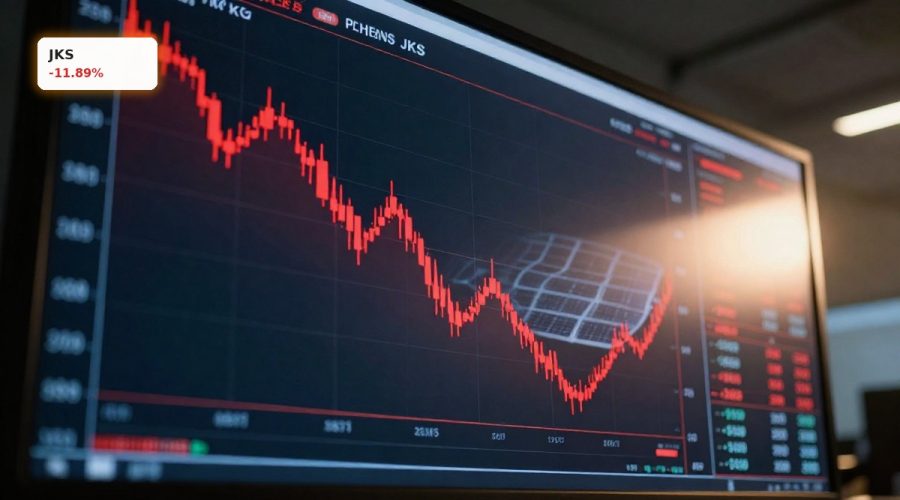
Investors reacted sharply to the new JinkoSolar Earnings release. JKS fell about 11.9% to $21.34 on the NYSE by Thursday afternoon ET, extending recent weakness and trading below several published 12‑month price targets. The drop follows a fourth quarter in which revenue modestly beat consensus while losses widened and margins compressed further, reinforcing concerns about profitability in a brutally competitive solar module market.
The company reported Q4 2025 revenue of roughly $2.5 billion, about $140 million above average analyst expectations, but still down around 15% year over year. Adjusted net loss for the quarter came in at approximately $119.8 million, nearly doubling versus the prior-year period. For the full year 2025, JinkoSolar posted a net loss of about RMB 4.45 billion (roughly $620 million), as low selling prices, higher input costs and FX swings erased earnings despite record shipment volumes.
Wall Street had braced for a weak print: MarketBeat data ahead of the release showed consensus looking for a sizable per‑share loss and rating the stock “Reduce” with an average target of about $24.50. With shares now below that mark and also below an earlier $22.20 target cited by another research outlet, the latest JinkoSolar Earnings are forcing investors to reassess whether the current discount sufficiently compensates for margin risk and Chinese-policy exposure.
What do the numbers say about JinkoSolar’s core business?
Beneath the headline loss, the operational picture is a mix of scale leadership and profit strain. JinkoSolar shipped 86 gigawatts of modules in 2025, retaining its position as the world’s top module shipper for a seventh straight year. However, that scale delivered only a full-year gross margin of about 2.2%, with Q4 gross margin collapsing to roughly 0.3% as module prices stayed “persistently low” and raw material costs for polysilicon and silver moved higher.
Management noted that product mix remains in transition toward higher‑efficiency N‑type TOPCon modules and higher‑wattage formats above 640 watts, which currently earn a modest price premium. Even so, price competition across the PV value chain, especially in China, has kept average selling prices under pressure, driving the negative JinkoSolar Earnings outcome for 2025 despite volume growth and cost initiatives such as smart factories and supply chain optimization.
The surprising bright spot is cash generation. The company produced positive operating cash flow of roughly $470 million in Q4 and about $280 million for the full year, helped by working-capital management and slowing capex. JinkoSolar closed 2025 with cash and equivalents of around RMB 3.3 billion, providing a liquidity buffer but not eliminating the need for sustained margin repair.
How is JinkoSolar trying to fix margins and grow?
To shift the JinkoSolar Earnings trajectory, management is betting heavily on technology and adjacent businesses rather than pure volume growth. The company is ramping N‑type TOPCon cell technology with reported lab efficiency of 27.79% and has demonstrated a TOPCon‑based perovskite tandem cell at 34.76% efficiency—levels that, if commercialized at scale, could support better pricing and lower levelized cost of electricity for utility and data-center customers.
JinkoSolar also reported more than 700 TOPCon-related patents and is working on silver‑coated copper metallization to cut silver usage, a key cost driver. Its third-generation Tiger Neo modules are expected to reach up to 670 watts and gain share in 2026, especially in overseas markets. The company plans to lift integrated capacity to about 100 GW by the end of 2026 and guides for 75–85 GW of module shipments this year, with China’s share dropping to roughly 30% as it leans into higher‑value international demand.
Parallel to modules, energy storage systems (ESS) are being positioned as a “second growth engine.” JinkoSolar shipped 5.2 GWh of ESS in 2025 and sees 2026 growth coming from regions such as Europe, Latin America, the Middle East, and Asia‑Pacific. Management pegs ESS gross margin in the 10–15% range—well above current module margins—though still exposed to lithium price swings. The company is also courting AI data-center projects, an area where power-hungry players such as NVIDIA and large cloud operators are driving demand for renewables‑plus‑storage solutions.
How do JinkoSolar’s risks and opportunities compare for US investors?
From a US portfolio perspective, JKS sits in a very different bucket than mega-cap US tech names like Apple or Tesla, and even versus diversified renewable players in broad indices like the S&P 500. The stock is volatile, tied to Chinese industrial policy, and carries execution risk around technology ramps and overseas trade friction. At the same time, several research shops see valuation appeal after the latest JinkoSolar Earnings slide. Analyst data compiled by GuruFocus recently highlighted an upgrade from Daiwa Capital, which moved JKS from “Sell” to “Buy” with a $28.50 price target, while the site’s own fair‑value estimate hovered near $30 per share.
For context, JKS shares around the low‑$20s are well below some intrinsic-value models but still roughly 70% above their 52‑week low noted earlier this month, underlining how quickly sentiment can swing in the solar space. Institutional activity remains mixed: one recent filing showed SG Americas Securities boosting its JinkoSolar stake by nearly 190%, even as the broader analyst consensus leans cautious with “Reduce” and “Hold” stances dominating.
We regard energy storage and high-efficiency cell technology as twin growth engines that can gradually pull JinkoSolar back to a healthier margin profile.— Li Xiande, Chairman and CEO of JinkoSolar Holding Co., Ltd.
Compared with broad-market growth leaders, the JinkoSolar Earnings profile is far more cyclical and commodity‑like, but the company’s push into ESS, AI‑oriented solar modules, and higher‑efficiency cells could eventually move its valuation narrative closer to energy‑technology than pure manufacturing. For now, most US investors will likely view JKS as a satellite position rather than a core holding, sized appropriately for policy, pricing and FX risk.