Is Autodesk’s cash-rich model really a safer $50B bet than Snowflake’s high-growth, high-multiple story?

Is Autodesk or Snowflake the riskier $50B bet?
The current Autodesk vs. Snowflake Bewertungsvergleich matters for U.S. portfolios because both names sit at the intersection of cloud, data, and design software – sectors that helped drive the NASDAQ and mega caps like NVIDIA and Apple in recent years. At roughly the same market capitalization, Autodesk and Snowflake embody two very different approaches to growth: one already highly profitable with strong free cash flow, the other growing faster but still deeply loss-making.
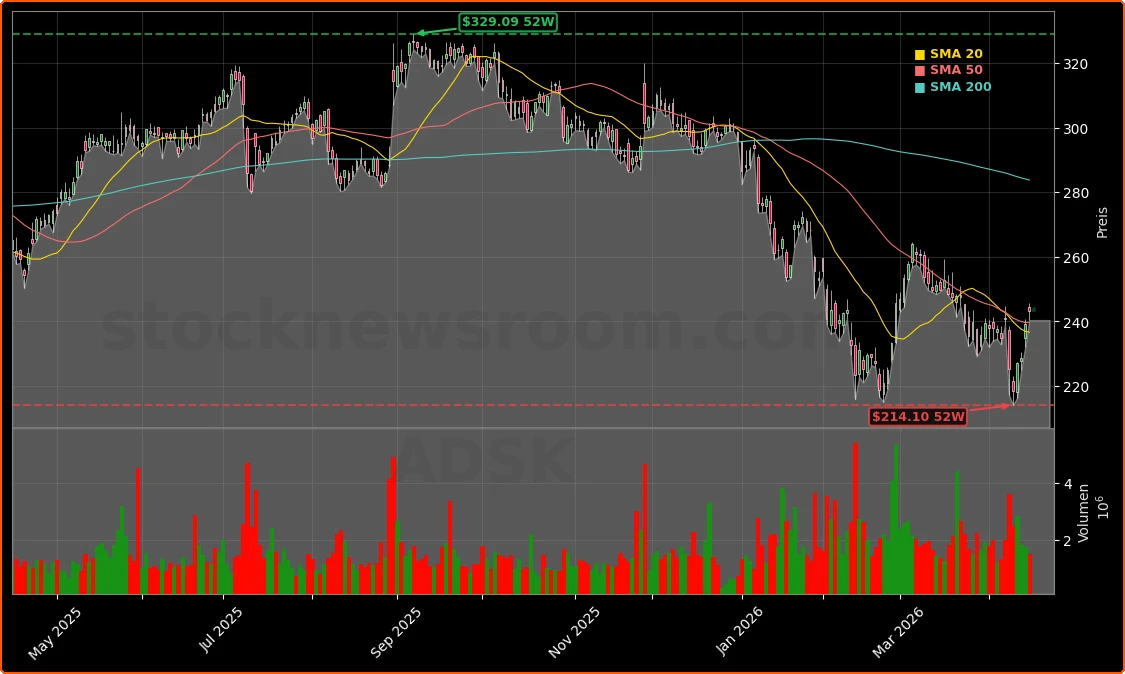
Autodesk trades around $243 after a recent rebound, down nearly 20% year-to-date and well below its 52-week high of $329.09. Snowflake, meanwhile, is down more than 30% year-to-date and trades almost 50% below its 52-week peak near $281. Both have corrected sharply, but valuation metrics show that Snowflake’s multiple remains far more demanding.
For U.S. investors worried about further compression in software multiples, the Autodesk Valuation case looks materially different from the Snowflake story: Autodesk’s premium is tied to proven cash generation, while Snowflake’s is still anchored in future expectations.
How does Autodesk Valuation stack up vs. Snowflake?
On headline numbers, the gap is stark. Autodesk currently trades at about 43x trailing earnings, 24x forward P/E, and roughly 7x sales. Its PEG ratio of 0.89 indicates that expected earnings growth more than justifies the multiple by traditional growth-at-a-reasonable-price standards. Snowflake, in contrast, trades around 116x non-GAAP earnings, an 81x forward P/E, and about 11.5x sales, with a PEG ratio above 4 – a level that historically leaves little margin of safety if growth slows.
This is the crux of the Autodesk Valuation debate: investors are paying a growth multiple, but one underpinned by GAAP profitability and rapidly expanding free cash flow. Autodesk generated about $1.12 billion in GAAP net income in its latest fiscal year and $2.41 billion in free cash flow, the latter up roughly 60% year over year. Non-GAAP operating margin reached about 37.5%, with management guiding for 38.5% to 39% in the coming fiscal year.
Snowflake is still on the opposite side of the profitability spectrum. The company posted a GAAP net loss of about $1.33 billion and a GAAP operating loss of $1.44 billion in its latest fiscal year, while stock-based compensation ran near $400 million in the most recent quarter alone. Shareholders’ equity has fallen by more than a third year over year, and the company continues to face securities class action litigation tied to prior disclosures. That combination of structural losses, dilution, and legal overhang makes Snowflake’s lofty multiple much more fragile if sentiment turns.
What do growth and guidance say about downside?
Snowflake is still the faster grower on the top line. Revenue climbed about 29% to $4.68 billion in its latest fiscal year, with product revenue guided to grow roughly 27% to $5.66 billion next year – a slowdown from prior years, and one the stock has already punished. Yet even after the selloff, the valuation assumes that elevated growth and consumption patterns will persist without material hiccups.
Autodesk delivered about 17.5% revenue growth to $7.21 billion and is guiding for $8.10 billion to $8.17 billion in the coming year, implying mid-teens growth from a larger base. Crucially for Wall Street, all four quarters of the last fiscal year came with consistent earnings beats and accelerating free cash flow. That track record, combined with a sticky subscription model across design, engineering, and construction software, supports a more predictable earnings and cash trajectory than Snowflake’s usage-based data cloud model.
There are risks around Autodesk’s execution, including $216 million in restructuring charges and a management-flagged, temporary billings headwind tied to a sales optimization plan. But these are tied to a profitable business fine-tuning its go-to-market motion, not a company trying to close massive GAAP losses.
How is Wall Street treating Autodesk vs. Snowflake?
Institutional positioning and analyst sentiment currently lean in Autodesk’s favor. Autodesk counts 29 Buy ratings and no Sell ratings, reflecting broad confidence among research desks. Recently, Jefferies initiated coverage with a Buy rating and a $300 price target, arguing that concerns about long-term terminal value in its architecture, engineering, and construction segment are overdone. GuruFocus’ GF Value framework similarly flags the shares as undervalued versus an intrinsic value estimate above $320, suggesting a sizable margin of safety from current levels.
Snowflake, despite its pullback, remains a polarizing name among U.S. growth managers. Bulls argue that its data cloud is strategically critical for AI workloads and analytics, placing it in the same secular tailwind as hyperscale partners like NVIDIA and large SaaS peers such as Tesla in the autonomous data space. Bears point to the combination of slowing growth, rich valuation, heavy stock-based compensation, and legal risk as a recipe for further multiple compression if any quarterly guidance disappoints.
Against that backdrop, the Autodesk Valuation setup appears more balanced: investors are not paying a bargain multiple, but they are getting durable profits, strong free cash flow, and a business model that has already weathered multiple macro cycles.