Is the Snowflake valuation still defensible when triple-digit earnings multiples collide with slowing growth, heavy losses and mounting legal risks?

Is Snowflake Inc. still a market leader?
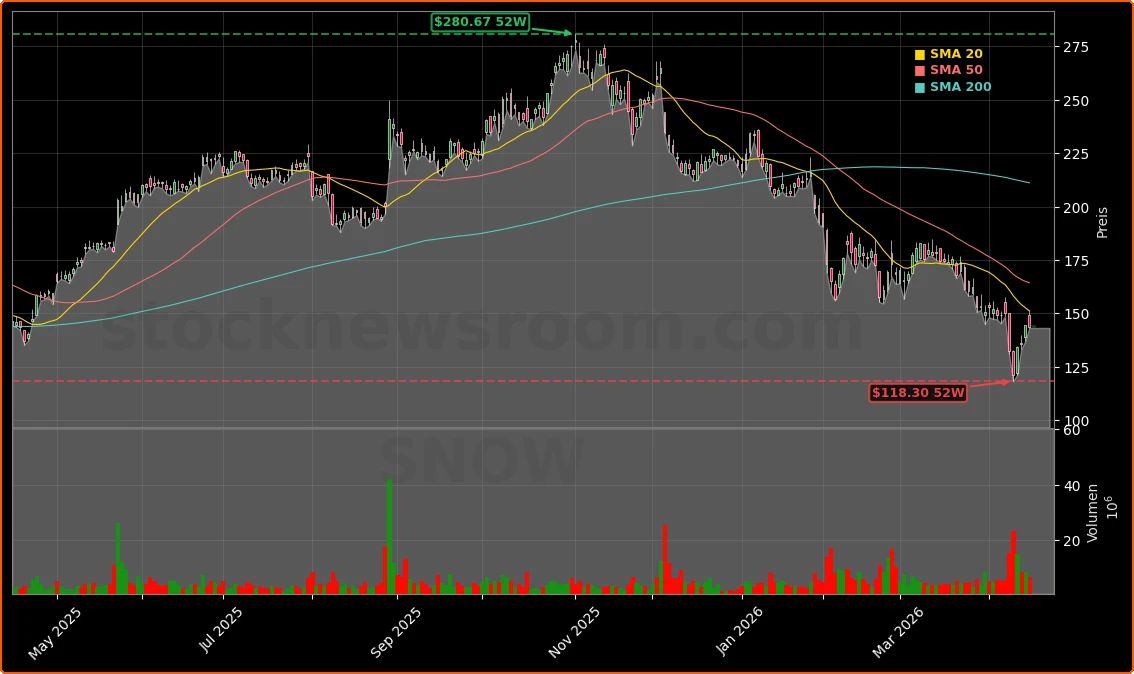
Snowflake Inc. continues to be a key name in high‑growth software, even after a painful reset in 2025 and early 2026. Software and cloud data names were heavily sold in recent months while the mega‑cap tech cohort, including NVIDIA and Apple, pushed major indices like the S&P 500 and NASDAQ toward record highs. Over the last two sessions, however, software stocks have staged a short‑term rebound, with Snowflake attempting to participate despite persistent concerns over growth deceleration and profitability.
At $143.55 at the regular close on Thursday (after‑hours: $144.01, +0.32%), Snowflake commands a market cap near $50 billion. That puts it in the same neighborhood as design‑software peer Autodesk, but the two companies could hardly be more different in terms of earnings power and risk profile. For investors benchmarking against broad tech ETFs or concentrated portfolios featuring names like Tesla, the question is less about Snowflake’s technology leadership and more about whether its current price leaves any margin for error.
How stretched is the Snowflake Valuation versus peers?
The most pointed bear argument centers on Snowflake valuation metrics. On fiscal 2026 non‑GAAP EPS of about $1.25, Snowflake trades at roughly 116x earnings. The forward P/E multiple, based on company guidance and consensus projections, is still around 81x, while the price‑to‑sales ratio sits near 11.5x. The company’s PEG ratio of just over 4 underscores that earnings growth, while strong, is not nearly fast enough to justify the premium on traditional valuation models.
Autodesk, by comparison, trades at a forward P/E of about 24x and a price‑to‑sales multiple of roughly 7x, despite being a profitable, cash‑generative software business with non‑GAAP operating margins approaching 38.5%–39% in fiscal 2027 guidance. Snowflake’s bulls argue that its consumption‑based data cloud can scale into a far larger revenue base over time, but for skeptics, the relative Snowflake valuation looks rich even after the recent slump.
What do Snowflake’s growth and losses look like?
Snowflake is still growing faster than many legacy software peers. Fiscal 2026 revenue rose 29.2% year‑over‑year to about $4.68 billion, with fiscal 2027 product revenue guided to $5.66 billion, implying roughly 27% growth. That is high by large‑cap standards, but it marks a clear deceleration from earlier years, and the stock has already reacted sharply to that slowdown.
Under GAAP, the picture is more troubling for valuation‑sensitive investors. Snowflake booked a GAAP net loss of approximately $1.33 billion in fiscal 2026 and an operating loss of about $1.44 billion. Stock‑based compensation remains substantial, running near $400 million in the fourth quarter alone and roughly $1.7 billion for the year. Shareholders’ equity has deteriorated by more than 35% year‑over‑year to around $1.92 billion, signaling ongoing dilution and balance‑sheet pressure that is hard to square with the current Snowflake valuation.
How do legal risks feed into the Snowflake Valuation debate?
Overlaying the financial concerns is a growing wave of securities class action lawsuits against Snowflake. Multiple law firms, including Kaplan Fox & Kilsheimer, The Gross Law Firm, Rosen Law Firm, Bernstein Liebhard, and others, have filed or promoted class actions on behalf of investors who bought Snowflake shares between June 27, 2023, and February 28, 2024. The complaints generally allege that Snowflake misled investors about the impact of product efficiency gains, Iceberg Tables, and tiered storage pricing on customer consumption and revenue growth.
Recent legal alerts emphasize upcoming April 27, 2026 lead‑plaintiff deadlines and argue that these product and pricing decisions may threaten Snowflake’s long‑term path to its oft‑cited $10 billion revenue target for 2029. While such lawsuits are common in high‑growth tech, they add another layer of uncertainty at a time when the Snowflake valuation already requires flawless execution. Any further slowdown in consumption‑based revenue or renewed guidance reset could compress the multiple quickly.
Are Wall Street analysts and insiders aligned?
Despite the drawdown, Wall Street research remains broadly positive on Snowflake, with around 45 Buy ratings still outstanding from major firms. Houses such as Goldman Sachs, Morgan Stanley, and Citigroup have historically highlighted Snowflake as a strategic data‑infrastructure play, justifying premium multiples with long‑term cloud and AI‑driven demand. Several analysts continue to see upside from current levels, arguing that the stock now trades at a discount to other high‑growth data and AI infrastructure plays like NVIDIA.
Yet insider activity tells a more cautious story. Disclosures show net selling by insiders even as the share price has slid and analyst consensus has stayed bullish. For short‑oriented investors, that divergence between management behavior and Street optimism is a key data point. In combination with structural GAAP losses, heavy stock‑based compensation, active litigation, and a volatile consumption model vulnerable to enterprise budget tightening, it reinforces the view that Snowflake is the more compelling short candidate compared with profitable peers in the same market‑cap range.
Related coverage on StockNewsroom
For a deeper dive into the legal overhang and insider transaction scrutiny, readers can review the detailed analysis in Snowflake Lawsuit -11.8% Crash as Insider Deals Face Scrutiny, which examines how litigation risk is reshaping the bull case. Investors interested in the broader frontier‑tech backdrop can also read IonQ Quantum Breakthrough: +3.3% Rally Shocks Wall Street, highlighting how quantum‑computing names like IonQ are influencing sentiment across high‑multiple technology stocks, including Snowflake.
In summary, the current Snowflake valuation leaves little room for disappointment: the stock trades at a rich multiple on decelerating growth, steep GAAP losses, and meaningful legal uncertainty. For U.S. investors balancing exposure between mega‑cap winners and higher‑risk cloud names, Snowflake now looks far more sensitive to macro and execution hiccups than its headline growth rate suggests. The next few quarters of consumption trends, legal developments, and any shifts in analyst stance will determine whether this premium data‑cloud story can grow back into its valuation or remains a prime target for short sellers.