Can the Oracle Cloud Strategy turn its AI infrastructure surge into lasting shareholder gains before its massive debt load bites back?

Is Oracle’s AI surge changing the Wall Street narrative?
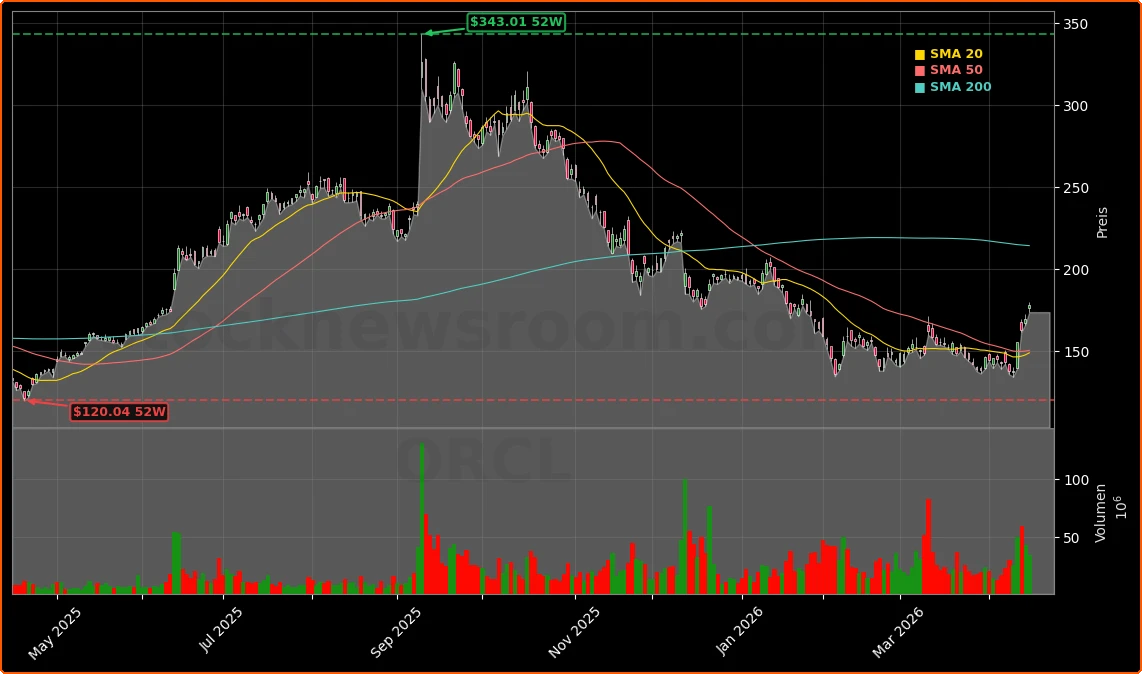
Software names have snapped back after months of underperformance, and Oracle Corporation has been one of the standout movers. After a brutal six‑month slide of more than 40%, the stock has bounced hard as institutional buyers crowd into AI infrastructure plays. The move mirrors renewed strength in large‑cap tech on the S&P 500 and Nasdaq, with Oracle now joining peers like Microsoft and NVIDIA as perceived beneficiaries of the generative AI build‑out.
The turning point came as Oracle showcased fresh AI and cloud wins and expanded its multicloud networking footprint. In fiscal Q3 2026, total cloud revenue (IaaS plus SaaS) jumped 44% year over year to $8.9 billion, while infrastructure‑as‑a‑service revenue alone soared 84% to $4.9 billion. That kind of acceleration positions the Oracle Cloud Strategy directly in the hyperscaler conversation, even if Oracle still trails AWS, Microsoft Azure and Google Cloud in absolute scale.
Markets are betting that Oracle’s deep enterprise roots and aggressive data center build‑out can turn AI demand into a multi‑year growth engine. But the same expansion is being funded with unprecedented leverage, creating a stark bull‑bear divide.
How does Oracle Cloud Strategy use multicloud to win AI workloads?
The most eye‑catching tactical move is Oracle’s expanded collaboration with Amazon Web Services. Oracle announced a private, high‑speed interconnect that will allow customers to move data seamlessly between Oracle Cloud Infrastructure data centers and AWS regions, initially launching later this year in US East (N. Virginia). Oracle already runs similar interconnects with Microsoft Azure and Google Cloud, and the AWS link effectively completes its multicloud mesh.
Strategically, this multicloud version of the Oracle Cloud Strategy aims to meet enterprises where they already operate. Many large US companies run mission‑critical databases on Oracle while relying on AWS or Azure for application and analytics workloads. By enabling low‑latency, secure data movement across clouds, Oracle is trying to eliminate the “all‑in‑one‑cloud” decision and instead become the default AI database and infrastructure backbone plugged into everyone else’s ecosystem.
At the database layer, Oracle is also pushing an AI convergence story. Its Unified Memory Core and converged database approach are designed to combine transactional, analytic and vector workloads in a single engine. That is pitched as a way to bring trust, governance and security to agentic AI inside the database itself, an angle that resonates with regulated industries and large enterprises that cannot compromise on data controls.
For US investors comparing AI platforms, this positions Oracle not as a direct rival to model providers like OpenAI or Anthropic, but as the infrastructure and data plane underneath them—similar in narrative to NVIDIA’s GPU role, but higher in the software stack.
Does massive leverage undermine the Oracle Cloud Strategy?
The bear case is blunt: Oracle is funding its AI land grab with one of the most aggressive balance sheets in big tech. Non‑current debt has swelled to roughly $124.7 billion, up from $85.3 billion at the prior fiscal year‑end. Interest expense climbed 32% year over year to $1.18 billion, and trailing four‑quarter free cash flow is negative $24.7 billion as roughly $48.3 billion of capex for data center construction overwhelms operating cash generation.
On top of public bond issuance, JPMorgan Chase and MUFG are close to finalizing a roughly $38 billion loan package for Oracle’s new data centers in Texas and Wisconsin. That deal, one of the largest data‑center financings ever seen on Wall Street, underscores both the scale of Oracle’s ambitions and the market’s growing concern about credit risk tied to AI infrastructure projects.
Much of the future revenue underpinning the Oracle Cloud Strategy is locked in on paper: remaining performance obligations have exploded to $553 billion, up more than 300% year over year. A sizable chunk is tied to a reported multi‑hundred‑billion‑dollar cloud capacity deal with OpenAI. While these contracts are often backed by customer prepayments or customer‑supplied GPUs, skeptics highlight that OpenAI is not yet profitable and continues to burn cash at a rapid pace. If OpenAI stumbles, Oracle may be able to reallocate compute capacity to other AI customers, but revenue timing and pricing could still be at risk.
How are analysts and peers framing Oracle now?
Wall Street research is broadly constructive despite the leverage. Across major banks, 28 analysts rate Oracle a Buy and seven a Strong Buy, versus just one Sell, with a consensus price target around $246, implying roughly 38% upside from the latest close. Several firms argue that a forward P/E near 19 and a PEG ratio under 1 look reasonable given management’s guidance for FY2027 revenue of about $90 billion and Q4 revenue growth of 19%–21%.
At the same time, some high‑profile commentators admit Oracle is hard to value in this phase, where hyperscale growth is colliding with negative free cash flow and elevated beta. Software peers such as ServiceNow, Salesforce and Apple trade on cleaner balance sheets, while cloud giants AWS (within Amazon), Microsoft Azure and Google Cloud grow from a stronger cash foundation. For investors building AI exposure in diversified US portfolios, Oracle offers higher operating leverage—and higher balance‑sheet risk—than mega‑cap stalwarts like Tesla or Apple.
Related Coverage
For a deeper look at Oracle’s power‑hungry data center build‑out, including a $21 billion AI energy agreement that sent the stock soaring earlier this week, see our analysis of Oracle’s AI energy deal and what it means for long‑term growth. Investors interested in how the broader semiconductor and AI infrastructure ecosystem is repricing risk can also read our coverage of Intel’s strategy rally on new AI deals with Musk and Google, which highlights how chip and infrastructure suppliers are being re‑valued alongside cloud platforms like Oracle.
In the end, the Oracle Cloud Strategy is delivering hyperscaler‑style growth and a powerful multicloud AI narrative, but it is being financed with exceptional leverage and concentrated customer risk. For US investors, the stock has become a high‑beta, high‑conviction way to play enterprise AI infrastructure rather than a defensive software staple. The next few quarters—particularly on free cash flow, debt trajectory and OpenAI contract execution—will determine whether this rally marks the start of a durable re‑rating or just another AI‑driven spike in a volatile name.