Is the new Intel Strategy with Musk and Google enough to justify a 200% rebound and one of tech’s richest valuations?

Is Intel Corporation now pricing in perfection?
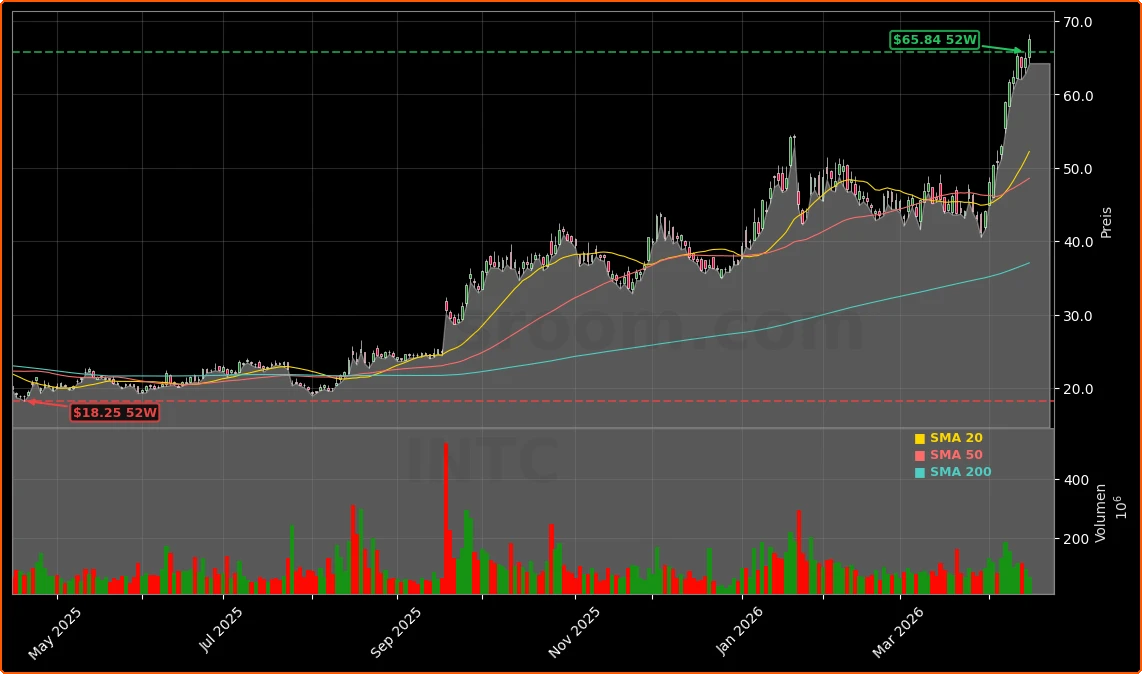
Intel (INTC) closed at $67.55 on Thursday, up 4.0% on the day and roughly 50% above its March recommendation level, extending a powerful rally that has seen the stock climb about 76% year to date. From a trough near $19, the shares have advanced close to 200%, taking the company toward all‑time highs and putting it back among the more closely watched semiconductor names on the NASDAQ and in the S&P 500. The chart shows a classic pattern: a long base, consolidation and then a breakout above a short‑term downtrend that came after a nine‑session winning streak earlier this week.
This surge comes ahead of Intel’s Q1 2026 earnings report, slated for Thursday, April 23, after the bell. Consensus on Wall Street looks for around $12.3 billion in revenue and a modest profit, a crucial test of whether the operational side can catch up with the share‑price euphoria. At roughly 122 times forward earnings, Intel trades on a far richer multiple than AI favorite NVIDIA, which sits near 23 times forward estimates, raising the bar for execution under the current Intel Strategy.
How do Musk and Google reshape Intel Strategy?
The rally has been fueled in part by a string of headline‑grabbing deals that reposition Intel at the center of AI and high‑performance computing. The most eye‑catching is Intel’s participation in Terafab, an ambitious fabrication initiative launched by Elon Musk to supply chips for Tesla, SpaceX and xAI. By aligning with Musk’s vertically integrated AI ecosystem, Intel signals that its foundry and design capabilities are again relevant to frontier workloads, not just legacy PC processors.
At the same time, Alphabet’s Google has agreed to deploy Intel CPU chips in its data centers, a vote of confidence from one of the world’s largest cloud and AI players. The arrangement strengthens Intel’s foothold in hyperscale infrastructure at a time when power‑hungry AI clusters threaten to reshape data‑center architectures globally. Together, these partnerships suggest the Intel Strategy is shifting from defense to offense, targeting both leading‑edge manufacturing and the AI compute stack.
Adding to that, Intel has moved to repurchase the 49% stake in its Ireland fabrication facility previously sold to Apollo. Buying back that interest consolidates control of a key European hub at a moment when geopolitical diversification of chip production is a strategic priority for the U.S. and EU alike. It also signals management’s confidence in cash‑flow durability, even as capital expenditures remain heavy.
How does Intel compare to other AI chip leaders?
The broader AI boom continues to provide a rising tide for the entire semiconductor complex. Strong guidance from Taiwan Semiconductor Manufacturing has helped improve sentiment toward NVIDIA, Intel and other data‑center suppliers, easing fears that higher energy costs could derail demand for AI‑oriented server farms. Investors are increasingly treating Intel as a leveraged rebound play within that theme, after years of underperformance against NVIDIA and Advanced Micro Devices.
Competition, however, remains intense. AMD is pushing hard in data‑center CPUs and accelerators; Qualcomm is chasing on‑device AI in smartphones, PCs and autos; and specialized equipment and software providers such as Lam Research, Teradyne and PDF Solutions are capturing the capex wave behind the scenes. Some large investors are choosing to gain diversified exposure via products like the SPDR S&P Semiconductor ETF instead of single‑stock bets on Intel’s turnaround.
Within consumer tech, Intel also intersects with giants like Apple, whose in‑house silicon shift underscored the risk of key customers vertically integrating. The new Intel Strategy is thus not just about winning AI sockets today, but about building a resilient, multi‑customer foundry and design business that can compete even as more system companies follow Apple’s path.
What are analysts and derivatives markets signaling?
On Wall Street, the picture is mixed despite the share‑price surge. MarketBeat data show a consensus rating around “Hold” for Intel, reflecting excitement about AI and foundry opportunities tempered by valuation and execution risk. Several banks, including firms like Goldman Sachs and Morgan Stanley, have raised their price targets in recent weeks to reflect the improved sentiment, while still cautioning that the stock now embeds a significant amount of future success.
Derivatives and structured‑product markets echo this two‑sided view. Nomura recently priced Intel‑linked autocallable notes that pay a contingent coupon of 15.75% annually as long as the stock stays above $31.91 and can be called away early if it trades at or above $63.81. With Intel now above that automatic call level, these notes highlight both how far the shares have run and how sensitive some investors are to a potential pullback.
Institutional holders are also watching governance and geopolitical factors closely. For example, shareholder advocacy around Intel’s operations in Israel is intensifying ahead of the May 13 annual meeting, underlining how the company’s global footprint can intersect with ESG debates—an additional layer of complexity for the Intel Strategy as it expands manufacturing in multiple regions.
Related Coverage
For a deeper dive into how management aims to reposition the company within the AI value chain, see “Intel AI Strategy Boom: Is This Comeback for Real?”, which analyzes whether the new Intel Strategy can translate today’s momentum into durable earnings growth. Investors looking to compare cross‑border tech pivots can also read “Alibaba AI Strategy +4.8% Surge as Cloud Pivot Deepens”, exploring how another tech giant is leveraging AI and cloud shifts to pursue a rerating on global markets.
In the end, the Intel Strategy now rests on three pillars: winning marquee AI and cloud customers, scaling a globally diversified foundry network and converting today’s narrative into sustainable earnings power. For U.S. investors, the stock’s sharp move and stretched multiple argue for careful position sizing and close attention to the upcoming Q1 report. If Intel can back up the headlines with hard numbers, the comeback story could have further to run; if not, today’s high expectations may prove difficult to sustain.