Can the revamped Intel AI Strategy really turn a lagging chip giant into a long-term winner of the next AI cycle?

Is Intel now an AI comeback play?
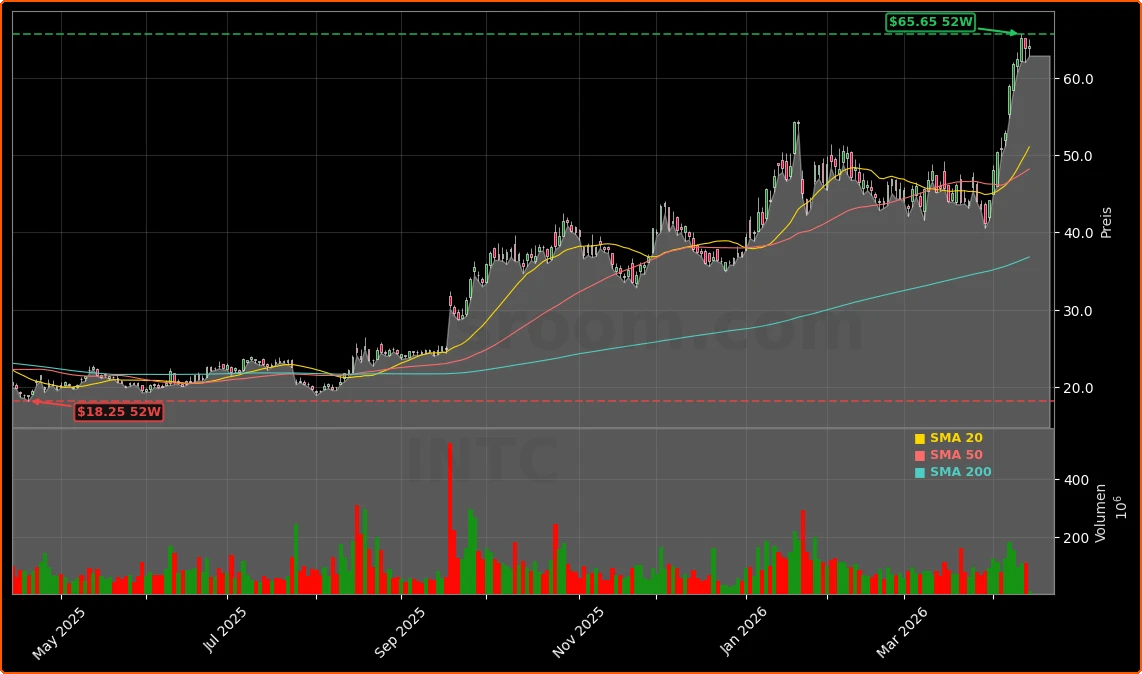
Intel shares have ripped higher, extending a powerful run that recently included a nine‑session winning streak and a roughly 41% surge between March 31 and April 10, vastly outperforming the S&P 500. Even after a small pullback, the stock hovers near fresh 52‑week highs and remains up about 220% year over year. At roughly $64, Intel is still below its dot‑com peak above $75 set in 2000, but sentiment has flipped from despair to fear of missing out as investors position for a potential multi‑year AI cycle.
The bull case rests on a simple idea: the Intel AI Strategy can transform a once‑stagnant PC CPU giant into a core infrastructure supplier for the next decade of AI demand. New CEO Lip‑Bu Tan has slashed more than 20,000 jobs, stabilized free cash flow after a cumulative negative $44 billion stretch from 2022 to 2025, and is refocusing the company on manufacturing execution and AI‑centric products. Bulls argue that if Intel can restore margins and win key AI design slots, today’s elevated valuation could be absorbed by much faster earnings growth later in the decade.
How central is Nvidia to Intel’s AI plans?
A cornerstone of the Intel AI Strategy is its expanding relationship with NVIDIA. In September, Nvidia invested $5 billion in Intel and tapped the company to build custom x86 server CPUs that integrate tightly with Nvidia’s AI accelerators and networking stack. The logic is straightforward: GPUs from Nvidia are extremely expensive, and pairing them with cost‑effective, high‑volume Intel CPUs can optimize total system cost for hyperscale data centers.
Intel is already sold out on certain AI‑related products into 2026, putting it in the same conversation as Nvidia and AMD in terms of forward demand visibility. On the PC side, Intel plans to combine its CPUs with Nvidia GPU chiplets to deliver AI‑enhanced client systems, while in the data center Nvidia will couple its infrastructure with tailor‑made Intel server CPUs. This gives Intel a second chance in AI infrastructure after missing the initial GPU wave and positions x86 CPUs as indispensable companions to GPU‑heavy clusters.
The partnership also has portfolio implications: Nvidia itself now holds a substantial stake in Intel as part of its AI infrastructure exposure, underscoring how intertwined the two companies have become even as they still compete in some segments.
Can manufacturing and foundry catch up?
Intel’s AI ambitions will live or die on its ability to fix manufacturing. The company lost process leadership to TSMC back in 2017 and has since ceded share in PCs and servers to AMD and Arm‑based designs used by Apple and major cloud providers. Yields on Intel’s newest nodes are estimated around 70%, well below the roughly 90% level achieved by Taiwan Semiconductor, depressing margins and forcing Intel to outsource about 30% of its wafers to its rival.
To reverse that, Intel is doubling down on its foundry and fab network. It is reacquiring the remaining 49% stake in its Fab 34 joint venture in Ireland from Apollo Global Management for about $14.2 billion, regaining full control of a key EU manufacturing hub for advanced chips aimed at AI and next‑gen data centers. Management expects the deal to become accretive to earnings per share from 2027 onward, a critical milestone for a business that has been bleeding cash.
At the same time, Intel Foundry is targeting external customers and aims to surpass Samsung as the second‑largest contract manufacturer by 2030. The challenge is steep: Intel has yet to land major external wins on its cutting‑edge 14A node, and Arm‑based players continue to gain traction. For now, the market is giving Tan time to prove that Intel can hit process roadmaps and scale yields, but patience will not be infinite.
What does valuation say after the spike?
The biggest pushback to the Intel AI Strategy today is price. Shares trade around 90–100 times next‑twelve‑month earnings, well above their prior peak multiple of about 60x and richer than many peers including NVIDIA, TSMC and Broadcom. Wall Street consensus pegs 2026 earnings per share at roughly $0.50, down sharply from almost $5.50 in 2021, as Intel digests heavy capex and low yields.
Yet some analysts argue that depressed earnings make current multiples misleading. Bulls see a path to $7 per share in earnings by 2029 as margins normalize and AI‑driven revenue ramps. At a more standard semiconductor multiple of about 22x forward earnings, that would justify a stock price near $150, more than double today’s level. Barron’s recently highlighted this upside scenario, while Melius Research’s Ben Reitzes upgraded Intel to Buy in January with a $75 price target, citing explosive x86 server CPU demand for AI workloads.
Even after the rally, Intel’s roughly $320 billion market cap still trails AMD’s ~$415 billion despite higher current sales, and remains far below the trillion‑dollar valuations now attached to top AI names. That size gap is part of the opportunity the bulls are chasing, but it also sets a high bar for execution.
Related Coverage
For a deeper dive into how Intel’s partnerships with Google Cloud and Elon Musk’s “Terafab” venture are reshaping its AI positioning, see this analysis on Intel AI partnerships and the recent share price surge. For broader sector context on how AI demand is driving capex and tool orders across the chip ecosystem, including key suppliers to Intel’s fabs, read our coverage of record ASML earnings and its upgraded 2026 outlook.
If they get things right, the payoff is huge.— Krishna Chintalapalli, Parnassus portfolio manager
In the end, the Intel AI Strategy has turned the stock into one of the market’s most controversial AI comeback plays: richly valued, but finally backed by a coherent roadmap and heavyweight partners. For US investors, the key question is whether Intel can translate its manufacturing and AI ambitions into sustained earnings power before the cycle turns. The next few quarters of yield progress, AI design wins and foundry customer announcements will determine whether Intel remains a high‑beta trading vehicle or evolves into a durable core holding for the AI decade.