Can the latest ASML Earnings and upgraded 2026 outlook keep powering the AI chip boom, or is investor optimism running ahead of reality?

How strong were the ASML Earnings this quarter?
ASML Holding N.V. reported Q1 2026 total net sales of EUR 8.8 billion, roughly in line with expectations and within its prior guidance band. Gross margin came in at 53.0%, landing at the top end of management’s forecast and improving from 52.2% in Q4 2025. Net income reached EUR 2.8 billion, with basic EPS at EUR 7.15, up from EUR 6.00 a year earlier, underscoring solid operating leverage despite a sequential dip in revenue versus the prior quarter.
The ASML Earnings report showed 67 new lithography systems and 12 used systems shipped in the period, down from 94 and 8 respectively in Q4 2025 as the mix shifted and customers adjusted delivery timing. Installed Base Management sales, which include upgrades and services, climbed to EUR 2.49 billion from EUR 2.13 billion, highlighting the importance of recurring and upgrade-driven revenue as fabs push existing tools harder to meet AI-related demand.
From a balance-sheet perspective, end-quarter cash and short-term investments fell to EUR 8.38 billion from EUR 13.32 billion, reflecting heavy capital returns and ongoing investment. The company also continued its shareholder-friendly stance, repurchasing around EUR 1.1 billion of shares under its 2026–2028 buyback program and confirming its intention to pay a total dividend of EUR 7.50 per share for 2025, a 17% increase year over year.
What changed in ASML’s 2026 guidance?
The headline from the ASML Earnings release is a clear upgrade to the 2026 outlook. Management now expects full-year total net sales between EUR 36 billion and EUR 40 billion, up from the prior EUR 34–39 billion range. The anticipated gross margin is 51–53%, broadly in line with earlier commentary but confirming a structurally higher profitability profile as EUV and advanced DUV tools dominate the mix.
For Q2 2026, ASML guides net sales to EUR 8.4–9.0 billion, with a gross margin of 51–52%. While still robust, that mid-point is slightly softer than some analysts had penciled in, which helps explain the initially muted share reaction despite the stronger full-year view. R&D expenses are projected around EUR 1.2 billion and SG&A about EUR 0.3 billion, underscoring the company’s continued heavy investment in next-generation lithography platforms.
CEO Christophe Fouquet emphasized that demand for chips “continues to outpace supply” and that customers are accelerating capacity expansion plans for 2026 and beyond, backed by long-term agreements with hyperscalers and leading chip designers. He also stressed that the widened revenue range for 2026 is designed to accommodate potential outcomes from ongoing export-control discussions, particularly around shipments to China.
How are AI and U.S. tech giants driving demand?
The ASML Earnings backdrop is dominated by a global AI arms race. Spending on AI data-center infrastructure by companies like Microsoft, Alphabet, and fast-growing model developers is feeding record demand for advanced GPUs and high-bandwidth memory. ASML’s EUV and high-end DUV systems are critical for manufacturing leading-edge logic and DRAM chips powering NVIDIA accelerators and high-end processors used across cloud and edge workloads.
Key customers such as TSMC, Samsung Electronics, and SK Hynix have announced aggressive capex plans, with TSMC targeting up to $56 billion in investment this year and SK Hynix planning roughly $8 billion in purchases of ASML tools through 2027. For U.S. investors, this means ASML sits upstream of many NASDAQ favorites and provides a leveraged way to play the structural AI buildout, even though the stock trades in Europe and on NASDAQ as an ADR.
At the same time, geopolitical risk is not going away. Export restrictions from the U.S. and the Dutch government are already limiting sales of advanced DUV and blocking EUV shipments to China. New proposals in Washington could further curb immersion DUV tools and even restrict servicing certain installed systems. ASML has indicated it expects China’s share of total revenue to fall to around 20% over time, down from 36% of net system sales in Q4 2025.
How is Wall Street valuing ASML after these results?
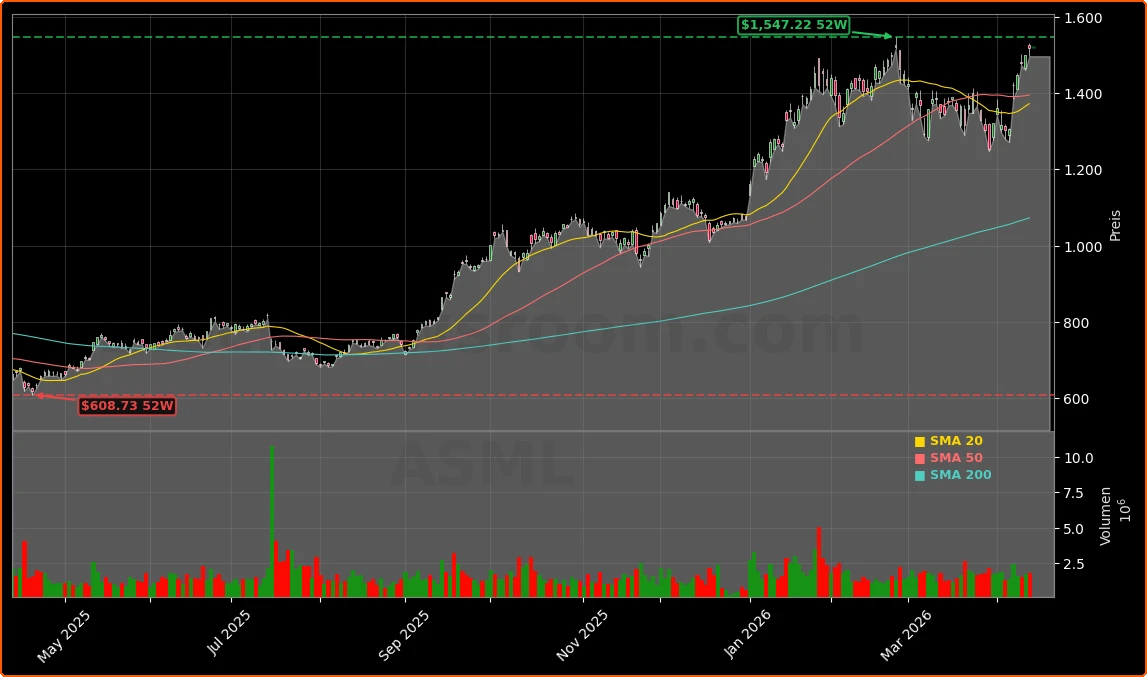
The ASML Earnings have landed as the stock trades near its 52-week high, with U.S.-listed shares recently around $1,518, up sharply year-to-date. That strength is drawing mixed reactions from analysts. Jefferies reiterated a “Hold” rating and kept its EUR 1,260 price target, flagging the combination of a rich P/E multiple and Q2 guidance that sits below prior consensus. In contrast, UBS maintained a “Buy” with a EUR 1,500 target and Cantor Fitzgerald’s C.J. Muse reaffirmed a “Buy” and set a EUR 1,600 target, pointing to ASML’s near-monopoly in EUV and long-term EPS growth potential.
Other research shops and institutional investors remain broadly constructive. UBS has labeled ASML a European leader in AI and high-performance computing exposure, while BofA Securities has highlighted the company as a top semiconductor pick into 2030. On the fund side, some managers such as Timber Creek Capital Management have initiated new positions, even as others trim allocations after a strong run. For U.S. portfolios already heavy in mega-cap chip designers and device makers like Apple and Tesla, ASML offers diversification into the critical equipment layer, though volatility and policy risk are key considerations.
Related Coverage
Investors looking for more background on ASML’s technology edge and risk profile can revisit our deep dive on EUV tools in “ASML EUV Technology -3.7% Plunge as AI Demand Soars”, which examines how its monopoly position intersects with export controls and valuation swings. For a broader view of how high-growth tech names can correct sharply and then rebound, the adtech-focused analysis “AppLovin Forecast: +3.8% Rally After a 50% Crash Shock” offers useful parallels on sentiment whiplash and recovery potential in software and platform stocks.
The semiconductor industry’s growth outlook continues to solidify, driven by ongoing AI-related infrastructure investments. Demand for chips is outpacing supply.— Christophe Fouquet, CEO of ASML Holding N.V.
In summary, the latest ASML Earnings underscore a company executing well in the middle of an AI-driven capex supercycle, with upgraded 2026 guidance and rising dividends reinforcing its quality profile. For U.S. investors, ASML remains a strategic, if volatile, way to gain upstream exposure to the same AI trends powering NVIDIA and other NASDAQ leaders. The next few quarters will show whether management can navigate export risks and sustain double-digit growth, but for long-term portfolios focused on semiconductors, ASML’s combination of technology leadership and shareholder returns is hard to ignore.