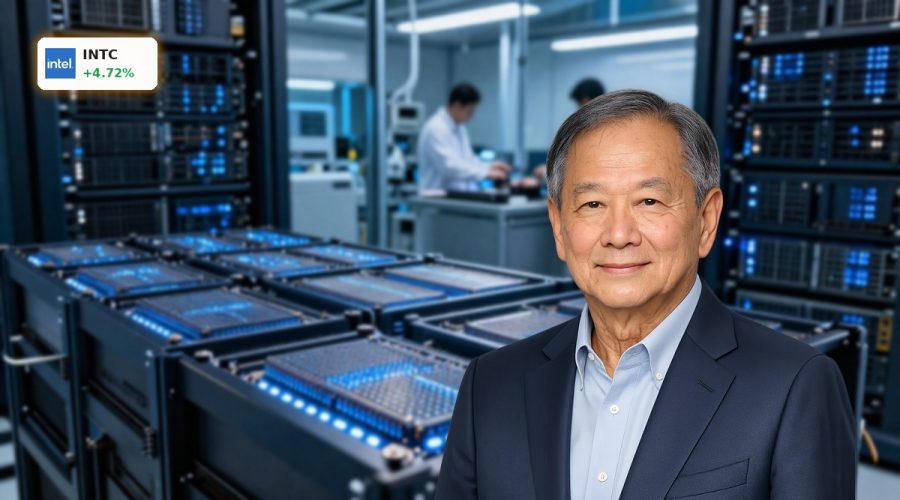

Are Intel AI Partnerships with Google and Elon Musk enough to turn a short squeeze into a lasting Wall Street comeback?

Can Intel’s AI surge outlast the rally?
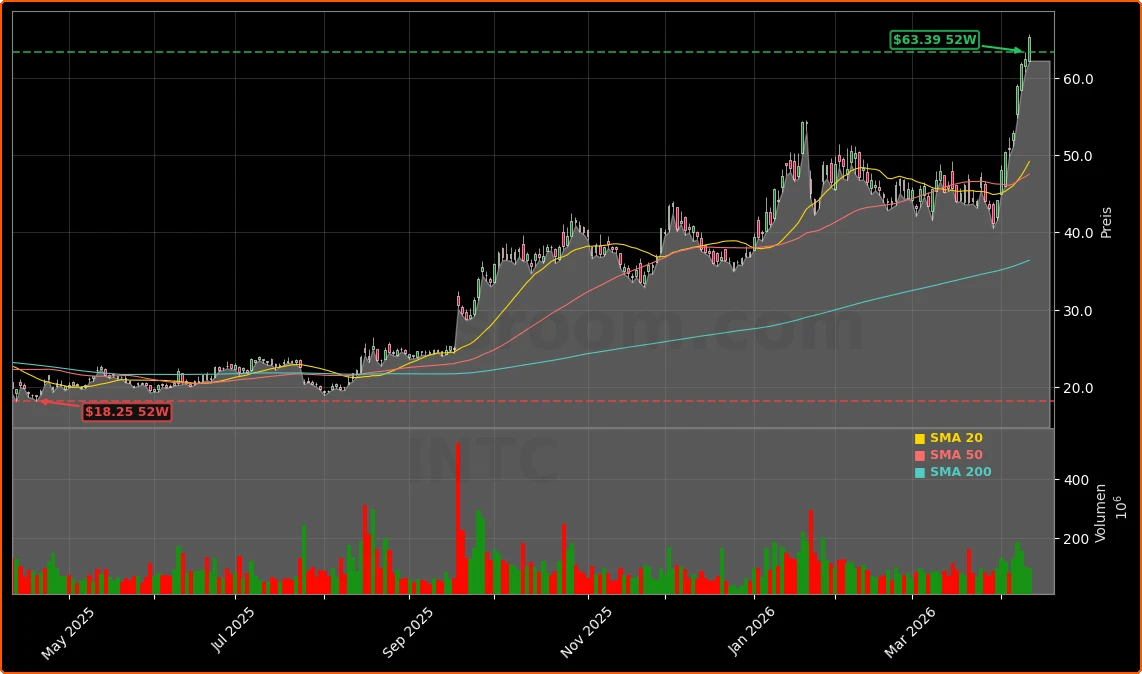
Intel Corporation extended its remarkable run on Monday, adding to a roughly 56% gain over the past nine trading days and closing at $65.33, up 4.72% from Friday’s $62.40. The stock has added about $100 billion in market capitalization over this stretch, helping lift the Philadelphia Semiconductor Index and positioning Intel near the upper end of its 52-week range, though still below all-time highs. Traders on Wall Street are debating how much of the move is driven by short covering versus a genuine re-rating on the back of Intel AI Partnerships and a renewed manufacturing strategy.
The rally comes after years in which Intel lagged high-fliers like NVIDIA and Advanced Micro Devices, losing share in key markets and sacrificing its dividend amid heavy capital spending. Under CEO Lip-Bu Tan and the IDM 2.0 strategy, the company is now pitching itself as both a leading CPU designer and a contract manufacturer, with AI as the core growth engine.
How do Intel AI Partnerships with Google change the game?
A key driver behind the latest move is the expanded AI infrastructure agreement with Google parent Alphabet. Google will deploy Intel’s newest Xeon 6 CPUs to handle AI training and inference workloads in its cloud, bolstering Intel’s relevance in hyperscale data centers at a time when GPUs from NVIDIA dominate headlines. Multiple institutional filings in recent weeks highlight this collaboration as a positive catalyst for both sides, with asset managers citing the Google-Intel AI partnership as a reason for optimism around Alphabet’s infrastructure and Intel’s CPU roadmap.
This deal matters because CPUs have increasingly been criticized as the bottleneck in complex AI and so-called agentic workflows. Dion Harris, who leads AI infrastructure at NVIDIA, recently warned that CPUs were lagging the rapid pace of accelerator innovation. Intel’s counter is that its Xeon 6 platform, combined with its manufacturing roadmap, can rebalance the AI stack in its favor and make Intel AI Partnerships with cloud leaders like Google an important hedge for investors who are overexposed to GPU-centric names.
What does Terafab mean for Elon Musk and Intel?
At least as eye-catching for Wall Street is Intel’s decision to join Elon Musk’s Terafab project, an ambitious AI chip complex planned for Austin, Texas. Terafab aims to design and manufacture custom chips for SpaceX, xAI, and Tesla, with a stated goal of delivering 1 terawatt per year of compute for AI and robotics. Intel posted a photo of Lip-Bu Tan standing alongside Musk, touting its ability to design, fabricate, and package ultra-high-performance chips at scale as a core contribution to Terafab’s mission.
Strategically, this deepens Intel’s presence in the broader Musk ecosystem, which already includes space-related work with SpaceX. For investors, Terafab positions Intel as a critical partner in one of the most aggressive AI build-out plans globally, potentially opening a multi-year stream of custom silicon orders. However, some analysts caution that such large bespoke projects carry execution and capital-intensity risks, especially for a company still working through the financial strain of recent fab investments.
Is Intel’s manufacturing pivot finally paying off?
Beyond headline Intel AI Partnerships, the company is working to reestablish itself as a top-tier foundry. Earlier this month, Intel repurchased the remaining 49% stake in its Ireland fabrication plant for $14.2 billion, reversing a 2024 transaction and signaling renewed balance sheet confidence. The fab is central to Intel’s cutting-edge 18A process and future 14A node, both critical to securing external foundry customers and meeting its own AI chip ambitions.
Recent research notes describe a “Great Silicon Resurgence,” highlighting Intel’s progress in 18A, the ramp of advanced packaging, and potential CHIPS Act tailwinds for U.S. manufacturing. The U.S. government’s earlier move to take a 10% equity stake underscored Intel’s role as the only domestic company currently capable of producing the most advanced chips onshore, a strategic advantage amid rising geopolitical risk and supply chain scrutiny.
How does Intel stack up against NVIDIA and AMD now?
For U.S. investors, the key comparison remains Intel versus NVIDIA and AMD. Both rivals outsource production to foundry partners, while Intel designs and manufactures in-house. That vertical integration is capital-intensive, but it gives Intel tighter control over cost, capacity, and customization for large customers like Google and Elon Musk’s Terafab. The growing web of Intel AI Partnerships is intended to monetize that structure and close the performance and valuation gap with faster-growing peers.
Valuation, however, is still contested. Intel trades near a 12‑month high, and some institutional holders have recently trimmed positions, pointing to lingering execution risk and uncertainty about long-term margins in foundry services. Several Wall Street firms, including houses that acknowledge the AI upside, continue to rate the stock cautiously, with consensus skewing toward “Reduce” and conservative price targets until yield and cost metrics on new nodes are more fully proven.
Related Coverage
For a deeper dive into Intel’s capital allocation and manufacturing reset, including the Irish fab buyback, read our recent analysis “Intel Strategy Boom: Irish Fab Buyback Marks Bold AI Pivot”, which explores whether this is the start of a sustained AI-driven comeback or another cyclical spike. Investors also looking beyond chips should consider how demand for AI compute feeds into software and data platforms; our coverage of Palantir in “Palantir Earnings +70%: Record AI Boom vs. Rich Valuation” examines how surging AI workloads impact valuation debates across the broader tech sector.
In sum, the latest leg of Intel AI Partnerships with Google and Musk’s Terafab, combined with a sharpened foundry strategy, has reignited belief in Intel as a serious contender in the next AI hardware cycle. For U.S. portfolios heavily tilted toward pure-play GPU and cloud names, Intel now offers a more diversified way to gain exposure to the build-out of AI infrastructure. The next few quarters of execution on Xeon 6, Terafab, and the Ireland fab ramp will determine whether this rally becomes a durable re-rating or a momentum-driven detour, but for now Intel is firmly back in the AI conversation.