Is Palantir’s AI Defense boom building a durable moat for the stock, or just inflating one of tech’s priciest bubbles?

Is Palantir Technologies becoming a defense AI heavyweight?
On the battlefield and on Wall Street, Palantir Technologies Inc. is increasingly viewed as a core pillar of the next generation of defense infrastructure. The company’s data and analytics platforms, Gotham and Foundry, are being positioned as the digital backbone of U.S. military operations, while its Artificial Intelligence Platform (AIP) powers decision-making for both government and commercial clients.
The centerpiece of the current Palantir AI Defense narrative is a new U.S. Army deal signed for 2025 that could be worth up to $10 billion over 10 years. That agreement, focused on AI-enabled intelligence and operational software, would further entrench Palantir as the data layer of the Defense Department just as Washington prioritizes software and AI modernization in its budget. In parallel, the company has played a prominent role in the U.S. conflict with Iran, with its CTO calling it the first large-scale combat operation truly driven by AI tools.
Former President Donald Trump recently amplified the Palantir AI Defense story, publicly praising the group’s “war-fighting capabilities.” The endorsement helped the stock quickly regain more than $10 billion in market capitalization, but also triggered pushback from Democrats, who raised conflict-of-interest questions as some Trump advisors reportedly hold PLTR shares.
How strong is Palantir’s AI-driven growth?
Behind the headline-grabbing contracts, Palantir’s fundamentals remain firmly in hyper-growth territory. In the latest reported quarter, revenue jumped 70% year over year to about $1.4 billion. Government revenue reached roughly $730 million, up 60%, reflecting both the Iran conflict and growing reliance by U.S. agencies on Palantir’s AI tools.
Even more striking for long-term investors, commercial revenue surged 82% to approximately $677 million, signaling that Palantir AI Defense is only one pillar of a broader AI software platform strategy. In the U.S. commercial segment alone, Wedbush analyst Dan Ives highlighted 137% year-over-year growth and reiterated an Outperform rating with a $230 price target, implying around 60% upside from current levels. He argues Palantir remains a “long-term winner” in AI software as enterprises rush to embed decision-making AI in their operations.
Other Wall Street firms are more measured. Morgan Stanley’s Sanjit Singh recently stated that Palantir has a “strong setup” heading into earnings, citing robust AI demand and adoption by large customers, but he maintains a Hold rating with a $205 price target and a more moderate path to $10 billion in annual revenue. Consensus on the Street currently sits around a “Moderate Buy,” reflecting a tug of war between bulls focused on AI optionality and skeptics wary of valuation.
Are Palantir’s valuation and balance sheet compatible?
Palantir’s financial profile is a study in contrasts. On one hand, the company is now consistently profitable, posting Q4 net income of about $612 million versus $77 million a year earlier. It ended 2025 with $8.9 billion in total assets, including $1.4 billion in cash and $5.8 billion in marketable securities, and carries essentially no debt. Its debt-to-equity ratio of roughly 0.03 stands out as far more conservative than most software peers, giving management ample flexibility for R&D and potential acquisitions.
On the other hand, the stock is priced for near-perfection. Palantir trades at a price-to-earnings ratio around 226.6, over three times the software industry average near 73. Its price-to-sales ratio of roughly 81.8 is more than nine times the peer average and arguably one of the richest among large-cap software names, even more expensive than fast-growing cloud players and AI beneficiaries such as NVIDIA. Price-to-book above 46 likewise dwarfs sector norms.
Return on equity around 8.7% slightly beats the industry average, and revenue growth of 70% massively outpaces the roughly 23% sector mean. However, EBITDA and gross profit still trail peer averages in absolute terms, underscoring that the Palantir AI Defense premium is based more on future growth and strategic positioning than current operational efficiency. As a result, some institutional investors have turned cautious, with short-selling activity in defense-focused ETFs increasing as traders question whether names like Palantir and RTX have run ahead of fundamentals.
What does Palantir’s chart say about risk and timing?
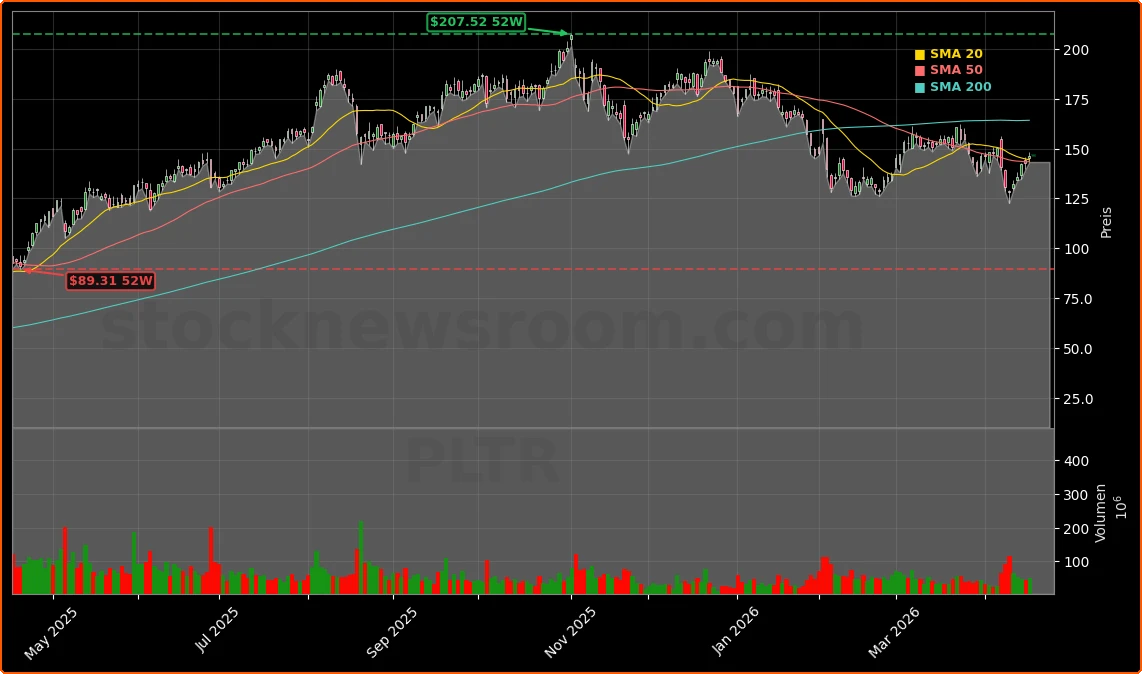
Technically, PLTR is trading within its 52-week range of $89.31 to $207.52, recently bouncing off support around $126.50 after a sizeable pullback from its November 2025 peak. The stock now sits just under its 20-day simple moving average and nearly 9% below its 100-day SMA. A death cross in February, where the 50-day SMA dipped below the 200-day SMA, remains an overhang for short-term traders even as the 20-day has reclaimed the 50-day.
For momentum-focused investors, the immediate line in the sand is the $150 level. Technical commentary suggests Palantir needs to retake and hold that zone to signal a new leg higher, with resistance seen near $162. Until that happens, some traders are using options strategies, including new PLTR-focused income ETFs, to harvest premium while the stock consolidates. Others are outright shorting or hedging through defense-sector ETFs, betting that any further easing of Middle East tensions could reduce the near-term Palantir AI Defense tailwind.
How does Palantir stack up in the broader AI race?
In the larger AI ecosystem, Palantir sits alongside infrastructure providers like NVIDIA and application-layer innovators such as Apple and Tesla, but it is carving out a distinct niche in mission-critical decision intelligence. At events like the Space Symposium 2026, Palantir is increasingly mentioned in the same breath as SpaceX and L3Harris as defense and space technologies converge around data and AI.
The company is also extending its AI reach far beyond defense. Long-term commercial deals with Stellantis, GE Aerospace and fintech partners show how Palantir AIP is being embedded into automotive, aerospace and financial workflows. That diversification matters for U.S. investors worried that Palantir AI Defense demand could fade once the Iran conflict stabilizes or a future administration recalibrates defense tech priorities.
Still, the market’s current pricing assumes Palantir can convert today’s wartime visibility and AI leadership into durable, multi-sector dominance. Any slowdown in 2026 revenue growth toward more traditional software levels could challenge that thesis and compress multiples quickly.
Related Coverage
For a deeper dive into how Pentagon spending could shape Palantir’s trajectory, including scenarios where the Palantir AI Defense narrative either solidifies or unravels, see this detailed analysis of Palantir’s AI defense strategy and recent rally. Investors interested in how regulation and headline risk can abruptly reprice high-growth fintech and trading platforms may also want to read our coverage of Robinhood’s sharp move following a surprise SEC decision, which offers useful parallels for sentiment swings in richly valued tech names.
We are still at the very start of things. This remains the beginning, the first moment of a first chapter.— Alex Karp, CEO of Palantir Technologies Inc.
In the end, Palantir AI Defense has elevated the company into a rare class of software vendors that directly influence national security, giving it powerful contracts, a fortress balance sheet and exceptional growth. For U.S. investors, the opportunity now hinges on whether that advantage can justify a valuation that already assumes years of flawless execution. The next few earnings reports and contract announcements will show if Palantir can grow into its price or if today’s premium leaves little margin for error.