Can Morgan Stanley’s record trading quarter and wealth inflows really justify a 4.5% stock surge, or is optimism running hot?

How did Morgan Stanley Earnings move the stock?
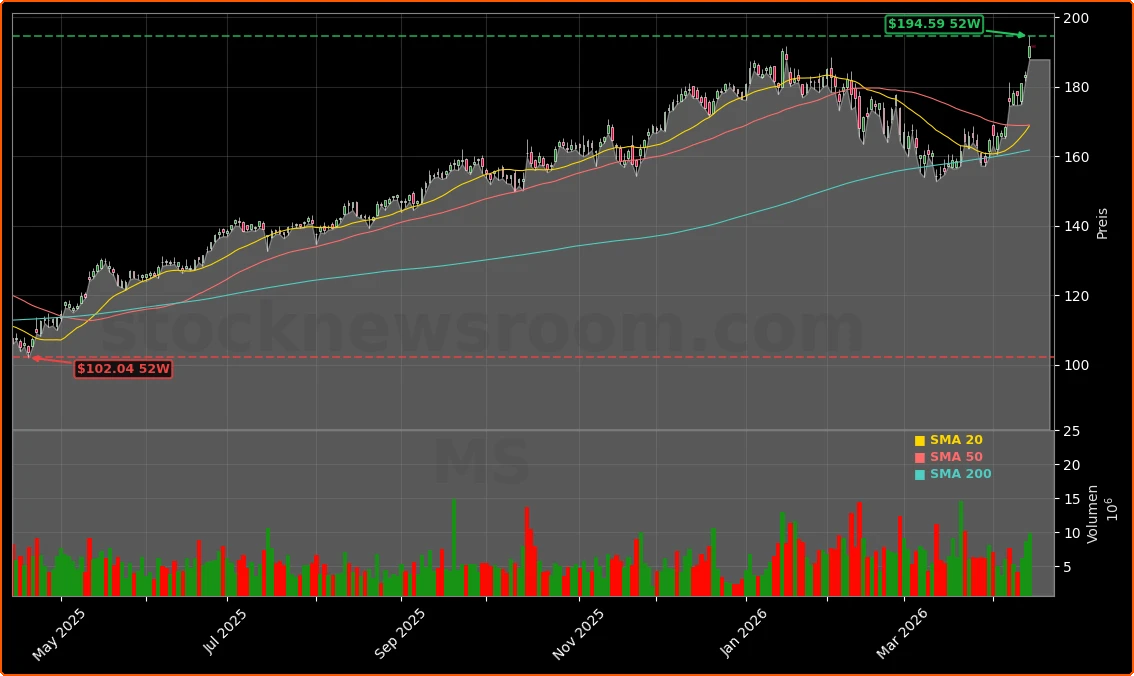
Morgan Stanley Quartalszahlen und Rekord-Handelsergebnisse for the first quarter of 2026 gave the stock a clear boost on Wall Street. Shares of Morgan Stanley (MS) recently traded around $191.62, up about 4.5% on the earnings reaction day, modestly below the prior close of $191.80 but still reflecting a strong post-report rally of roughly +4.52%. Pre-market indications at $191.45 (-0.09%) suggest some consolidation after the initial jump, yet the stock remains firmly supported by investors reassessing growth and profitability.
Valuation remains a key part of the Morgan Stanley Earnings story. The bank is expected to grow profit by roughly 11.7% this year and trades at less than 17 times estimated 2026 earnings per share, a notable discount to the S&P 500’s price-to-earnings ratio near 22. For portfolio managers benchmarking against the index, Morgan Stanley offers cyclical upside, exposure to capital markets and wealth management, and still trades at a valuation that looks undemanding relative to high-multiple technology leaders such as NVIDIA and Apple.
Against that backdrop, the latest Morgan Stanley Earnings have reinforced the view that major U.S. banks are not just rate plays but also beneficiaries of robust trading, advisory fees and asset-gathering, especially when market volatility picks up.
What drove the record trading performance at Morgan Stanley?
The highlight of the quarter was equity trading. Morgan Stanley reported record equity trading revenue of about $5.15 billion in Q1 2026, comfortably ahead of Wall Street expectations near $4.78 billion. This record print underscores the bank’s strength in cash equities, derivatives and structured products, and it helped lift overall results well above consensus.
Management pointed to heightened volatility across asset classes – stocks, fixed income, currencies and commodities – particularly toward the end of March. This backdrop spurred higher client activity and wider bid-ask spreads, boosting trading income across the Institutional Securities division. Fixed-income, currencies and commodities (FICC) trading also contributed meaningfully, though the biggest headline came from equities.
Beyond trading, corporate finance and capital markets showed clear signs of life. Investment-banking fees rose about 36% year over year as the bank tapped into a recovering environment for mergers and acquisitions and selective equity and debt issuance. With Wall Street deal activity beginning to resemble the more vibrant backdrop of 2025, Morgan Stanley’s franchise in advisory and underwriting again looks like a core profit driver rather than a drag.
How important is wealth management for Morgan Stanley Earnings?
If trading is the high-octane driver, wealth management is the ballast in the Morgan Stanley Earnings engine. The firm’s wealth business attracted roughly $118 billion in net new assets in the quarter, with some reports putting the figure at $118.4 billion. That significantly exceeded internal and external expectations and highlights the bank’s success in cross-selling solutions to high-net-worth and ultra-high-net-worth clients globally.
The steady, fee-based revenues from this segment help smooth earnings versus more volatile trading income. For long-term shareholders, the rapid compounding of assets under management is crucial: larger asset pools translate into higher recurring fees and more opportunities to offer lending, capital markets access and alternative investments. In an era when ultra-large tech names like Tesla can introduce pronounced volatility to growth-heavy portfolios, some investors see Morgan Stanley’s wealth business as a stabilizing counterweight within the financials allocation.
CEO Ted Pick emphasized that the firm’s limited exposure to the $1.8 trillion private-credit market is not a systemic risk for the bank. He described private credit as going through a “learning moment” or adolescence, highlighting that returns are likely to diverge sharply among asset managers. Importantly, banks have been reviewing their credit books – especially in software – and currently do not see broad-based stress that would require material reserve builds.
What are the risks and macro drivers after Morgan Stanley Earnings?
Macro conditions remain central to how investors interpret Morgan Stanley Earnings. Inflation in the U.S. has stayed above the Federal Reserve’s 2% target for several years, keeping policy rates elevated. However, economists at major institutions, including those at Morgan Stanley and some European banks, still see a path where price-sensitive U.S. consumers and strong productivity gains help keep inflation in check.
If that scenario plays out, interest-rate cuts in the second half of the year could return to the Fed’s agenda. Lower borrowing costs would tend to support loan demand, deal financing and risk assets more broadly, which would be constructive for both trading volumes and wealth management flows. On the other hand, a re-acceleration of inflation or a sharper economic slowdown could curb risk appetite, dampen IPO and M&A pipelines, and potentially weigh on market-sensitive revenue streams.
Credit quality is another watchpoint. While there have been some high-profile defaults in pockets of private credit and software, banks stress that most of these loans are first-lien and heavily collateralized, with coverage around 98% in many cases. So far, they do not view private credit as a likely catalyst for a systemic downturn, but a sustained deterioration in credit conditions would change that assessment.
Relative to U.S. peers such as Bank of America and other large-cap financials in the S&P 500, Morgan Stanley’s current mix of record trading, rising investment-banking fees and powerful wealth inflows positions the firm near the top of the group on revenue momentum. While specific analyst rating changes were not highlighted, major Wall Street houses such as Goldman Sachs, Citigroup and RBC Capital Markets typically factor this combination of growth, volatility exposure and valuation discount into their calls on the stock.
Private credit is in a kind of adolescence — it has grown like a weed, and we expect a wide dispersion of returns among managers.— Ted Pick, CEO of Morgan Stanley
Overall, Morgan Stanley Earnings underline that the bank has successfully leveraged market volatility and a recovering deal environment while steadily scaling its global wealth platform. For investors building diversified U.S. and global equity portfolios, the stock offers leveraged exposure to capital markets with a growing fee-based backbone. The next set of Morgan Stanley Earnings will show whether record trading and strong asset inflows can be repeated if volatility normalizes and the rate cycle turns, but for now the franchise remains one of Wall Street’s most balanced large-bank stories.