
Is Micron’s latest AI-fueled record quarter enough to justify the stock’s wild swings and sudden pullback?

How is Micron trading after its latest surge?
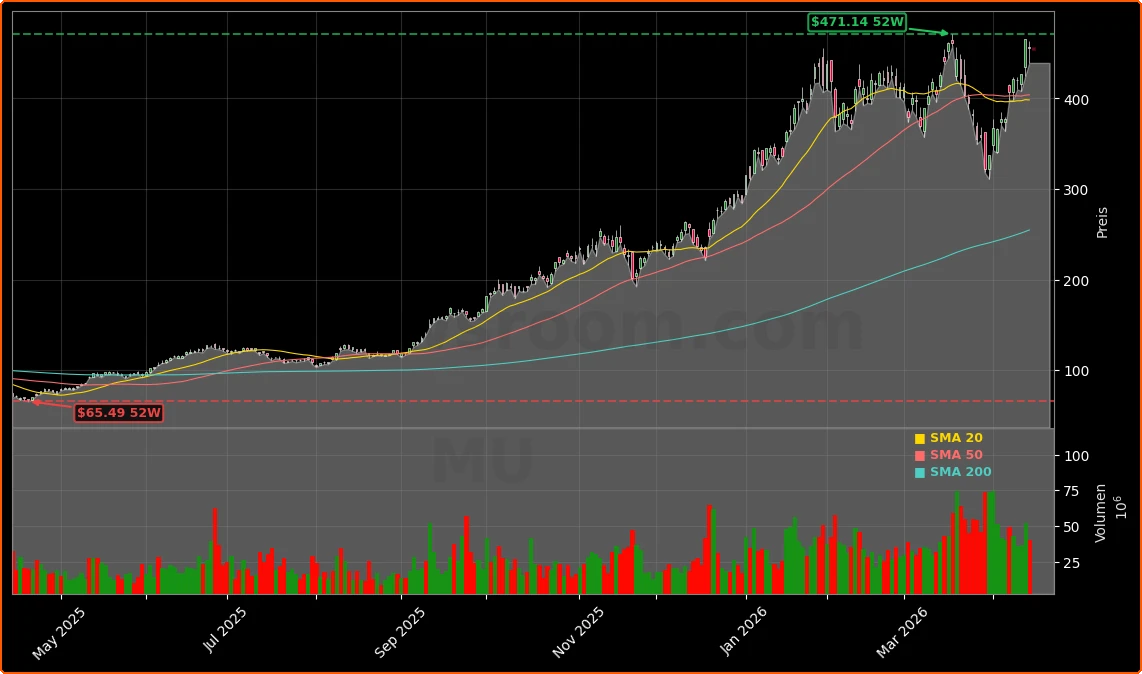
Micron shares closed Wednesday at $456.23, down 2.03% on the day, with after‑hours trading slipping further to $453.77. The move comes less than 48 hours after a sharp rally that pushed the stock back near its recent all‑time highs, completing a dramatic V‑shaped recovery from a prior correction. The current consolidation reflects investors taking profits after one of the most powerful runs in the semiconductor space, even as Micron’s fundamentals tied to Micron AI Demand remain exceptionally strong.
The stock’s volatility stands in contrast to the broader market, where the S&P 500 and Nasdaq Composite traded higher during Wednesday’s session. Micron briefly fell as much as 5% intraday, underperforming many high‑beta AI names and signaling that positioning and valuation, rather than news of weakening demand, are driving near‑term price action.
What is driving Micron AI Demand?
Micron’s fiscal Q1 2026 numbers underscored how central Micron AI Demand has become to the company’s story. Revenue jumped 57% year over year, while non‑GAAP EPS reached $4.78, handily topping Wall Street estimates around $3.94. CEO Sanjay Mehrotra highlighted “record revenue and significant margin expansion,” driven primarily by high‑bandwidth memory (HBM) and data‑center DRAM tied to AI training and inference workloads.
Guidance reinforced the theme. For Q2 FY26, Micron is targeting revenue of $18.70 billion and non‑GAAP EPS of $8.42, implying continued acceleration in AI‑rich segments. Management has indicated that HBM capacity is effectively sold out through 2026, and industry checks suggest Micron’s AI‑grade DRAM and NAND order book stretches even further into 2027. This constrained supply backdrop helps explain why memory stocks such as Micron, SanDisk, Western Digital, and Seagate have started to outperform GPU leader NVIDIA since early 2025, as investors rotate toward companies with direct leverage to AI memory pricing power.
For portfolio managers benchmarked to the Nasdaq or semiconductor ETFs, Micron has become a core way to express a view on AI infrastructure beyond accelerators. Several chip funds now hold Micron as a 6–7% position, alongside heavyweights like NVIDIA and Broadcom, meaning shifts in sentiment around Micron AI Demand can move entire sector products.
Did ASML’s results change the Micron story?
Part of Wednesday’s pressure on Micron followed earnings from ASML, the dominant supplier of EUV lithography tools used to fabricate advanced DRAM and HBM. ASML delivered better‑than‑expected Q1 revenue and EPS and raised its full‑year sales outlook to 36–40 billion EUR, but the market reaction was muted as some investors had hoped for even more aggressive guidance and clarity on China export restrictions.
Because Micron relies on ASML’s EUV systems for its cutting‑edge memory lines, ASML’s updates often act as a sentiment gauge. This time, the read‑through appears more psychological than fundamental. ASML’s outlook for 2026 still aligns with a robust wafer‑equipment cycle, and there was no indication of a break in AI‑driven memory investment. For Micron shareholders, the message is that the current dip likely reflects de‑risking after a huge run rather than a structural reversal in Micron AI Demand.
How are analysts reacting to Micron’s valuation?
Wall Street remains broadly constructive. Out of 43 covering analysts, 38 rate Micron a Buy or Strong Buy, with a consensus price target around $533.73, implying meaningful upside from current levels. KeyBanc Capital Markets recently reiterated an Overweight rating and sees roughly 40% additional upside as HBM and AI data‑center demand continue to surprise to the upside. Other major houses such as Goldman Sachs, Morgan Stanley, and Citigroup have also been raising their targets over recent months as Micron repeatedly beats guidance.
At around $450, Micron trades at a growth‑dependent multiple but still a discount to many AI hardware peers on forward earnings. One prominent analysis at $420 per share argued the stock was priced at roughly 7x forward EPS, attractive for the only U.S. manufacturer with scale in both DRAM and NAND. The key risk, repeatedly cited by analysts, is the historic boom‑bust nature of memory: years of tight supply and high margins can lead to aggressive capacity additions and eventual price pressure if Micron AI Demand normalizes.
What about insider selling and retail sentiment?
Insider activity has caught investor attention. Executive vice president Michael Cordano sold 3,407 shares at roughly $420.81 each, totaling about $1.43 million, while a Micron business chief recently offloaded roughly $10 million in stock near record highs. These transactions have fueled debate over whether management views the current valuation as stretched. However, Wall Street generally sees the sales as standard diversification and compensation‑related activity, particularly after a steep stock appreciation.
Retail and derivatives markets tell a different story: options traders have been treating pullbacks as opportunities to accumulate bullish exposure, and sentiment around Micron remains supportive. Leveraged products such as the Direxion Daily MU Bull 2X Shares ETF have recorded higher volumes on up days, underscoring continued speculative interest in the name.
How does Micron stack up against other AI leaders?
In the broader AI complex, Micron now sits alongside NVIDIA, AMD, and Apple as a central pillar of Wall Street’s AI infrastructure theme. While GPU vendors capture the headlines, Micron’s DRAM, NAND, and HBM products are essential for scaling AI models, including emerging agentic and “physical AI” applications. That makes Micron a complementary holding rather than a direct competitor to GPU names: if AI workloads grow as expected, demand for both compute and memory expands in tandem.
For U.S. investors, this positioning offers a differentiated way to play AI growth. Instead of betting solely on accelerators, Micron provides leveraged exposure to memory pricing, capacity utilization, and data‑center capex cycles. The main challenge will be timing the inevitable normalization when AI capacity growth slows or when new supply finally catches up with Micron AI Demand.
Related Coverage
For a deeper dive into whether Micron’s current strength marks just another memory upcycle or a fundamentally different AI super‑cycle, read “Micron AI Memory Boom: -1.8% Dip as $100B Bet Surges”, which examines long‑term capex and structural demand drivers. To understand how competing infrastructure players are evolving, including GPU and quantum initiatives from sector leaders, see “NVIDIA Quantum AI Boom: Ising Labs Shock the Quantum Race”, which explores how breakthroughs at NVIDIA could reshape the balance between compute and memory in future AI systems.
Micron AI Demand remains the central force behind the company’s record financial performance, even as the stock digests a powerful rally. For long‑term investors, the combination of sold‑out HBM capacity, strong analyst support, and Micron’s unique position in U.S. memory manufacturing keeps the bull case intact despite short‑term volatility. The next few quarters will show whether this AI‑driven memory boom can sustain current margins and validate today’s valuation, making Micron a key name to watch in any AI‑focused portfolio.