Can the latest Robinhood Regulation shock from the SEC turn a trading spike into lasting growth for HOOD investors?

How big was the Robinhood move?
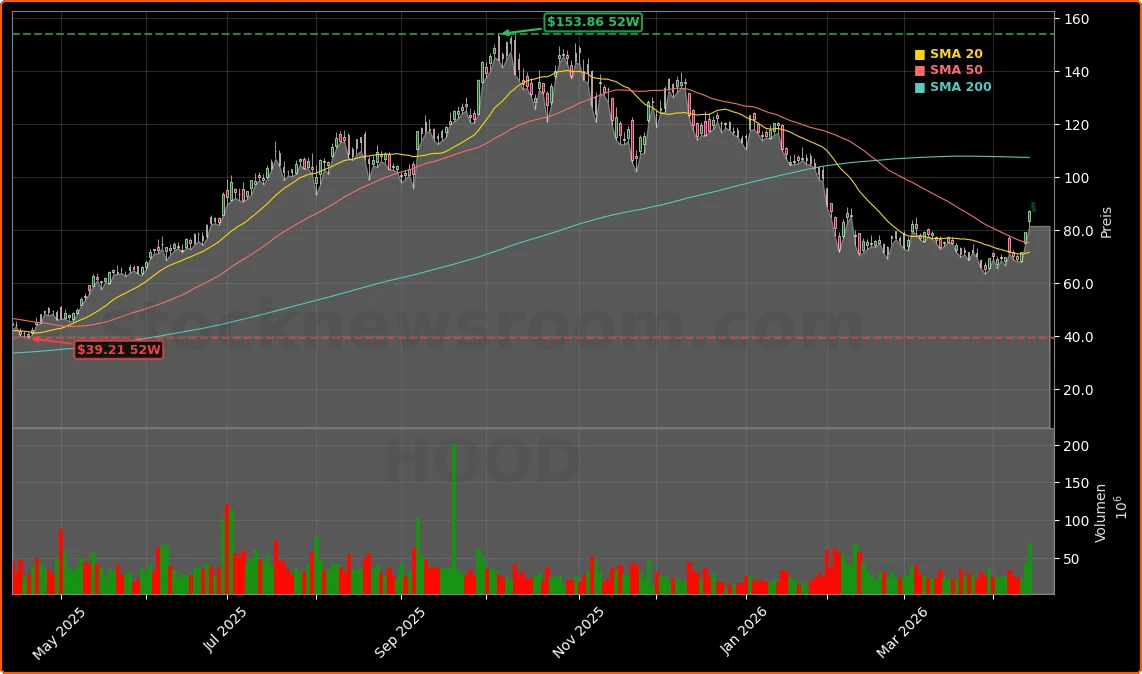
Robinhood Markets, Inc. (HOOD) closed Wednesday at $87.32, up 10.41% on the day, with after-hours trading pushing the stock another 3.36% higher to $90.25. Volume spiked to roughly 68.5 million shares, more than double its recent three-month average around 30.7 million, signaling that institutional traders and retail investors alike are repositioning after the SEC’s surprise shift on day-trading rules. The rally comes after a volatile start to 2026, where the stock had previously suffered a steep year-to-date drawdown before this Robinhood Regulation tailwind arrived.
The move also lands as investors look toward Robinhood’s late-April or early-May earnings report, where management will have to quantify how much incremental volume and revenue they expect from the new regime. With HOOD now up roughly 151% since its 2021 IPO, the stock is trading as a high-beta play on retail risk appetite—closer in sentiment profile to high-growth NASDAQ names like Tesla and NVIDIA than to traditional S&P 500 brokers.
What exactly changed in Robinhood Regulation?
The core of the Robinhood Regulation shift is the SEC’s decision to scrap the 2001-era pattern-day-trader rule that required at least $25,000 in a margin account for investors making four or more intraday trades in five business days. Under the revised framework, the minimum falls to around $2,000, drastically enlarging the pool of potential day traders on platforms like Robinhood, Charles Schwab, and Interactive Brokers.
For Robinhood, whose average account balance sits near $12,000 and skews toward a younger, more risk-tolerant user base, this is a structural boost. More users can now legally execute frequent intraday trades instead of being forced into cash accounts or sidelined by capital limits. That should translate into higher equity and options volumes, more order flow routed to market makers, and potentially higher subscription uptake for Robinhood Gold as users seek margin, research, and higher cash yields.
Bernstein has reiterated an “Outperform” rating on HOOD with a $130 price target, explicitly citing the firm’s resilience in crypto trading, growth in emerging prediction markets, and now the potential demand uplift as Robinhood Regulation eases constraints on active customers. That target implies substantial upside from current levels, although other research houses remain more cautious.
Can Robinhood turn rule changes into durable growth?
Beyond the short-term pop in HOOD, the key question for Wall Street is whether the new Robinhood Regulation dynamic accelerates the company’s push to become a broader financial “super app.” Robinhood already offers stocks, ETFs, options, futures, event contracts, and crypto, alongside a growing banking arm that has gathered more than $1.5 billion in deposits from nearly 100,000 customers in under six months. The firm also launched “Robinhood Strategies,” a digital advisory product that charges 25 basis points—waived for Gold customers above $100,000—blending automated portfolios with human-style in-app messaging.
The regulatory tailwind arrives just as trading data show robust interest in mega-cap names like Tesla and NVIDIA on the platform, with clients often trading around core positions while shifting into ETFs during bouts of macro or geopolitical stress. That pattern suggests that an expanded ability to day trade could raise engagement metrics—equity and options contracts traded—without necessarily turning every user into a full-time speculator. Still, some long-term investors view more aggressive intraday activity as a double-edged sword that can amplify both profits and behavioral mistakes.
On the competitive side, Robinhood’s edge is its mobile-first design and social trading feel, but incumbents like Charles Schwab, Morgan Stanley’s E*Trade, and SoFi are poised to benefit from the same structural lift in volumes. Meanwhile, Citigroup, Needham, and other Wall Street firms have recently trimmed price targets or ratings for HOOD on valuation and regulatory-risk grounds, even as some, like Needham, still see upside from current prices after their target cut to about $90 earlier this month.
How do politics and new products complicate the story?
While the latest Robinhood Regulation development focuses on day trading, it layers onto an already complex policy and product backdrop. Robinhood recently partnered with BNY Mellon to win administration of so-called “Trump Accounts,” tax-deferred investment accounts for eligible children that come seeded with $1,000 and allow annual contributions up to $5,000, invested primarily in low-cost index funds. More than 4 million sign-ups have reportedly been registered ahead of a planned July 4 rollout, creating a second, more conservative pillar alongside its speculative trading engine.
At the same time, Robinhood is piloting prediction markets and leaning into AI-powered advice, areas that could invite scrutiny from the same regulators now loosening the reins on day trading. Commentators have already warned that while the new Robinhood Regulation framework is being sold as democratization, it effectively hands online brokers like Robinhood, Schwab, and Interactive Brokers a revenue gift: more trades, more order flow, and, ultimately, more fees. That tension between access and investor protection is likely to define the next chapter of oversight.
Investor sentiment also remains divided. Ark Invest’s Cathie Wood has been buying HOOD shares on weakness this month alongside additional purchases of Tesla, signaling conviction that Robinhood’s ecosystem and user growth can outpace regulatory headwinds. By contrast, stock-grading services such as those highlighted by Yahoo Finance have seen Robinhood downgraded from “Strong” to “Neutral,” reflecting valuation concerns and the risk that heightened volatility could lead to political blowback or new constraints down the road.
Related Coverage
For a deeper dive into how the SEC’s overhaul might reshape day trading and risk-taking on HOOD, readers can explore “Robinhood Regulation Rally: SEC Rule Shock Sends HOOD +9.1%”, which analyzes whether the rule change marks a sustainable new era or a short-lived trading frenzy. To put Robinhood’s volatility into a broader tech context, “Micron AI Demand Record Meets -2% Stock Plunge Warning” looks at how AI-fueled growth stories can still face sharp pullbacks, a risk that increasingly resonates across high-beta NASDAQ names.
In summary, the latest Robinhood Regulation shift has unleashed a powerful rally in HOOD and opened the door for far more intensive day trading by smaller U.S. investors. For portfolios, that means Robinhood is becoming an even purer play on retail risk appetite, with upside tied to volumes but downside tied to behavioral and political risk. The next earnings report and the first full quarter under the new rules will show whether this regulatory break becomes a durable growth engine or just another volatile chapter in Robinhood’s market story.