Is the IonQ DARPA Program turning a niche quantum bet into a mainstream defense-backed growth story for investors?

How is the IonQ DARPA Program moving the stock?
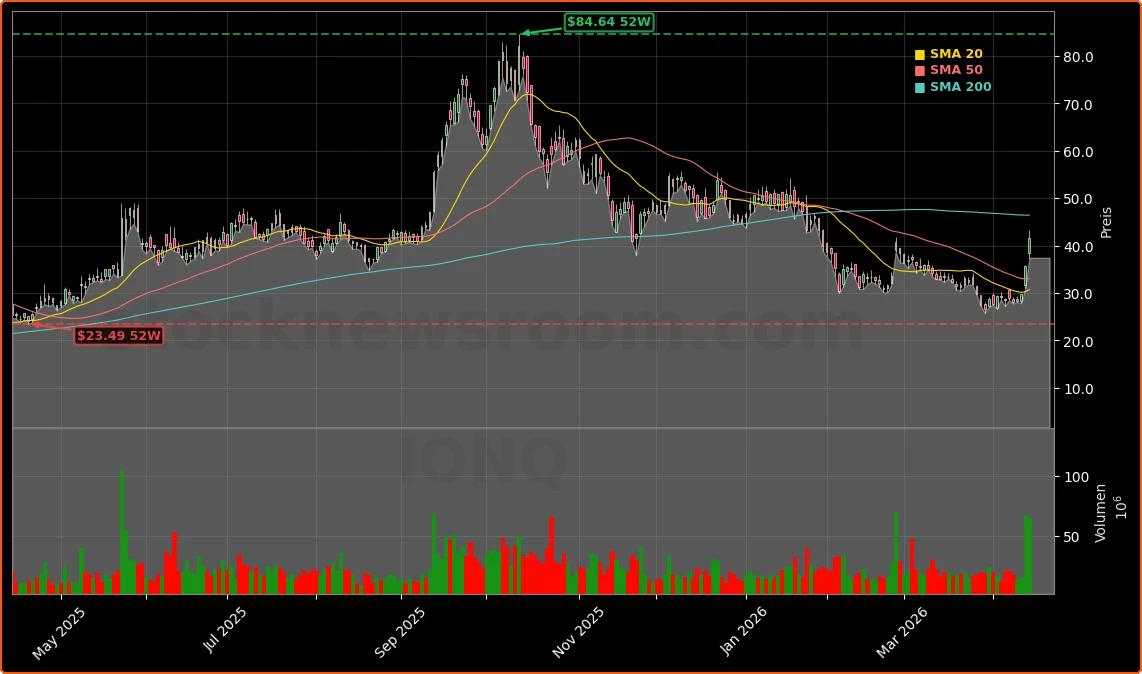
IonQ shares extended their recent rally on Wednesday as traders digested the company’s selection for the Defense Advanced Research Projects Agency’s Heterogeneous Architectures for Quantum (HARQ) initiative, widely discussed as the IonQ DARPA Program on Wall Street. The stock, now trading at $41.67, has surged well beyond its premarket level of $38.27 cited earlier in the session, signaling renewed risk appetite for quantum computing names on the NYSE and NASDAQ. While the broader S&P 500 tech cohort has been driven mainly by AI leaders like NVIDIA and hyperscale cloud players, IonQ stands out as one of the few listed pure‑play quantum hardware and platform companies.
For short‑term traders, the stock’s attempt to break through its recent premarket high has been interpreted as a potential signal for another short‑term pop. Longer‑term investors, however, are focusing less on the day‑to‑day volatility and more on how the IonQ DARPA Program could lock in multi‑year federal funding streams, deepen technical moats in quantum networking and increase IonQ’s relevance alongside AI and high‑performance computing ecosystems.
What exactly is IonQ doing in DARPA’s HARQ effort?
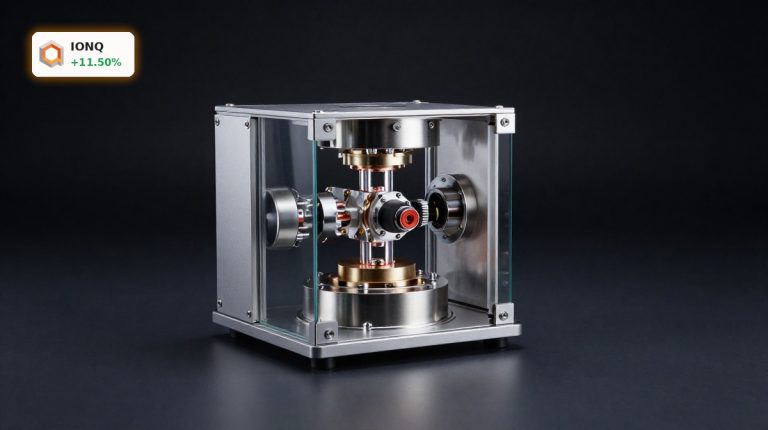
The IonQ DARPA Program centers on DARPA’s HARQ initiative, which aims to build high‑speed quantum interconnects that can link different types of quantum computers into a single networked architecture. IonQ has been tapped to contribute its trapped‑ion quantum systems and quantum memories to help realize these heterogeneous architectures that may combine trapped ions, superconducting qubits and other modalities. A key goal is to create scalable quantum networks with reliable entanglement between distinct processors, a foundational capability for secure communications and advanced defense applications.
IonQ’s role builds directly on its record of technical achievements, including achieving 99.99% two‑qubit gate fidelity in 2025 and advancing photonic interfaces that convert qubit states into photons for long‑distance transmission. The IonQ DARPA Program could therefore validate the company’s trapped‑ion approach as a preferred building block for modular and distributed quantum systems, potentially strengthening its negotiating position with large cloud partners and government agencies.
First networked commercial quantum computers: why does it matter?
In parallel with the DARPA news, IonQ announced it has successfully photonically interconnected two independent trapped‑ion quantum systems, claiming the first demonstration of linked commercial quantum computers. The company established a photonic connection that could generate, transmit and detect photons to create remote quantum entanglement between two IonQ machines. Unlike earlier laboratory‑only experiments, this milestone took place on fully commercial systems, suggesting the architecture is maturing toward real‑world deployment.
This breakthrough is central to the IonQ DARPA Program because high‑fidelity networking between separate quantum processors is the backbone of any future quantum internet. By showing that its commercial systems can be entangled over distance while maintaining coherence, IonQ is taking a step beyond stand‑alone quantum processors toward distributed architectures. For enterprise and government customers, that opens the door to scaling performance by linking multiple smaller systems instead of waiting for a single monolithic quantum computer.
How do IonQ’s partnerships and roadmap compare?
Beyond DARPA, IonQ is deepening its ecosystem in ways that could appeal to US institutional investors watching the quantum race among tech giants like Apple and cloud providers. The company recently expanded its QLab partnership with the University of Maryland through a $7.5 million multi‑year agreement supported by Maryland’s Capital of Quantum Initiative. That collaboration focuses on deploying a quantum memory node, boosting quantum compute access for researchers and pushing forward areas such as quantum machine learning and holographic error‑correcting codes.
IonQ has also introduced an application‑centric benchmarking framework that moves beyond raw qubit counts to metrics like Time‑to‑Solution and Energy‑to‑Solution. This approach is designed to make comparisons more meaningful for enterprise buyers weighing different architectures, including trapped ions, superconducting qubits and neutral atoms. While mega‑cap players like NVIDIA dominate AI accelerators and Tesla pushes AI at the edge, IonQ is positioning itself as the go‑to independent quantum platform that can plug into those AI and cloud workflows through major providers such as Amazon Web Services.
What should investors watch in the upcoming Q1 2026 report?
IonQ plans to release its Q1 2026 financial results on Wednesday, May 6, 2026, after the market close, followed by a 4:30 p.m. ET conference call. Management is expected to update investors on revenue growth from quantum compute access, hardware sales such as its 256‑qubit trapped‑ion system, federal contracts including the IonQ DARPA Program, and ongoing R&D investment needed to maintain its technical lead. Given IonQ’s history of operating losses and heavy research spending, cash burn and backlog development will remain front‑and‑center for Wall Street.
While there have been no fresh rating changes from major banks like Goldman Sachs, Morgan Stanley, Citigroup or RBC Capital Markets in the latest updates, their future stance will likely hinge on whether IonQ can translate the DARPA win, academic collaborations and networking breakthroughs into a clearer path toward commercial scale. With the stock already pricing in substantial growth expectations, any commentary on longer‑term revenue visibility from government and cloud partners will be closely parsed.
Related Coverage
For a deeper dive into how speculative enthusiasm built around the DARPA contract and photonic interconnect milestones, readers can review the earlier analysis in IonQ DARPA HARQ +17.9% Surge After Quantum Breakthroughs, which dissects the initial market reaction and trading dynamics. Broader context on how advanced computing themes are reshaping semiconductor and infrastructure plays is available in Intel AI Strategy Boom: Is This Comeback for Real?, highlighting how established chipmakers are repositioning for the next AI cycle alongside emerging quantum players like IonQ.
The IonQ DARPA Program, combined with the first entangled commercial quantum systems and a strengthening academic and cloud ecosystem, underscores IonQ’s ambition to lead the next phase of quantum networking. For investors, the key question now is whether upcoming quarters can convert that technical momentum into durable, high‑margin revenue streams. The May 6 earnings call will be the next major checkpoint, and for long‑term portfolios seeking exposure beyond traditional AI and semiconductor names, IonQ’s evolving quantum platform could become an increasingly relevant high‑risk, high‑reward component.