Is the Tesla Robotaxi vision finally turning today’s FSD and energy gains into the next leg of the stock’s AI story?

Is Tesla stock’s rebound more than a bounce?
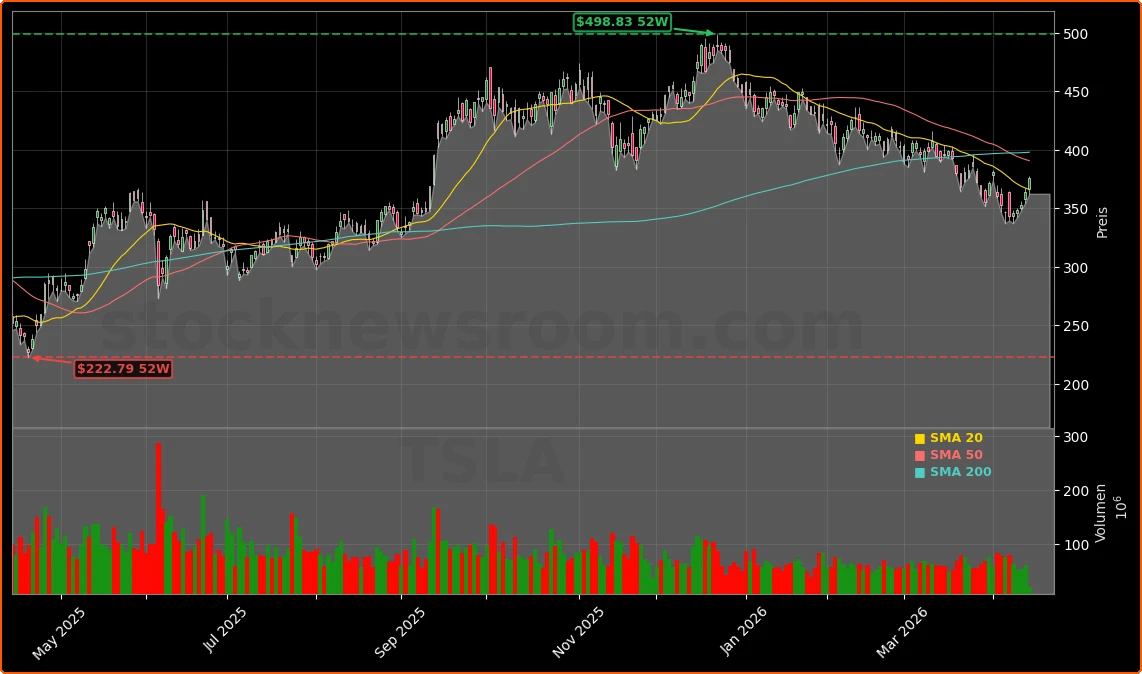
After a deep correction, Tesla, Inc. has rebounded from around $345 to roughly $376, still more than 30% below its all‑time high but technically back above short‑term resistance. The stock is up about 4% so far this week and roughly 1.7% on Wednesday, outperforming the broader S&P 500 and helping lead the Consumer Discretionary sector higher.
Despite a trailing P/E above 300 and price‑to‑sales north of 13, Tesla trades at a premium to traditional automakers on virtually every multiple. Industry comparisons show its price‑to‑book of about 16 is nearly four times the peer average, while revenue growth recently dipped slightly negative. Yet EBITDA and gross profit still dwarf those of legacy rivals, helped by software, services and a fast‑scaling energy business.
UBS recently upgraded Tesla from Sell to Neutral with a $352 price target, arguing that the roughly 20% year‑to‑date pullback had finally balanced risk and reward for investors who believe in the company’s long‑term “physical AI” thesis spanning Tesla Robotaxi services and humanoid robots. For short‑term traders, many technicians see the $430–$435 region as the next major resistance zone if momentum continues.
What changes with Tesla Robotaxi and FSD?
The most immediate catalyst for the Tesla Robotaxi narrative is regulatory rather than financial. Dutch regulators have granted the first European approval for Tesla’s supervised FSD system, a critical beachhead in a region that often sets the tone for global safety standards. While the current version still requires active driver supervision, it establishes a legal and technical framework that could be expanded across the EU over time.
In the U.S., Tesla has started tying its insurance business more directly to FSD usage. Drivers using “FSD Supervised” now automatically receive a safety score of 100 for every mile driven under the system, which can translate into lower monthly insurance premiums in select states such as Texas, Arizona and Virginia. That move not only incentivizes more FSD miles, it also reinforces management’s claim that software‑guided driving will ultimately be safer than humans.
For investors, the key question is how quickly supervised FSD can evolve into a scalable Tesla Robotaxi platform that truly competes with Waymo, Cruise‑like startups and well‑funded rivals in the Middle East and China. Local, city‑by‑city approvals and public‑safety perceptions remain the biggest operational bottlenecks. Tesla plans to expand robotaxi test operations in U.S. cities like Dallas, Phoenix, Houston, Miami and Las Vegas, but the global market will be fragmented long before it consolidates around one or two platforms.
How is Tesla shifting beyond the EV core?
While debates about the Tesla Robotaxi timeline dominate headlines, the company’s energy storage business is already changing the earnings mix. After roughly a decade of investment, stationary storage has turned into one of Tesla’s fastest‑growing divisions, with Megapack deployments showing strong momentum and gross margins around 30% versus roughly 15% in the core automotive segment (excluding regulatory credits).
That margin profile matters at a time when price cuts and competition from Chinese EV makers have compressed vehicle profitability. One large example of demand: Megapack sales to Elon Musk’s xAI reportedly generated hundreds of millions of dollars of revenue last year, underscoring how the AI data‑center build‑out is directly driving battery orders. As hyperscale compute clusters proliferate, Tesla’s position at the intersection of batteries, power electronics and software looks increasingly strategic.
On the automotive side, the Model Y remains a workhorse, with strong registrations in Europe and China helped by a mix of government incentives and aggressive pricing. In parts of Europe, buyers can combine EV subsidies with a roughly EUR 3,000 Tesla bonus, bringing lease rates for a new Model Y down to levels that undercut many internal combustion rivals. Global pure EV deliveries grew about 6.5% year over year last quarter, allowing Tesla to reclaim the crown as the top battery‑electric vehicle seller.
Where do robots and rivals like NVIDIA fit?
Beyond the Tesla Robotaxi roadmap, management is pushing the Optimus humanoid robot as the next multi‑billion‑dollar hardware and software platform. Executives have outlined a path to mass production out of the Shanghai Gigafactory, targeting volume manufacturing of a third‑generation Optimus by late 2026 and ultimately as many as 1 million units a year. That ambition will face real competition: Chinese group Unitree is already selling humanoid robots online and preparing for an IPO, and industrial players from Caterpillar to agricultural tech startups are racing to automate physical labor.
For U.S. tech investors, the broader “physical AI” theme puts Tesla in the same strategic conversation as NVIDIA in chips and Apple in consumer hardware ecosystems. Wall Street is watching whether Tesla can translate its software stack, custom silicon efforts and massive vehicle fleet data into sustainable advantages in autonomy and robotics before deep‑pocketed rivals catch up.
Related coverage on StockNewsroom
For a detailed look at how the recent UBS upgrade reframes the risk‑reward around autonomy and AI, readers can review our Tesla forecast on whether the UBS upgrade marks a fading EV story or a high‑beta robotaxi reboot. Investors interested in the energy angle beyond Tesla should also see how battery reuse is reshaping the sector in our analysis of Rivian’s energy storage strategy and its partnership to turn old EV packs into grid assets.
In the end, Tesla’s near‑term share price will still react to Q1 2026 earnings on April 22, but the story on Wall Street is steadily migrating from cars to code, batteries and the Tesla Robotaxi platform. For portfolios, that means evaluating the stock less like an automaker and more like a volatile hybrid of AI, energy infrastructure and advanced manufacturing. The next few quarters will show whether management can convert today’s lofty promises into durable cash flows; if it does, Tesla Robotaxi services and robots could justify today’s premium multiples rather than merely explain them.