Are strong Zscaler Earnings and a double‑digit growth outlook enough to offset a sharply lower valuation and cautious analyst signals?

Is Wall Street mispricing Zscaler, Inc.?
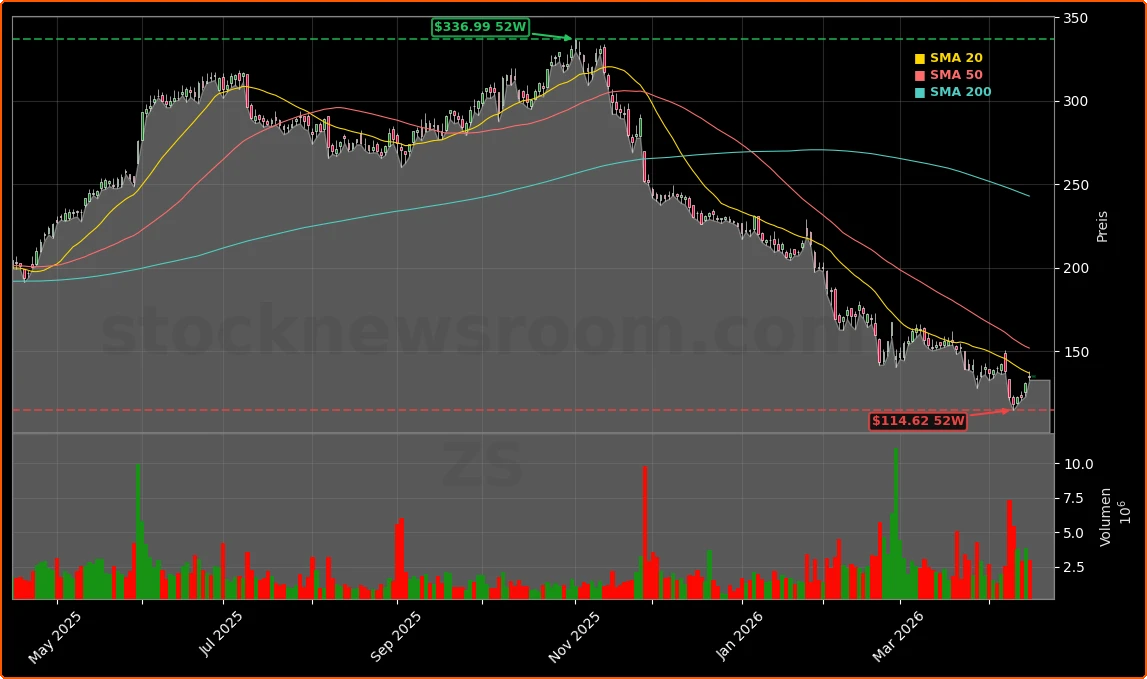
Zscaler, Inc. (ZS) is trading near $134.33 on the NASDAQ, up about 2.5% on the latest session, but still a long way from its 52‑week high of $336.97. The stock has shed a significant portion of its value since the start of 2026, even as the company delivered another quarter of solid top‑ and bottom‑line expansion. For US investors who rode the cybersecurity boom through 2023–2024, the current setup is unusual: the business continues to grow at a healthy clip, yet the price‑to‑sales multiple has compressed toward multi‑year lows, putting Zscaler alongside peers like NVIDIA and Apple in the broader debate over how much to pay for growth in a higher‑rate environment.
In the context of the NASDAQ and S&P 500, where many high‑quality tech names have already recovered much of their drawdown, Zscaler’s lagging share price is drawing attention from growth‑oriented portfolios. The question is whether the recent reset reflects a structural slowdown in demand for zero‑trust security or a temporary sentiment overshoot that could set up attractive long‑term entry points.
How did recent Zscaler Earnings perform?
The most recent reported Zscaler Earnings for fiscal Q2 (ended January 31) showed that demand for its cloud‑native security platform remains resilient. Revenue climbed roughly 26% year over year to about $816 million, underlining ongoing strength in large enterprise deployments and upselling within the installed base. On a per‑share basis, Zscaler posted earnings of $1.01, comfortably ahead of typical Wall Street expectations for the quarter, while maintaining a robust gross margin of around 77%.
The company’s guidance also underscores management’s confidence: for the third fiscal quarter, Zscaler targets earnings per share of around $1. For the full fiscal year 2026, it is aiming for EPS between $3.99 and $4.02. Those targets, combined with current revenue momentum, suggest that Zscaler is already operating at a scale where incremental margins can remain attractive, even as customer IT budgets become more selective. For investors screening US tech for durable profit growth instead of pure top‑line expansion, these Zscaler Earnings metrics are central to the bullish thesis.
Why did KeyBanc slash its price target on Zscaler?
Despite the strength of the latest Zscaler Earnings, the sentiment backdrop has cooled. KeyBanc Capital Markets recently cut its price target on Zscaler from $220 to $160, citing a partner survey indicating slowing momentum in the Secure Access Service Edge (SASE) market. Channel checks suggested Zscaler was named less frequently as the preferred vendor than in previous years, a sign that the market is maturing and that incremental wins may require more intensive sales and product differentiation efforts.
Importantly, KeyBanc kept an “Overweight” rating on the stock, signaling continued belief in the long‑term story while acknowledging that the easy phase of customer acquisition may be behind the company. For US investors who follow other high‑growth security names like Palo Alto Networks and SentinelOne, the note echoes a sector‑wide theme: growth is still there, but selectivity and competition are rising, and valuation multiples are being recalibrated accordingly.
What strategic shift and leadership changes are underway at Zscaler?
To navigate a more mature SASE and zero‑trust landscape, Zscaler is pivoting its strategy toward deeper monetization of existing relationships. The company is leaning more heavily into cross‑selling, with a focus on customers obtained via partners such as Red Canary, while continuing to expand its global infrastructure, which now spans over 160 data centers. All of this is built around the Zero Trust Exchange platform, which Zscaler is enhancing with advanced AI capabilities to automatically detect and mitigate complex cyber threats.
From a structural growth perspective, this AI emphasis is critical as enterprises modernize security around cloud workloads, identity and data protection. At the same time, the company announced that Raj Judge, Executive Vice President of Corporate Strategy and a member of the Board, has resigned, with his departure as an officer effective April 15, 2026, and his exit from the company expected on July 31, 2026. Zscaler stated that the resignation was not due to disagreements over operations, policies or practices. While such leadership changes can raise governance questions, the continuity of product and go‑to‑market strategy remains the primary driver for institutional investors.
How do Zscaler Earnings compare to cybersecurity peers?
Within the broader cybersecurity cohort, Zscaler sits in the same zero‑trust and cloud‑security conversation as players like Palo Alto Networks, SentinelOne and platform‑oriented names held widely in US growth funds. Recent data show that revenue growth at these companies, including Zscaler, remains solid, even as their price‑to‑sales ratios trade near multi‑year lows. SentinelOne and Zscaler, in particular, stand out for how far their valuation multiples have compressed relative to their historic averages.
For investors who previously favored high‑multiple software names such as Tesla on pure growth narratives, this combination of steady execution and lower valuation could be compelling. However, the same factors that pushed Wall Street to cut price targets—competition, market saturation risks and tighter IT budgets—mean that Zscaler Earnings alone may not be enough to drive multiple expansion without clear evidence of sustained share gains in the enterprise and AI‑driven security segments.
Related coverage
For a deeper dive into how short‑term price swings and bearish calls could shape the next leg for the stock, the analysis in Zscaler Forecast -11.3% Crash: BTIG Warning vs Growth examines whether recent volatility reflects a lasting shift in the Zscaler outlook or a potential buying opportunity for contrarian investors. To put Zscaler’s valuation reset into a broader high‑growth tech context, the article Snowflake Valuation Warning: 116x Earnings and Deep Losses looks at how premium multiples in cloud software can unravel when growth slows and legal as well as profit headwinds build.
Ultimately, Zscaler Earnings highlight a company that is still growing fast, investing aggressively in AI‑powered security and adjusting strategy as its core markets mature. For US and global investors, the key will be whether this combination of execution and innovation can overcome a more skeptical Wall Street and turn today’s discounted valuation into long‑term upside. The next few quarters will show whether Zscaler can convert its earnings momentum and strategic shift into renewed share‑price leadership in the cybersecurity space.