
Can Opendoor’s AI-driven turnaround survive a market that now rewards almost nothing except pure AI exposure?

Why Is Opendoor Technologies Inc. Losing Ground to AI Stocks?
While NVIDIA and Meta post record revenue from AI infrastructure and ad-supported LLM integrations, Opendoor Technologies Inc. faces mounting pressure amid a stagnant housing market. Mortgage rates remain elevated, de-listing rates are climbing, and homebuyer demand is tepid — yet the company’s Q1 2026 results showed a surprising operational acceleration: fastest home acquisition and resale pace since 2022, with AI-powered pricing and logistics driving reduced holding times. Still, revenue beat ($552M vs. $538M consensus) couldn’t offset a $112M net loss and negative EBITDA. The disconnect between execution progress and market valuation is widening — a textbook symptom of the Opendoor AI Rotation.
How Deep Is the Capital Rotation Into AI?
Over $210 billion has flowed into AI-focused ETFs and venture funds since early 2025 — a surge that’s directly correlating with outflows from real estate tech and non-AI growth sectors. According to Bloomberg, the S&P 500’s top 10 AI-linked stocks now command 38% of the index’s total market cap, up from 22% in Q1 2024. In that context, Opendoor Technologies Inc. isn’t just underperforming — it’s being priced out of the growth conversation. Options activity confirms this shift: open interest hit 1.53 million contracts on June 3, with 166K contracts traded — the highest single-day volume since March. Traders aren’t betting on housing recovery; they’re hedging against continued dilution and narrative abandonment.
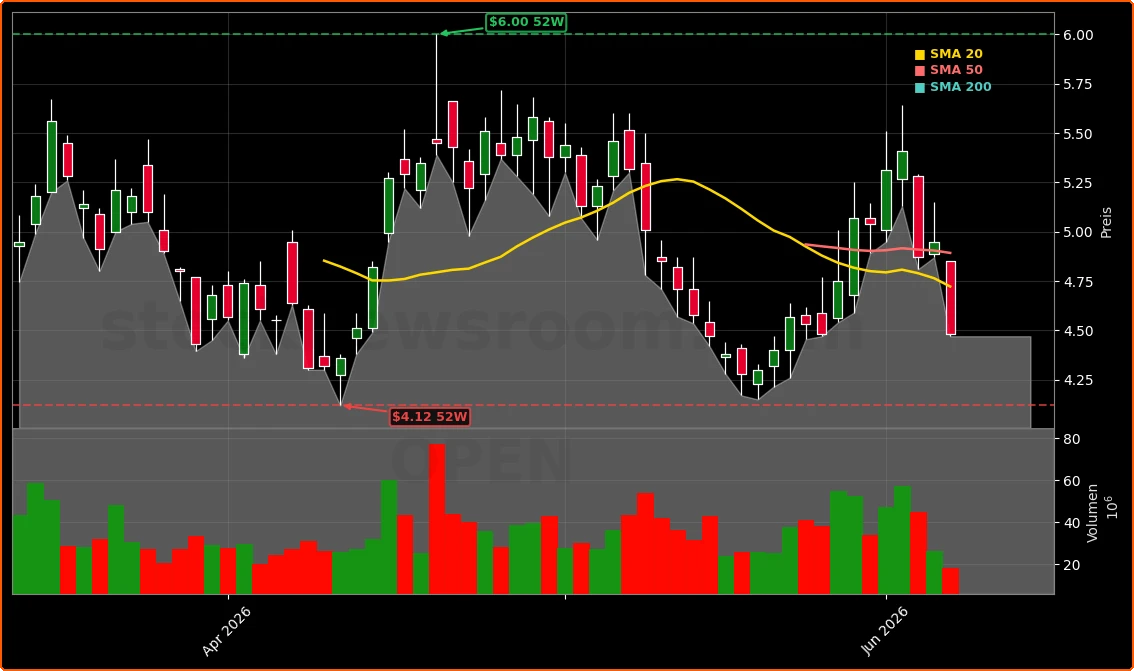
Opendoor AI Rotation: What’s Next for the ‘iBuying’ Leader?
CEO Kaz Nejatian’s ‘Opendoor 2.0’ strategy hinges on AI-driven margin expansion, targeting adjusted EBITDA profitability by Q2 2026 and net income by year-end. But profitability timelines mean little when Wall Street’s attention span is measured in IPO countdowns. With OpenAI reportedly in talks with the Trump administration about equity-for-public-fund structures — and Senator Bernie Sanders proposing a 50% stake and AI tax — the political and capital gravity around AI is intensifying. Meanwhile, Morgan Stanley cut its price target to $5.50, and Keefe Bruyette lifted its target to $2.25 while maintaining an Underperform rating. That split reflects investor fatigue: liquidity is solid ($1.2B cash), but the path to sustainable returns remains opaque amid the Opendoor AI Rotation.
Can Retail Support Offset Institutional Flight?
Nejatian’s recent call to the ‘Open Army’ of retail investors — urging support at the June 11 annual meeting against ISS and Glass Lewis recommendations — signals a last-ditch effort to stabilize sentiment. The stock rallied 26% in early June, briefly reviving meme-energy, but the move faded as options gamma flipped bearish. Unlike Tesla or Apple, where retail rallies often catalyze institutional re-engagement, Opendoor Technologies Inc. lacks a clear tech moat or ecosystem lock-in. Its AI tools are operational — not proprietary or monetizable beyond resale margins. That structural limitation makes it vulnerable in any rotation where ‘AI exposure’ is the benchmark, not ‘housing efficiency’.
What’s the Real Risk for U.S. Portfolios?
For U.S. investors holding OPEN, the risk isn’t just housing weakness — it’s index exclusion and liquidity compression. Though recently added to the Russell 3000, continued underperformance could trigger removal in June’s reconstitution. More critically, the Opendoor AI Rotation mirrors broader stress in the S&P 500’s mid-cap tech segment: companies without AI-native revenue streams face valuation compression, regardless of operational improvement. With peers Zillow and Offerpad pursuing asset-light models, Opendoor’s capital-intensive iBuying remains a hard sell — especially as Wall Street demands AI-driven scalability, not just speed.
We’re building the infrastructure for the next generation of real estate — but Wall Street is only listening to AI’s keynote address.— Kaz Nejatian, CEO of Opendoor Technologies Inc.
Related Coverage: The latest earnings deep dive reveals whether Opendoor’s margin surge can withstand the Opendoor AI Rotation — read Opendoor Earnings Q1: Margin Surge and Growth Reset. Analysts are split on whether the company’s AI-enhanced resale engine can deliver on its ambitious EBITDA timeline, making this quarter a critical inflection point for long-term holders.