
Can the latest Opendoor Earnings turn a volatile housing trade into a credible path to scalable, tech-driven profitability?

Are Opendoor Earnings changing the stock story?
Opendoor Technologies Inc. (OPEN) has quickly shifted from meme‑stock territory to a more fundamentals‑driven narrative after its latest Opendoor Earnings. The company posted a Q1 loss of $0.30 per share, beating the consensus for a $0.34 loss, while revenue of roughly $1.2 billion exceeded expectations even though sales were sharply below the prior year. Management now forecasts Q2 revenue between $1.25 billion and $1.35 billion, signaling a gradual rebuild of transaction volume rather than a rapid snap‑back.
On the market side, shares trade around $4.61, only slightly above the previous close but still dramatically higher year over year, reflecting optimism around the new strategy under CEO Kasra (Kaz) Nejatian. Options activity has been heavy, with more than 110,000 contracts changing hands on May 11 and open interest around 1.7 million contracts, underlining how Opendoor remains a favored vehicle for traders seeking leveraged exposure to US housing volatility.
For US growth investors comparing housing tech to broader NASDAQ names like NVIDIA or Apple, the key question is whether Opendoor Earnings now support a path toward durable margins and eventual profitability, not just trading momentum.
How is Opendoor Technologies trying to grow faster?
Nejatian has put speed and volume at the center of Opendoor’s turnaround. On the latest call he framed the shift as moving from a “forward‑centered” company that tried to time macro housing cycles to a “now‑centered” operator focused on fast inventory turnover. Instead of hunting only for deeply discounted homes with a wide price spread, Opendoor is prioritizing “great homes” it can resell quickly at scale, even if per‑unit spreads are narrower.
The early data points are encouraging. Homes purchased rose 45% sequentially, and the company signed more than 5,000 acquisition contracts in the quarter, its highest level since 2022. Inventory velocity is improving: the share of homes on Opendoor’s books for more than 120 days fell to 10%, down from 33% in the prior quarter, while the broader market remained stuck around 33%. At the same time, fixed costs declined both sequentially and year over year, hinting at growing operating leverage as volume returns.
Artificial intelligence is a major ingredient in this shift. Management says Opendoor is moving to a lighter, more automated platform, using AI for pricing, risk assessment and workflow automation to cut labor and transaction costs. That aligns the company more closely with data‑driven tech peers on NASDAQ, even though its underlying asset base is residential real estate rather than chips or software.
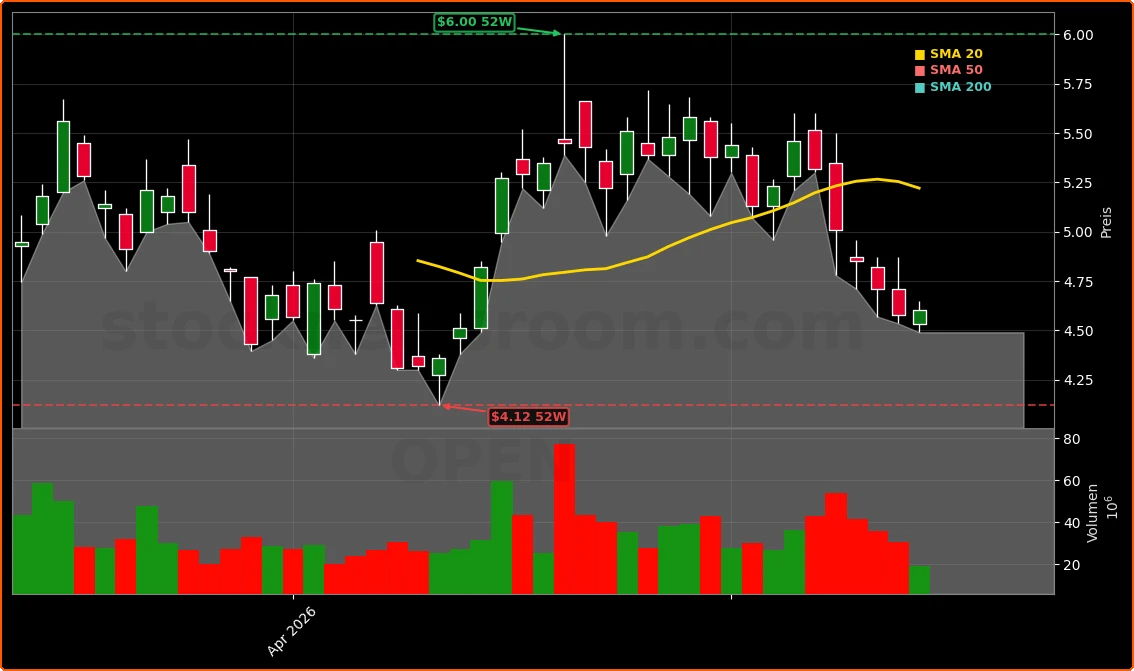
Do the latest Opendoor Earnings fix profitability?
The short answer is no—but they show progress. Q1 revenue was still down about 37% year over year, with homes sold falling from 2,946 to 1,921 and homes purchased dropping from 3,609 to 2,474. However, homes under contract nearly doubled from about 1,050 to 1,939 by quarter‑end, suggesting a pipeline that should support the Q2 revenue outlook.
On margins, gross margin improved from 8.6% to 10.1%, showing that the new focus on quality inventory and faster turnover is helping unit economics. Adjusted net loss narrowed from $63 million to $49 million, and management continues to emphasize cost discipline even as it ramps acquisitions. Earlier transcripts from 2025 highlight similar themes, but the latest quarter demonstrates that the strategy can work even in what the company describes as a housing market low, rather than a frothy upcycle.
Wall Street research desks remain cautious overall, often tagging the stock with neutral or “hold”‑style views and highlighting risks from housing demand, interest rates and legacy inventory. Unlike mega‑cap darlings such as Tesla, Opendoor isn’t yet in the S&P 500 or a staple of large‑cap growth funds, so sentiment can swing quickly with each Opendoor Earnings print.
What does insider buying mean for US investors?
One of the strongest near‑term signals from the post‑earnings window is insider activity. Nejatian bought 100,000 Opendoor shares in the open market on May 11, spending roughly $487,800 at an average price around $4.88. A Form 4 filing shows his direct holdings rising to more than 83.5 million shares, a sizable vote of confidence from the CEO even as some valuation models still flag the stock as overvalued versus intrinsic estimates.
Insider trading patterns over the past year show more buys than many investors might expect for a stock that has been as volatile as Opendoor, though sells still outnumber buys in absolute count. For US retail and institutional investors, CEO purchases around current levels can help anchor sentiment after a period in which short sellers and macro bears have pressured the name. The upcoming presentation at J.P. Morgan’s 2026 Global Technology, Media and Communications Conference should give Nejatian another platform to defend the strategy in front of large money managers and explain how AI, risk controls and balance‑sheet discipline fit together.
Against that backdrop, the latest Opendoor Earnings are less about a single quarter’s EPS beat or miss and more about whether the company can compound small gains in volume, margin and cost efficiency across the next several quarters.
For now, Opendoor remains a high‑risk, high‑beta housing tech play rather than a stable cash generator, but each quarter of execution reduces uncertainty. The Q1 Opendoor Earnings update shows a business that is getting faster, leaner and more data‑driven, and the next few reports will reveal whether that momentum can hold as US mortgage and rate conditions evolve.