
Is the sudden NVIDIA China optimism a real new growth driver for NVDA or just another politically driven head fake?

Is Wall Street betting on an NVIDIA China reset?
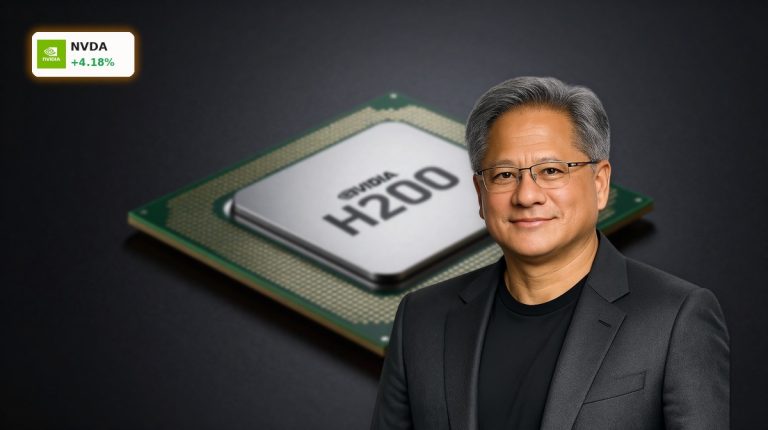
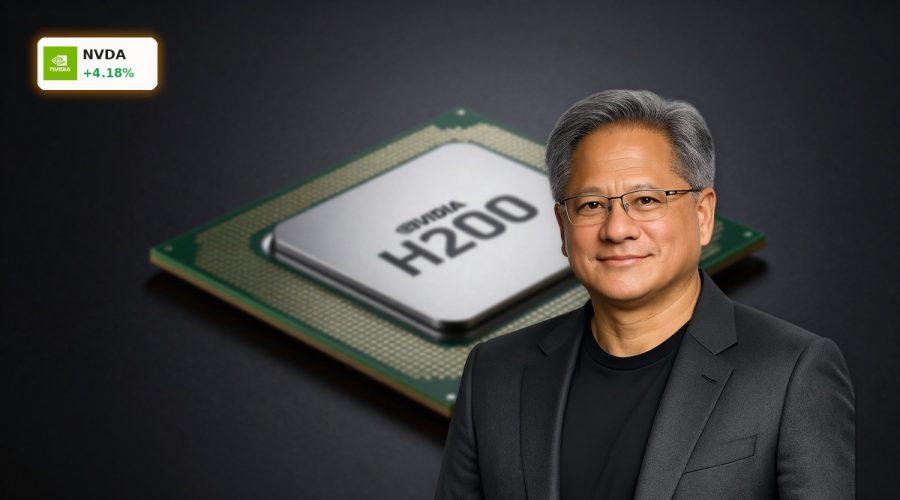
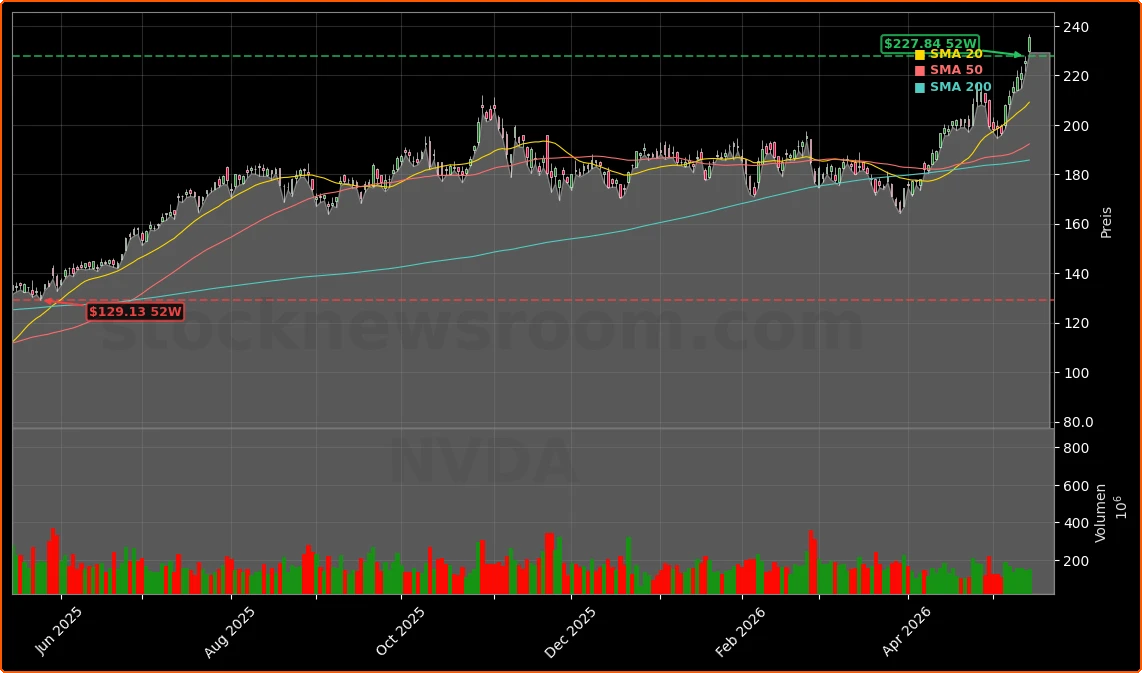
NVIDIA Corporation (NVDA) extended its winning streak on Thursday, climbing 4.18% to $235.32 and flirting with fresh record territory as optimism around an NVIDIA China breakthrough rippled across the NASDAQ and S&P 500. The move added tens of billions of dollars in market value and helped power tech-led gains on Wall Street, with chip peers also firming as investors rotated back into AI leaders.
The immediate catalyst: the U.S. government has authorized H200 AI chip sales to roughly ten Chinese giants, including Alibaba, Tencent, ByteDance, JD.com and Lenovo, while President Trump signaled broader openness to business ties during meetings with Xi Jinping in Beijing. Huang called the gathering “one of the most important summits in human history” and described the tone from both leaders as welcoming, even as he declined to detail specific orders.
Importantly for U.S. investors, current guidance from NVIDIA explicitly excludes China data center compute revenue after earlier H20‑related export controls triggered a $4.5 billion inventory charge. That means any NVIDIA China recovery would be incremental upside on top of an already massive AI run rate, rather than something the market is currently counting on.
NVIDIA China: breakthrough or political mirage?
The new H200 licenses are not a clean win yet. Beijing has effectively frozen deliveries, advising domestic champions to prioritize homegrown AI chips over U.S. imports. No H200 units have actually shipped to the approved customers so far, leaving a roughly $50 billion annual Chinese AI compute market hanging in the balance.
This creates a strange limbo: Washington has softened enough to allow limited exports, but Chinese regulators are slowing the flow to nurture local suppliers and address cybersecurity concerns. For NVIDIA China revenue, the risk is that today’s “green light” turns into a tightly managed, stop‑start channel where volumes and margins are capped by policy rather than demand.
At the same time, CUDA’s global dominance gives NVIDIA an edge even in a constrained scenario. Chinese hyperscalers have invested heavily in NVIDIA’s software stack, and domestic alternatives still lag on tools, libraries and developer ecosystems. That lock‑in makes NVIDIA the default choice whenever export rules permit, reinforcing why both Washington hawks and Beijing strategists see these chips as strategic assets rather than ordinary components.
How big is the upside if NVIDIA China reopens?
Before restrictions tightened, China was one of NVIDIA’s fastest‑growing markets, accounting for roughly low‑teens percentage of total revenue and rising quickly. Analysts have floated scenarios in which a more stable export regime could eventually restore a multi‑billion‑dollar quarterly data center stream out of China alone, on top of the hyperscale demand already coming from U.S. and European clouds.
For context, NVIDIA closed fiscal 2026 with about $216 billion in revenue and quarterly data center sales north of $60 billion, while guiding the current quarter to roughly $78 billion. Management has framed its forecast as assuming essentially zero China data center compute, implying that a re‑opening could extend triple‑digit AI growth longer than many models assume.
Competitors are watching closely. Advanced Micro Devices is pushing its own AI accelerators, and Chinese firms are accelerating domestic chip projects, but research houses still estimate NVIDIA controls more than 80% of the global AI GPU market. A durable NVIDIA China channel would make it even harder for rivals to close that gap, especially if Chinese firms opt for a hybrid strategy that pairs domestic silicon with export‑compliant H200 and future Blackwell‑class parts.
What are analysts saying about NVDA now?
Sell‑side sentiment remains overwhelmingly positive despite the geopolitical noise. Zacks recently highlighted NVIDIA as one of two “rockstar AI stocks” with unusually strong earnings momentum and noted that, even near all‑time highs, the valuation looks reasonable relative to its 70%‑plus earnings growth trajectory. Barron’s likewise argued that the stock is still cheap given its dominance in AI infrastructure, suggesting NVIDIA’s market value could climb toward $8 trillion if execution holds.
Individual banks have become increasingly vocal as well. Wells Fargo this week lifted its NVIDIA price target to $315, seeing roughly 40% upside from current levels and describing an “AI supercycle” driven not only by standalone GPUs but by full $3 million server racks like the GB200 and rubin‑generation systems. Cantor Fitzgerald’s C.J. Muse bumped his target to $350 and reiterated an Overweight rating, arguing that NVIDIA’s AI chips are effectively sold out for the current fiscal year and that the Street is still underestimating medium‑term earnings power.
Against that bullish backdrop, there are dissenting voices. Short‑seller Culper Research has warned that NVIDIA’s China exposure remains a material risk and alleged that unofficial channels may still account for a meaningful slice of compute revenue, claims the company disputes. Meanwhile, U.S. lawmakers on both sides of the aisle are already criticizing H200 approvals as a strategic concession that could narrow America’s AI lead.
How does the summit change the competitive landscape?
Trump’s decision to bring Huang and Tesla boss Elon Musk onto Air Force One underscored how central NVIDIA and EV‑AI platforms have become to U.S. tech policy. Other CEOs — including Apple’s Tim Cook, Boeing and major banks — traveled on separate aircraft. That proximity matters because export rules increasingly appear to be shaped in small rooms with a handful of power brokers rather than through slow, predictable bureaucracy.
If the Beijing summit yields concrete licensing clarity for future architectures like Blackwell and Rubin, NVIDIA could lock in a managed but durable NVIDIA China corridor that competitors will struggle to match. If talks stall and Beijing doubles down on domestic chips, the company still has hyperscaler and sovereign AI demand in North America, Europe and the Middle East to fall back on — but one of its biggest long‑term upside levers would remain stuck in neutral.
Related coverage
For a deeper dive into how Huang’s last‑minute addition to Trump’s delegation reshaped expectations, see this analysis of the NVIDIA China trip and its shock impact on Wall Street, which explores why futures markets suddenly began pricing in a higher probability of export relief and what that could mean for NVDA volatility around next week’s earnings report.
Today’s summit was uplifting. President Xi was very inspiring, very welcoming, and President Trump was very inspiring and very welcoming.— Jensen Huang, NVIDIA CEO
In sum, NVIDIA China dynamics have turned from a hard stop into a live negotiation just as NVDA enters another critical earnings stretch. For U.S. investors, that means the stock’s upside is no longer tied only to cloud and sovereign demand but also to how far policymakers on both sides are willing to reopen the world’s second‑largest AI market. The next few months of licensing decisions and summit follow‑through will show whether today’s H200 headlines translate into real revenue or remain a geopolitical teaser that keeps NVIDIA’s China story on hold.