Can a blockbuster Netflix Earnings beat still tank the stock when guidance, content spending and leadership all flash new risk signals?

How did Netflix Earnings beat but the stock sink?
Netflix, Inc. posted a powerful Q1 2026 headline performance. Revenue climbed 16% year over year to roughly $12.25 billion, topping management’s own forecast of $12.16 billion and edging past Wall Street estimates. Earnings per share jumped to $1.23, well above the 76 cents Netflix had guided and nearly double the prior-year $0.66. Operating margin and operating income also ran ahead of expectations, helped by stronger-than-anticipated subscriber monetization and advertising.
Beneath the surface, though, a one-time factor did a lot of the heavy lifting. Netflix booked a $2.8 billion termination fee after walking away from its bid for Warner Bros. Discovery, which inflated net income to about $5.28 billion and flattered the bottom line. That makes the Q1 Netflix Earnings less comparable on a pure operating basis and helps explain why the stock reaction was so unforgiving.
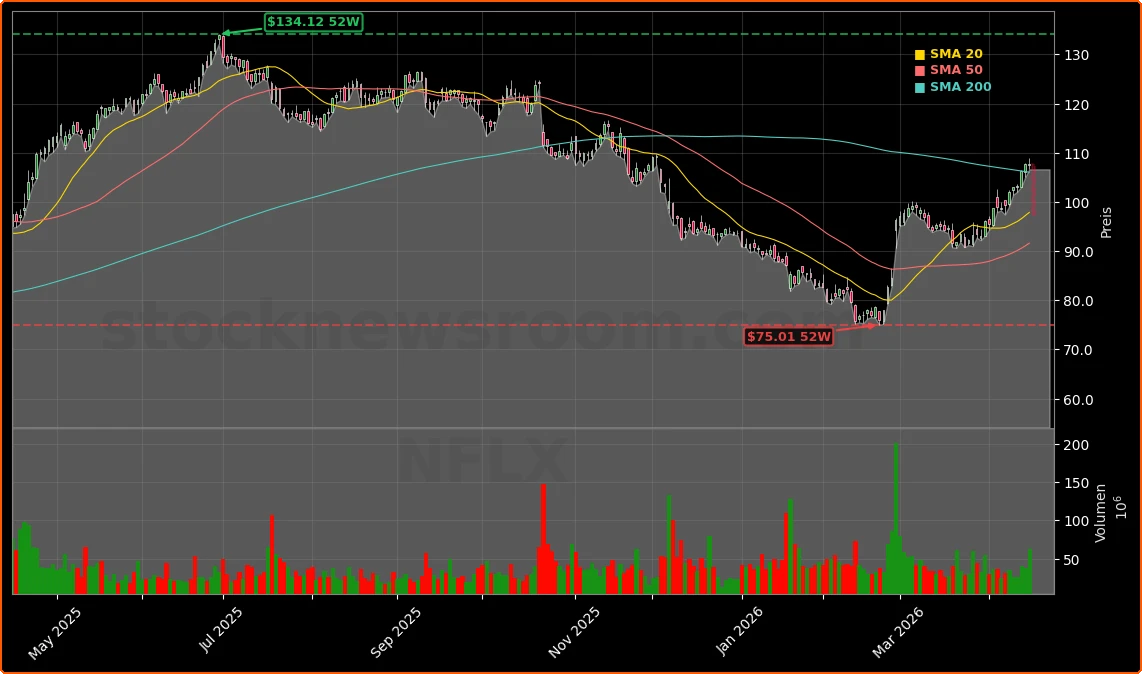
At the close on Thursday, Netflix finished regular NASDAQ trading at $107.79, up 0.07% on the day. In the after-hours session, the stock slid to about $97–98, down nearly 10%, even though the shares remain well below their 52‑week high near $134 and above the 12‑month low around $75.
What worried investors in the guidance?
The core problem in this Netflix Earnings report was the outlook. For Q2 2026, management guided revenue to $12.57 billion, shy of the roughly $12.64 billion Wall Street had penciled in. EPS guidance of $0.78 also missed consensus near $0.84. Operating income is projected around $4.11 billion versus expectations closer to $4.34 billion, reflecting a planned front-loading of content spending.
Netflix reiterated that 2026 will see the fastest year-over-year growth in content amortization in the first half, then slow to mid- to high-single-digit growth later in the year as spending normalizes. Full‑year revenue guidance was left unchanged at $50.7–$51.7 billion despite the Q1 beat, a clear signal that management does not want expectations drifting higher. For a stock that had surged more than 30% since late February after abandoning the Warner Bros. pursuit, the lack of an upward revision was enough to trigger profit-taking.
On the Street, Wedbush recently raised its Netflix price target to $118 and kept an “Outperform” rating, while Evercore ISI reiterated “Outperform” with a $115 target, underlining that many analysts still view the stock favorably even after the post-earnings drop. But as Investor’s Business Daily and other outlets highlighted, soft forward guidance is now being punished more harshly across the NASDAQ and S&P 500 growth complex, especially after big rallies.
Is the Netflix Earnings story still about ads and pricing?
Beyond the headline volatility, the strategic engine of the Netflix Earnings narrative is shifting steadily toward advertising and price optimization. Netflix generated about $1.5 billion in ad revenue in 2025 and remains on track to double that to roughly $3 billion in 2026. The ad-supported tier now accounts for roughly 60% of new sign-ups in markets where it is offered, and the company reports more than 4,000 active advertisers, up around 70% year over year. In some regions where ads are live, one-third of the subscriber base is already on the ad tier.
To reinforce that pivot, Netflix recently raised prices for its ad-free plans while keeping the ad-supported Standard plan at $8.99 per month, undercutting comparable offerings from rivals like Disney+ and Max by roughly 25–30%. The Standard ad-free plan in the U.S. now costs $19.99 and the Premium tier $26.99. Management insists engagement and churn trends after these hikes are tracking in line with previous increases, with co‑CEO Greg Peters arguing that Netflix still offers the lowest cost per hour of viewing among major subscription video competitors.
This strategy positions Netflix differently from Big Tech platforms such as Apple, which still leans heavily on hardware and services bundles, or from pure-play streamers under broader media umbrellas like Disney and Warner Bros. The company is also pushing into live content, having streamed a BTS concert and World Baseball Classic games, and it is reportedly in talks with the NFL to expand its relationship beyond Christmas Day matchups—moves aimed at making the ad inventory more premium and comparable with big-sports buys at companies like NVIDIA’s AI-fueled streaming partners and traditional broadcasters.
What does Hastings’ exit mean for governance risk?
Layered on top of the cautious guidance, the Netflix Earnings release confirmed a symbolic end of an era: co‑founder and executive chairman Reed Hastings will not seek re-election to the board at the June 4, 2026 annual meeting, ending nearly 29 years in formal leadership. Hastings, who handed the CEO role to Ted Sarandos and Greg Peters in 2023, said the company’s “greatness is so strong” that he can now focus on philanthropy and other pursuits.
Investors initially framed the Hastings news as an additional overhang, compounding the guidance disappointment. However, governance risk appears limited: operational control has long since shifted to Sarandos and Peters, and Netflix’s culture of aggressive experimentation, performance-driven compensation and tech-forward content decisions is deeply institutionalized. Hastings will remain the company’s public “founder” figurehead even as he steps off the board, similar in spirit to how other Silicon Valley founders have transitioned while leaving day-to-day execution to successors.
From a capital allocation perspective, Netflix resumed share repurchases after the Warner Bros. deal collapsed, buying back 13.5 million shares for $1.3 billion in Q1 at an average price around $96.30, with roughly $6.8 billion still authorized. Combined with robust free cash flow of roughly $5.1 billion and $12.3 billion of cash on the balance sheet, that gives management meaningful flexibility even as content investment is expected to reach about $20 billion this year.
Related Coverage: What’s next after this Netflix Earnings volatility?
For readers tracking the medium-term setup, Netflix’s growing ad and live-content ambitions were explored in more depth earlier this week. In particular, our analysis “Netflix Earnings +3% Surge: Are Ads and Sports the New Engine?” examined whether the ad tier, sports and live events can structurally accelerate revenue and justify richer multiples as the core subscription market matures. That piece also outlines how the latest price hikes and potential NFL expansion could reshape Netflix’s competitive positioning versus entrenched media groups and big tech ecosystems.
The same article, “Netflix Earnings +3% Surge: Are Ads and Sports the New Engine?”, also looked at how these growth levers compare to adjacent players in streaming, gaming and advertising technology, and why U.S. investors should weigh Netflix’s long-term optionality against near-term valuation and guidance risks. Together with today’s post-earnings reset, that context can help investors decide whether this drawdown is a buying opportunity or simply a pause after a powerful rally.
Reed will always be Netflix’s founder and biggest champion — he is a part of our DNA.— Greg Peters, Co-CEO of Netflix
In the end, the latest Netflix Earnings underscore a familiar pattern: strong execution today is not enough when guidance and leadership headlines spook a momentum-driven market. For long-term investors, the combination of an expanding ad business, disciplined—but still heavy—content spending and a robust balance sheet keeps Netflix firmly in the top tier of global media assets. The next few quarters of Netflix Earnings will show whether management can convert that strategic promise into sustained growth that justifies buying the dip after this double-digit slide.