
Are investors overreacting to the latest ServiceNow Earnings margin reset, or is this the start of a deeper SaaS rerating?

Why did ServiceNow, Inc. sink after hours?
The immediate reaction in extended trading suggests that the market was not disappointed by the headline ServiceNow Earnings themselves, but by what management signaled about profitability. For the latest reported quarter, ServiceNow delivered adjusted earnings of $0.97 per share, matching Wall Street expectations, while total revenue climbed 22% year over year to $3.77 billion, just ahead of the roughly $3.75 billion consensus. Subscription revenue, the core of the business model, continued to grow at about 23%, confirming that demand for workflow automation and AI‑driven productivity tools remains healthy.
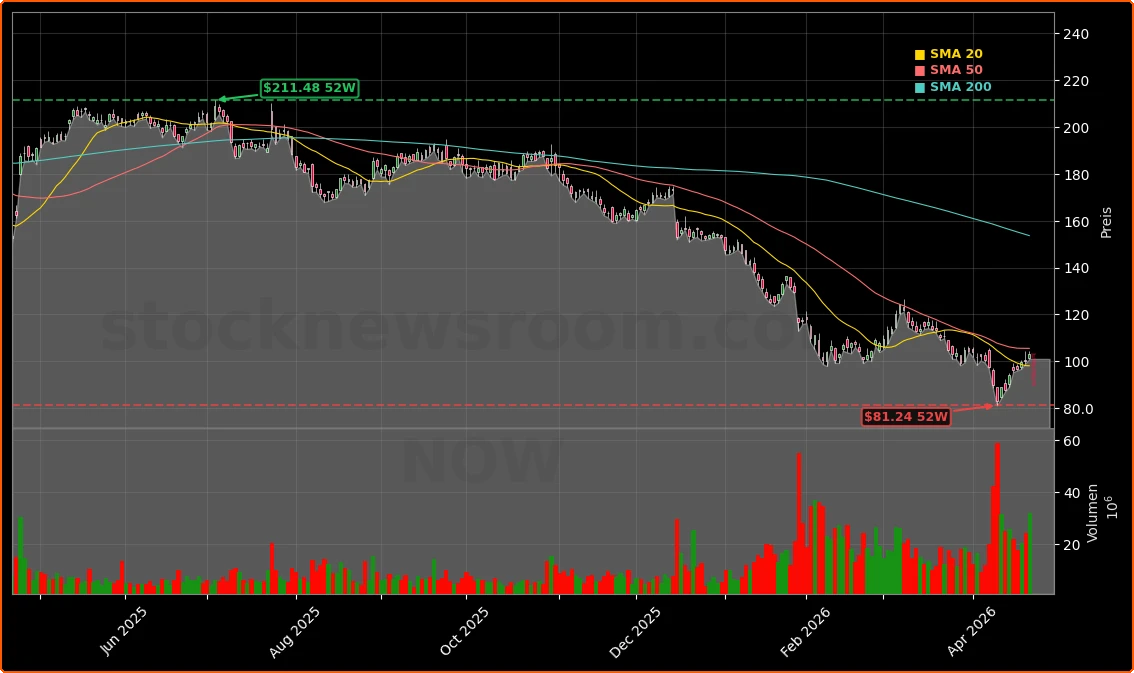
Despite this solid top‑line performance, the stock’s sharp reversal points to guidance as the key pressure point. Coming into the release, NOW had already rallied more than 25% off lows near $80, driven by optimism over AI products, backlog strength, and expectations that ServiceNow Earnings would support a broader rebound in cloud software. That run‑up left little room for any perceived step back on margins or cash‑flow leverage.
How did guidance undercut the ServiceNow Earnings story?
The biggest surprise came from a reset in profitability expectations. Management now projects a full‑year adjusted operating margin of about 31.5%, trimming its prior target of 32%. For the upcoming quarter, the company guided to an adjusted operating margin near 26.5%, well below a Wall Street consensus around 30.1%. That gap effectively reframed the latest ServiceNow Earnings update from a steady growth story into a margin‑compression story, at least in the near term.
On the revenue side, the outlook did not look weak on its face: ServiceNow expects Q2 subscription revenue of roughly $3.82 billion, implying about 23% year‑over‑year growth and coming in slightly above the $3.75 billion many analysts had modeled. However, high‑multiple software names are often punished when margin guidance moves in the wrong direction, even if growth stays intact. Management pointed to geopolitical headwinds in the Middle East, noting that Q1 2026 subscription revenue growth faced roughly a 75‑basis‑point drag from delayed closing of several large on‑premise deals in the region, and warned that such timing issues could weigh on the rest of the fiscal year.
Is AI growth enough to offset the margin reset?
One of the most closely watched elements of ServiceNow Earnings has been the contribution from generative AI products. CEO Bill McDermott highlighted stronger prospects here, raising expected AI revenue for 2026 to about $1.5 billion from a previous $1 billion view and suggesting even that figure might prove conservative. The company is leaning on its Now Assist portfolio, workflow data fabric, and the new RaptorDB database engine, which is positioned as delivering materially faster transaction and analytics performance for large enterprise customers.
Historically, ServiceNow has shown that AI‑enhanced SKUs can command meaningful pricing power, with Plus‑tier offerings generating more than 30% price uplift versus Pro SKUs. Earlier quarterly updates also highlighted rapid adoption of GenAI capabilities, including dozens of customers already spending over $1 million annually on Now Assist. Still, Wednesday’s market reaction indicates investors are currently more focused on near‑term operating leverage than on long‑term AI revenue potential. For growth‑oriented portfolios, the risk is that ongoing investment in AI, sales, and R&D – while strategically necessary – continues to cap margin expansion at a time when rates remain elevated and investors are demanding cleaner profit trajectories.
What does this mean for other SaaS leaders?
The disappointment around the latest ServiceNow Earnings reverberated quickly across the SaaS universe. After hours, major software peers like Salesforce, Atlassian, HubSpot, Workday, MongoDB, Snowflake, and Cloudflare traded meaningfully lower, as traders extrapolated ServiceNow’s softer margin outlook and geopolitical comments to the broader enterprise‑software complex. Even mega‑cap platforms such as Microsoft and NVIDIA – both central to the AI narrative – saw selling pressure as risk appetite for richly valued growth names faded.
ServiceNow remains a key barometer for how large enterprises are prioritizing digital workflows and AI spend. The company’s deep integration into corporate value chains, combined with partnerships with AI specialists like Anthropic and strong vertical traction in sectors such as financial services, technology, media, and telecom, had made it a top pick for many technology strategists. Some Wall Street analysts had flagged the stock as attractive around its 50‑day moving average, with price targets near $105.50, implying modest upside before the latest post‑earnings drop. The new guidance, however, is likely to trigger a round of estimate cuts and rating updates from firms such as Goldman Sachs, Morgan Stanley, Citigroup, and RBC Capital as they recalibrate margin and free‑cash‑flow trajectories.
How strong is the underlying business?
Beyond the market‑driven volatility around this set of ServiceNow Earnings, operational indicators still look robust. Previous quarters showed subscription revenue growth of more than 22% in constant currency, current remaining performance obligations (cRPO) climbing roughly 23.5%, and total remaining performance obligations up around 33%, signaling strong multi‑year demand. Large‑deal activity has been a standout, with nearly 100 deals above $1 million in net new annual contract value in a recent quarter and a growing cohort of customers committing more than $20 million annually.
ServiceNow has also continued to invest heavily in its product portfolio, releasing hundreds of AI‑enabled features and expanding its workflow automation and unified data fabric to integrate with platforms like Databricks and Snowflake. Federal‑sector demand has been described as resilient despite timing noise, with several deals above $20 million, although management does expect contract‑duration headwinds to reappear in upcoming quarters. For long‑term investors, the question is less about the durability of demand – which still appears strong – and more about how quickly management can translate that demand into expanding margins without sacrificing innovation.
Related Coverage
Investors looking for a deeper dive into how backlog and AI could influence the next ServiceNow Earnings cycle may want to read ServiceNow Earnings +2.8% Surge: Will Backlog Growth Shock Investors?. That analysis examines whether strong remaining performance obligations and early AI monetization can surprise Wall Street on the upside in coming quarters and help rebuild confidence in the stock after the latest guidance reset.
The reset in margin guidance overshadowed otherwise healthy growth, reminding investors that valuation and profitability still matter even in the age of AI.— Maik Kemper, Editor in Chief, stocknewsroom.com
In summary, the latest ServiceNow Earnings update combined solid growth with a softer profit outlook, triggering a sharp after‑hours selloff and broad pressure across SaaS leaders. For U.S. investors, the stock now trades well below its recent highs, and the reset may create an entry point for those who believe in the company’s AI roadmap and long‑term workflow moat. The next few quarters of execution on margins and AI adoption will determine whether ServiceNow can reclaim its role as a dependable compounder in technology‑heavy portfolios.