

Is Bitcoin’s latest consolidation a calm before a short squeeze surge or a warning that the post-crash rally is running on fumes?

How resilient is Bitcoin after its 52% drawdown?
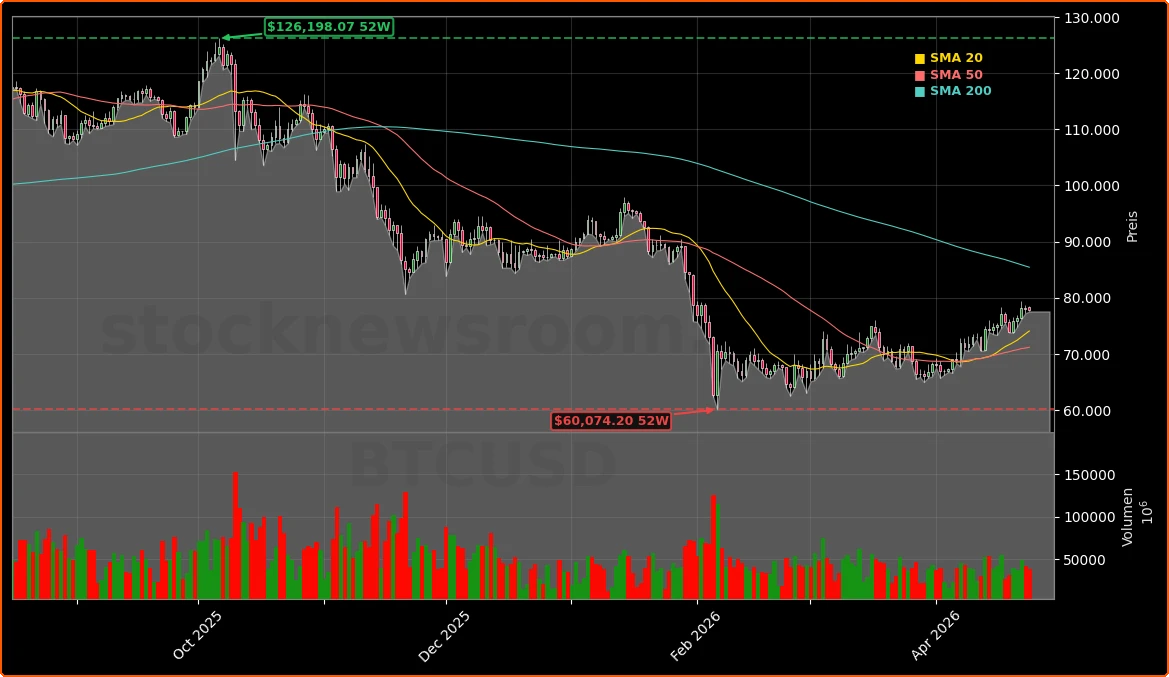
Bitcoin has already proven that six-figure territory is possible, with the price surging past $100,000 and topping out near $126,198 in 2025 before a deep correction set in. The subsequent decline dragged BTC back toward the high-$70,000s, a move that shook out many late-cycle speculators and triggered profit-taking by long-term holders who had accumulated during earlier phases of the bull market.
Despite the intensity of that pullback, the drawdown of roughly 52% from peak to trough still fits the historical pattern of major Bitcoin corrections. Previous cycles have seen deeper losses, yet ultimately resolved with new highs as underlying demand reasserted itself. In this cycle, the selloff was amplified by an exchange-related incident, concerns over institutional trading counterparties and a spike in global geopolitical uncertainty.
From a Bitcoin Market Analysis standpoint, that context matters for U.S. investors weighing whether BTC belongs alongside large-cap tech like NVIDIA, Apple or Tesla in growth-oriented portfolios. The recent consolidation near $78,000 suggests the market is stabilizing rather than capitulating, with price holding above key technical support levels around $75,000–$77,000.
What are derivatives saying about sentiment?
Derivatives markets are sending a mixed but increasingly intriguing signal. Bitcoin futures open interest has climbed sharply, with total open interest surpassing $62 billion as traders reposition for potential upside. Within an hour of renewed diplomatic talk headlines out of Washington and Tehran, open interest on major venues rose, reflecting a quick build-up of bullish bets.
At the same time, funding rates on leading exchanges remain negative on a 30‑day cumulative basis, indicating that many traders are still paying to maintain short exposure even as spot prices grind higher. One on-chain analyst notes that cumulative funding around -4.5% echoes the late‑2022 “disbelief” phase, when BTC began recovering from its bear-market lows while sentiment stayed stubbornly bearish.
Another derivatives specialist points out that the short-term futures premium over spot has nearly vanished, with the 7‑day basis sliding toward zero while the 30‑day basis holds modestly positive. That compression shows the market is no longer willing to pay up for aggressive long leverage in the near term. In a Bitcoin Market Analysis framework, this combination — rising open interest, negative funding and compressed basis — often precedes sharp moves as crowded short positions risk being squeezed if spot continues to firm.
Why do geopolitics and equities matter now?
The latest BTC upswing has unfolded against a backdrop of easing risk aversion on Wall Street. The S&P 500, Nasdaq 100 and Dow Jones Industrial Average each bounced about 1% after signs that U.S.–Iran tensions might de‑escalate and ceasefire arrangements could be extended. That risk-on shift spilled over into crypto, helping Bitcoin reclaim the $78,000 area and put the $80,000 psychological threshold back within reach.
Yet there are warning flags: 24‑hour BTC trading volume fell roughly 30% even as the price moved higher, a divergence that often signals a rally built on thin participation. For U.S. traders used to deep liquidity in mega-cap tech and index ETFs, this setup implies that swift reversals remain possible if geopolitical headlines sour or if equity markets lose momentum.
Even so, Bitcoin’s technical backdrop has improved. BTC recently bounced from support near $75,000, cleared resistance at $76,500 and $77,500, and briefly pushed above $79,000 before a modest pullback. The price is currently holding above its 100‑hour moving average, with a bullish trend line offering support near $78,000. As long as $77,000–$77,200 holds, technicians see scope for retests of $79,000, $79,500 and potentially $80,000–$82,000.
Bitcoin Market Analysis: What role does the macro cycle play?
A growing camp of macro-focused analysts argues that the last move above $100,000 occurred under unusually restrictive conditions, during a contractionary business cycle that typically weighs on risk assets. The fact that Bitcoin still managed to break into six‑figure territory in that environment is seen as evidence of robust underlying demand.
Recent data now point to the business cycle moving back above a neutral threshold for several consecutive months, signaling a transition toward economic expansion. For U.S. investors accustomed to pairing growth stocks with alternative assets, this shift could be pivotal. If monetary and fiscal conditions remain more supportive, crypto could benefit alongside high-beta segments of the Nasdaq, particularly if correlations with tech remain elevated.
On the demand side, large-scale corporate buyers led by prominent Bitcoin advocates continue to accumulate, reportedly absorbing 10,000–30,000 BTC per week. While not in the same sector, this type of balance-sheet-driven demand mirrors the way firms like Tesla and NVIDIA became institutional staples once their growth stories solidified. For Bitcoin, persistent corporate and institutional accumulation provides a structural floor that purely retail-driven cycles lacked.
Each time such a strong consensus has formed against Bitcoin’s price, it has instead helped create a bottom and fueled the rally that was beginning to develop.— Darkfost, on-chain derivatives analyst
Within this broader Bitcoin Market Analysis, some experts now frame the 2025 high near $126,000 not as the final top, but as a first major peak in an extended cycle. They expect BTC to reclaim $100,000 as macro conditions improve and derivatives markets normalize, with the next major cycle high potentially emerging around 2027.