
Can a single Intel earnings beat and AI-fueled guidance really justify a record-breaking rally in this old-guard chip giant?

How did Intel Earnings beat Wall Street?
Intel Corporation reported Q1 2026 revenue of $13.6 billion, up 7% year over year and well ahead of consensus expectations around $12.4 billion. On a non-GAAP basis, adjusted earnings per share came in at $0.29, more than double the $0.13 recorded a year earlier and far above the roughly $0.01–$0.02 analysts had modeled. GAAP results were weighed down by restructuring and impairment charges, including a sizable hit tied to the Mobileye unit and broader cost-cutting.
Non-GAAP gross margin improved to 41%, up from 39.2% a year ago, while non-GAAP operating margin more than doubled to 12.3% from 5.4%. Management also highlighted a sixth consecutive quarter of revenue coming in above internal expectations, underscoring that the Intel Earnings rebound is not a one-off surprise but part of a gradual operational reset.
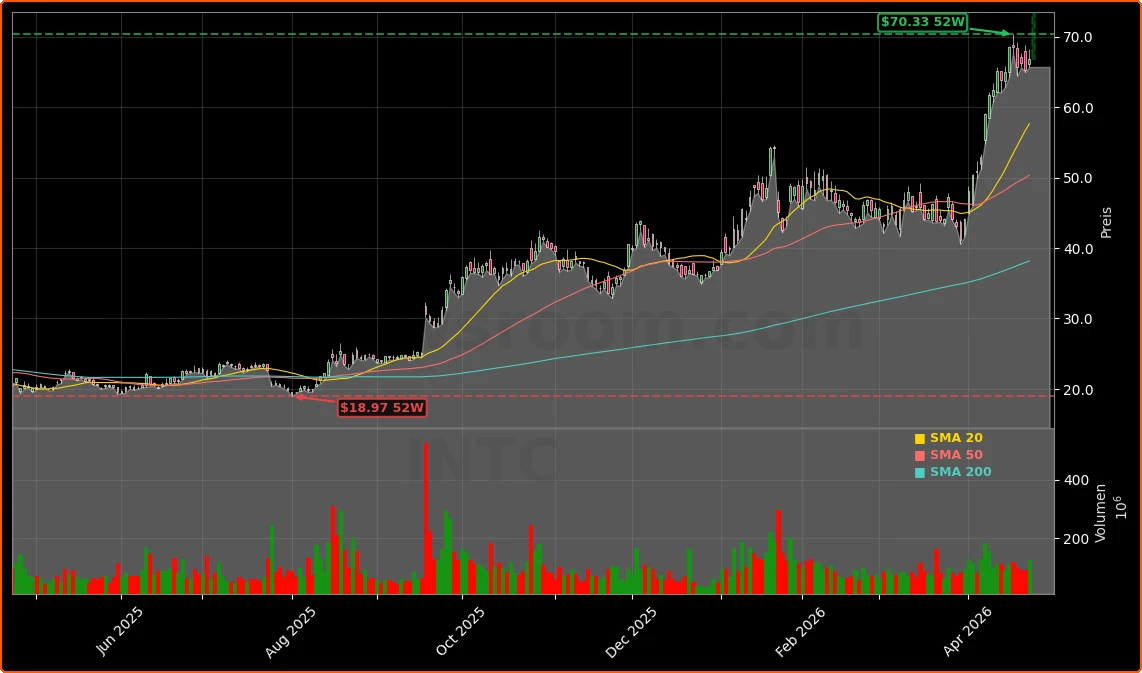
Market reaction was immediate. Intel shares closed the regular session at $66.78, up 2.31% on the day, then surged to roughly $79.67 in after-hours trading, a gain of more than 19% and above the company’s prior record closing high from 2000.
What is driving Intel in the AI cycle?
The core narrative around these Intel Earnings is simple: the AI boom is no longer just a GPU story. CEO Lip-Bu Tan emphasized that the “next wave of AI”—moving from foundational models to inference and agentic systems—is dramatically increasing the need for CPUs and advanced packaging. In Q1, Intel’s Data Center and AI segment revenue jumped about 22% year over year to $5.1 billion, handily beating Wall Street expectations and confirming that server CPU refresh cycles are accelerating.
The Client Computing Group, Intel’s PC-centric unit, delivered about $7.7 billion in revenue, up 1% despite industry headwinds from a global memory shortage pushing up system prices. Management noted that AI-related workloads now account for roughly 60% of company revenue, up sharply versus last year, as CPUs increasingly act as the orchestration layer in complex AI stacks that also involve accelerators from rivals like NVIDIA.
Strategic wins underscore this shift. Intel’s Xeon 6 processors have been selected as the host CPU for NVIDIA’s DGX Rubin NVL8 systems, keeping Intel at the center of high-end AI infrastructure even where it does not sell the primary accelerators. New multiyear collaborations with Google for Xeon-based cloud instances and custom infrastructure processing units further anchor Intel’s CPUs in hyperscale AI deployments.
How is Intel’s foundry strategy evolving?
Beyond short-term Intel Earnings strength, Wall Street is laser-focused on the company’s foundry pivot. Intel Foundry revenue reached $5.4 billion in Q1, up 16% year over year, though the unit still posted an operating loss of about $2.4 billion. External foundry sales are still modest—around $174 million in the quarter—but management highlighted improving yields on the leading-edge Intel 18A process and even faster progress on the upcoming 14A node.
The strategic importance of this was underlined by a newly formalized partnership with Elon Musk’s Terafab initiative, alongside SpaceX and Tesla, where Intel will help design, manufacture and package ultra-high-performance chips at scale. Musk has publicly signaled plans to use Intel’s 14A process once it matures, potentially making Intel a key manufacturing partner in future AI and robotics programs.
Financially, the foundry push is being supported by a strengthened balance sheet and substantial government backing. The U.S. government now holds roughly a 9–10% strategic stake, aligning Washington’s CHIPS Act ambitions with Intel’s domestic manufacturing build-out and helping crowd in private capital from partners such as NVIDIA and other institutional investors.
What does the new guidance signal for Intel Earnings?
Looking ahead, Intel guided for Q2 2026 revenue between $13.8 billion and $14.8 billion, implying roughly 11% growth at the midpoint versus the prior year and again beating analyst expectations that sat near $13.1 billion. The company expects GAAP EPS of about $0.08 and non-GAAP EPS of $0.20, double current consensus estimates around $0.09.
On profitability, Intel sees non-GAAP gross margin around 39% in Q2, down sequentially from Q1’s 41% but still comfortably above what many on Wall Street had penciled in. Full-year 2026 non-GAAP operating expenses are targeted near $16.5 billion, implying ongoing cost discipline even as capital expenditures for tools are set to rise about 25%. Management reiterated expectations for positive adjusted free cash flow for the full year, a critical milestone for income-oriented U.S. investors who had worried about dilution and leverage during the heavy investment phase.
Sentiment has shifted rapidly. HSBC recently upgraded Intel from Hold to Buy, with analyst Frank Lee lifting his price target from $50 to $95, citing “game-changing server CPU potential” that is still underappreciated. That call, combined with these Intel Earnings and guidance, is feeding a narrative that Intel could become a sustained AI infrastructure winner alongside established leaders like Apple in consumer devices and cloud-focused chip designers.
Related Coverage
For a deeper dive into how Wall Street was positioning ahead of this report, including bullish calls on server CPU growth and valuation re-rating potential, see Intel Forecast Boom: AI Server Cycle and Bold Upgrades. That analysis unpacks why some analysts argued the AI-driven server cycle and upgraded outlook could turn the tide for Intel Earnings even before the latest numbers confirmed the momentum.
A year ago, the conversation about Intel was about whether we could survive. Today, it’s about how quickly we can add manufacturing capacity and scale our supply to meet enormous demand for our products.— Lip-Bu Tan, CEO of Intel Corporation
In summary, the latest Intel Earnings confirm that the company is finally translating its AI narrative into tangible revenue growth, margin expansion and a powerful share-price reaction. For U.S. and global investors, Intel is re-emerging as a core semiconductor holding with leverage to both AI data centers and onshoring policy tailwinds. The next few quarters will show whether growing foundry wins and sustained CPU demand can keep this comeback on track and justify the stock’s sharply higher valuation.