Is the latest Atlassian Plunge just a routine tech shakeout or an early warning for richly valued cloud software stocks?

What is driving the Atlassian Plunge today?
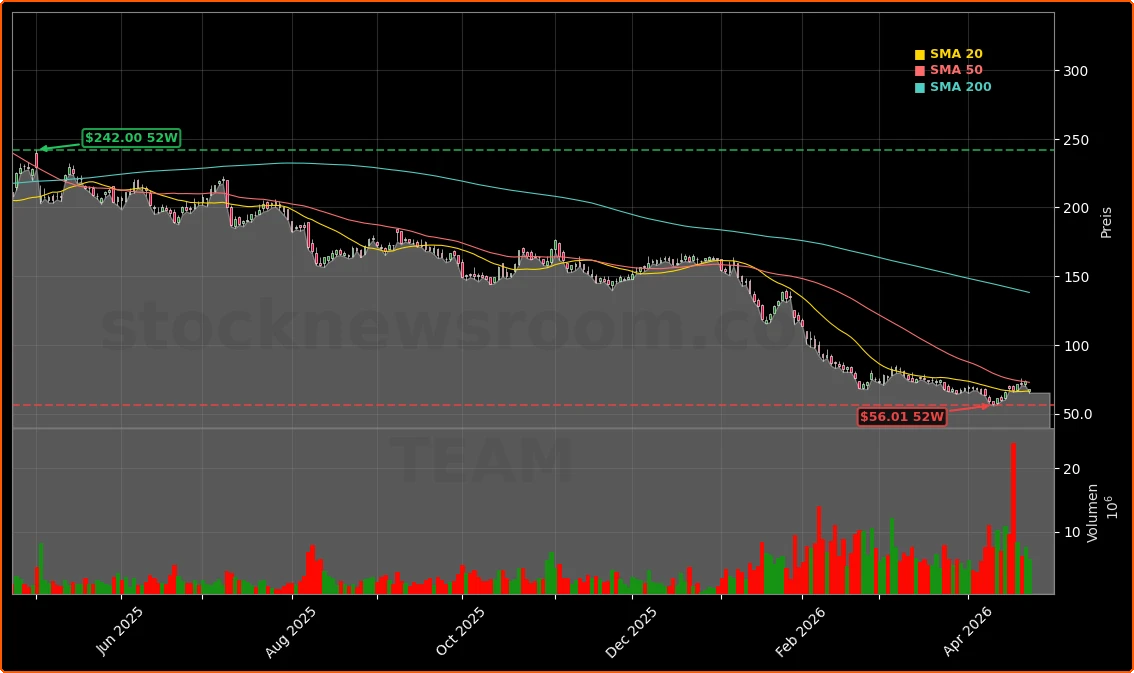
The latest Atlassian Plunge leaves TEAM down more than 8% in a single session, with the stock changing hands at $67.67 versus a previous close of $70.00. While there is no single headline catalyst in focus, traders point to a mix of fading enthusiasm for richly valued cloud software, ongoing rotation into more profitable technology leaders such as NVIDIA and Apple, and lingering worries about the pace of enterprise IT spending. After a strong multi‑year run fueled by demand for digital collaboration, investors are now scrutinizing margins, cash flow and sustainable growth more closely.
The pullback comes as broader tech indices trade choppily. On the NASDAQ, high‑multiple software names have lagged mega‑cap hardware and AI beneficiaries. Against that backdrop, the Atlassian Plunge looks less like a company‑specific collapse and more like part of a wider de‑risking in growth software. Still, the size of the intraday move shows just how sensitive TEAM has become to changes in risk appetite.
How does Atlassian Corporation stack up to U.S. tech peers?
For American portfolios heavily weighted toward technology, understanding where Atlassian Corporation fits in the landscape is critical. Unlike platform giants Apple or AI leaders like NVIDIA, Atlassian is not a component of the Dow Jones Industrial Average and does not dominate the S&P 500, but it remains a widely held name among growth and innovation funds. Its products such as Jira and Confluence are deeply embedded in software development and project management workflows across the globe.
Compared with more cyclical innovators such as Tesla, Atlassian’s revenue base is largely subscription‑driven, with relatively high visibility and low churn. That has historically justified a premium valuation. But as interest rates remain elevated and investors demand stronger free cash flow profiles, that premium is under pressure. The Atlassian Plunge reflects this shift: Wall Street is now rewarding scale, profitability and AI leverage more than pure top‑line growth, and TEAM is being repriced accordingly.
At the same time, competition in collaboration and developer tools remains intense, with large platforms from Microsoft and others bundling similar capabilities at aggressive price points. This competitive backdrop makes it harder for Atlassian to simply rely on past momentum to support its stock price.
How are analysts reacting to the Atlassian Plunge?
Major Wall Street houses remain divided on TEAM. Firms such as Morgan Stanley and Goldman Sachs have in recent months highlighted both the strength of Atlassian’s developer ecosystem and the risk that slower macroeconomic conditions could weigh on new seat additions and expansion deals. While specific ratings and targets vary, several research desks have shifted to more neutral stances, reflecting a belief that much of the medium‑term growth story is already priced into the shares.
Citi Research and RBC Capital Markets, for example, have in prior quarters framed Atlassian as a high‑quality asset whose valuation leaves less margin for error. In that context, the Atlassian Plunge can be seen as the market aligning the share price more closely with realistic growth and margin trajectories. Any future upgrades from houses like Citigroup, JPMorgan or RBC Capital will likely hinge on clear evidence that large‑enterprise demand remains resilient and that cost discipline is supporting operating leverage.
For now, the tone from the analyst community is that TEAM is transitioning from a pure growth story to a balanced growth‑and‑profit narrative, which could support the stock over the long run but also produce volatility quarter to quarter.
What should U.S. investors watch next?
For U.S. investors evaluating whether the Atlassian Plunge represents a buying opportunity or a warning sign, several catalysts stand out. First, upcoming earnings will be crucial. Any commentary from Atlassian Corporation on net new customer additions, cloud migration progress and large‑enterprise deal activity could either calm fears or reinforce the current pessimism. In addition, updated guidance on revenue growth and operating margins will be watched closely by institutional investors and the analyst community.
Second, the broader technology backdrop on the NASDAQ and S&P 500 remains a key driver. If the recent shift toward profitable, AI‑exposed leaders like NVIDIA and Apple continues, software names without a clear AI monetization angle may remain under pressure. Conversely, a stabilization in bond yields and a renewed appetite for growth stocks could help TEAM recover some lost ground.
Finally, corporate actions such as potential cost‑optimization initiatives, strategic acquisitions in adjacent tools, or more explicit capital allocation policies could influence sentiment. With the stock now well below recent peaks but not at 52‑week lows, the Atlassian Plunge has put the shares in a valuation zone where both downside risks and upside optionality warrant close attention.