
IBM Earnings beat expectations, so why did the stock suddenly plunge as investors questioned the company’s AI and software momentum?

Why did strong IBM Earnings trigger a sell-off?
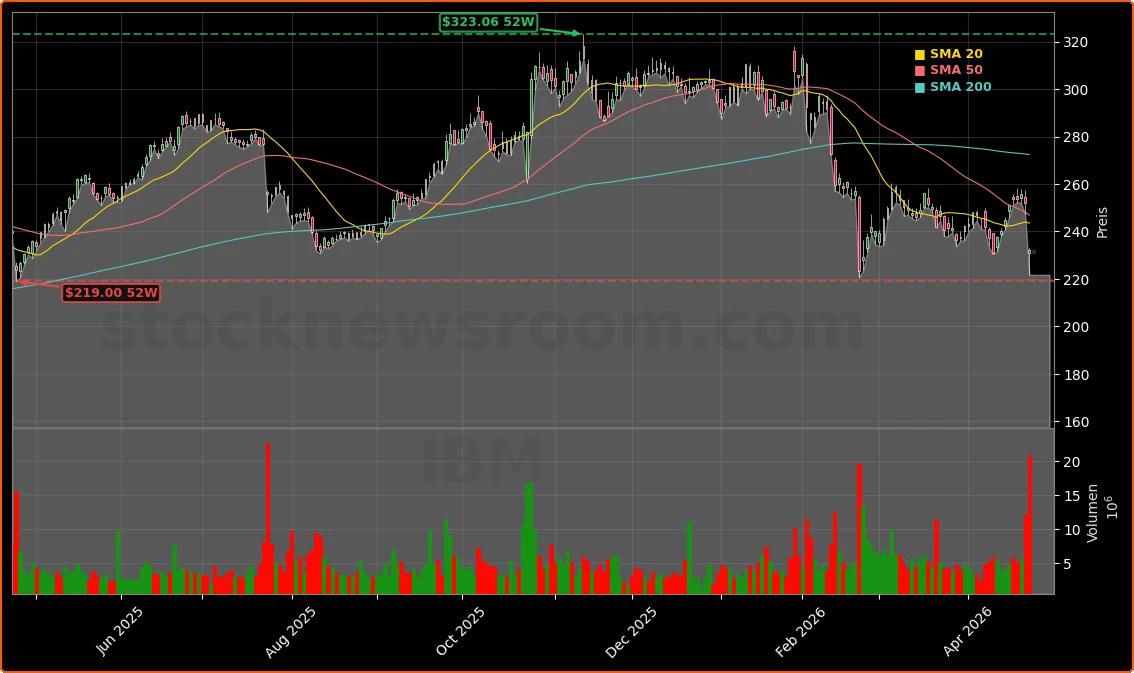
International Business Machines Corporation closed Thursday at about $231, down roughly 8% on the day and near the bottom of its 52‑week range, even after posting better‑than‑expected Q1 2026 results. Revenue rose 9% year over year to $15.92 billion, topping consensus estimates of around $15.6 billion. Adjusted earnings came in at $1.91 per share, about $0.10 ahead of forecasts, extending IBM’s streak of quarterly beats.
Despite that solid scorecard, the market reaction was harsh. Into the report, IBM had already underperformed the S&P 500 in 2026, and positioning in software and AI beneficiaries was crowded. When management chose to reaffirm, rather than raise, its full‑year outlook – targeting constant‑currency revenue growth of more than 5% and about $1 billion of year‑over‑year free cash flow improvement in 2026 – many investors saw the IBM Earnings beat as insufficient to justify richer AI‑style valuations.
CFO Jim Kavanaugh reminded analysts that IBM has historically avoided raising guidance in the first quarter, calling the stance “prudent” in an uncertain macro and geopolitical environment. But for traders increasingly treating IBM as a software and AI story, in‑line guidance simply was not enough.
How are IBM segments performing after Q1?
Beneath the headline IBM Earnings, segment trends were mixed but broadly positive. Software remained the largest business at $7.05 billion in revenue, growing about 11% year over year, with annual recurring revenue up 10% in constant currency to $24.6 billion. The Red Hat unit accelerated to around 10–13% growth, and data and AI‑related offerings benefited from early contributions from the recent Confluent acquisition.
Infrastructure surprised to the upside, with revenue up roughly 12–15% in constant currency to about $3.3 billion. A new z17 mainframe cycle powered a roughly 48–51% surge in IBM Z hardware sales, while hybrid infrastructure revenue jumped 25%. That hardware strength helped expand operating margins, with operating income up more than 20% and operating pre‑tax margin improving by over 100 basis points.
The weak spot was consulting, where revenue grew just about 1–4% to roughly $5.3 billion, lagging expectations and decelerating relative to IBM’s software momentum. That matters because management has previously highlighted a generative AI engagement “book of business” exceeding $12 billion, and roughly 80% of that opportunity sits in consulting. Slower growth there fuels concerns that AI‑native rivals and established players like Accenture could erode IBM’s most profitable transformation projects over time.
What do IBM Earnings mean for AI and software fears?
The IBM Earnings release underscored a key tension on Wall Street: IBM argues that AI is a tailwind, not a threat, while parts of the market are treating AI as a disruptive force for legacy software and services. CEO Arvind Krishna emphasized that IBM’s hybrid cloud stack, Red Hat, data fabric and AI governance tools are helping enterprises orchestrate and deploy AI at scale across complex environments.
The company is also leaning on its internal “client zero” program, where it applies its own AI and automation tools to IBM’s operations. Kavanaugh has said that this initiative has already driven roughly $4.5 billion in annual productivity at exit run rate over the past several years, with another $1 billion expected this year. IBM frames this as proof that its AI offerings can deliver measurable value for clients grappling with similar modernization and cost‑efficiency challenges.
Still, software growth of around 8% in constant currency fell short of IBM’s newly raised full‑year target of 10%+ for the segment, implying an acceleration later in 2026. After recent AI‑driven shocks to other software names, from ServiceNow to Oracle, some investors remain skeptical that legacy platforms like mainframes and traditional middleware can sustain double‑digit software expansion in a rapidly evolving AI stack dominated by players such as NVIDIA and hyperscalers like Apple’s ecosystem partners.
How are analysts reacting to the latest IBM Earnings?
Sell‑side reaction to the IBM Earnings print has been mixed but not disastrous. BMO Capital’s Keith Bachman kept a “Market Perform” rating while cutting his price target from $290 to $270, citing the lack of a guidance raise and lingering concerns around software and consulting growth. Morgan Stanley’s Erik Woodring maintained an “Equal‑Weight” stance and nudged his target up from $215 to $225, calling the decision to hold guidance steady reasonable given geopolitical risks and patchy European demand.
Goldman Sachs analyst James Schneider reiterated a bullish view, arguing that IBM’s ongoing efficiency measures support “steady, predictable earnings growth” and that free cash flow should rise as the year progresses. However, JPMorgan trimmed its target to $270 from $283, flagging incremental risk to software and consulting. Other firms, including Bank of America and UBS, have highlighted that while Q1 execution was solid, the quarter did not deliver the kind of AI‑driven upside surprise that might reset the long‑term growth narrative.
Valuation is another piece of the puzzle. After the sell‑off, IBM trades around 21x forward earnings – no longer cheap in absolute terms, but below the multiples enjoyed by high‑growth cloud and AI leaders like NVIDIA or high‑beta innovators such as Tesla. With IBM also declaring a quarterly dividend of $1.69 per share, marking its 31st consecutive annual increase, income‑oriented investors may see the pullback as a chance to accumulate a defensive tech name at a discount.
Related Coverage
For a deeper dive into how deals are reshaping the IBM story, investors can review coverage of IBM’s $11 billion Confluent acquisition, which explores how the data‑streaming specialist fits into IBM’s hybrid cloud and AI ambitions and why the transaction initially lifted the stock. Together with the latest IBM Earnings discussion, that analysis helps clarify how acquisitive growth, AI positioning and market expectations are interacting in real time for International Business Machines.
As clients scale use cases, AI continues to be a tailwind for our global business.— Arvind Krishna, IBM chairman and CEO
In summary, the latest IBM Earnings showcased the company’s strongest first‑quarter growth in years, solid margin expansion and a still‑intact balance sheet, yet an unchanged full‑year outlook and consulting softness weighed heavily on sentiment. For U.S. investors, the stock’s pullback toward the lower end of its 52‑week range puts more emphasis on dividend yield, free‑cash‑flow delivery and the pace of AI‑driven consulting recovery. The next few quarters will reveal whether IBM can turn today’s AI anxieties into sustained software and services acceleration that rewards patient shareholders.