Can Intel Earnings really support a 260% AI-fueled rally, or is the market about to rewrite the turnaround story?

Will Intel Earnings cool the AI chip frenzy?
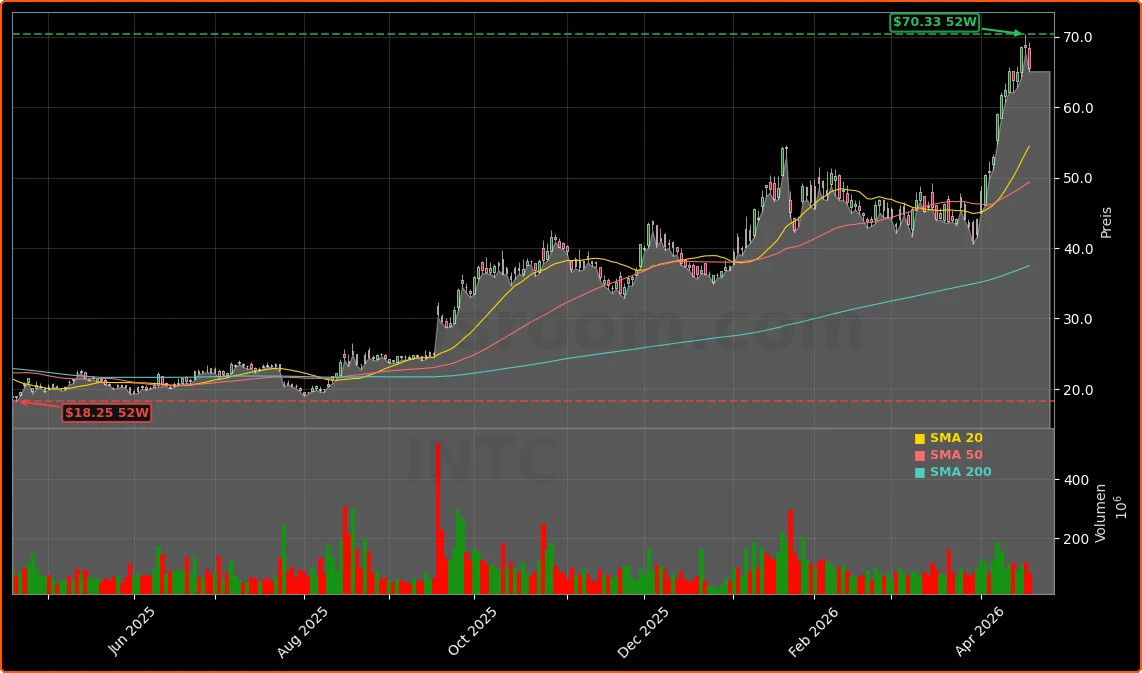
This week’s Intel Earnings land in a market that has priced in perfection for AI infrastructure plays across the NASDAQ and S&P 500. Chipmakers and AI-infrastructure stocks were under pressure on Monday, with Intel Corporation (INTC) sliding more than 4% intraday, leading decliners in the Nasdaq 100. That weakness follows a powerful run in which Intel joined Marvell and Advanced Micro Devices at fresh 52-week highs last Friday, buoyed by enthusiasm for AI data centers and a belief that Intel is finally clawing back relevance.
At around $65.48, Intel now trades slightly above Stifel’s $65 price target, even though the firm still only rates the stock at “Hold.” Stifel previously carried a much lower $42 target, badly underestimating the scale of the recent rally. Meanwhile, Morgan Stanley recently lifted its Intel target to $56 from $41, but also kept an “Equal-weight” stance, signaling that major Wall Street banks see upside already stretched relative to risk.
The backdrop makes the coming Intel Earnings update pivotal, not just for Intel but for sentiment toward high-multiple AI beneficiaries like NVIDIA and AMD that dominate the wider chip narrative.
Can Intel justify a 260% rally and triple-digit P/E?
Intel shares have exploded higher, gaining about 55% over the past month alone and roughly 260% over twelve months. That performance dwarfs many S&P 500 constituents and has turned a once-written-off legacy chipmaker into one of this earnings season’s most closely watched names. Yet the fundamentals are still in transition: the current price implies a trailing P/E near 100, with the equity story hinging on earnings growth that would push that multiple closer to 20 by 2029.
The last reported quarter highlighted this tension. Intel generated about $13.7 billion in revenue, down 4% year over year, while adjusted EPS ticked up modestly to $0.15 from $0.13. The bright spot was the data center and AI segment, where revenue grew 9% to $4.7 billion, reflecting progress in winning AI and cloud workloads. However, management also warned that Q1 would likely mark a supply trough before conditions improve in the second quarter and beyond, adding execution risk to an already demanding turnaround.
For US investors, the question is whether Intel Earnings can convincingly show that this supply squeeze is temporary and that the second-half acceleration baked into many models remains realistic. With a market cap around $330 billion and no GAAP profitability, any sign of margin pressure or demand slippage could trigger a sharp de-rating.
How does Intel stack up against AI competitors?
While Intel is positioning itself as a core AI infrastructure and foundry player, the competitive landscape is fierce. NVIDIA continues to dominate AI accelerators, while AMD is attacking data center share with its own GPU and CPU platforms. Recent analysis of AMD’s AI franchise underscores how investors are still debating whether its momentum is durable enough to rival Nvidia and Intel across data centers and high-performance computing.
At the same time, Morgan Stanley expects the rise of agentic AI — systems that can plan and execute tasks autonomously — to broaden spending from GPUs to CPUs and memory. That shift could be a structural positive for Intel, as data center CPU demand could swell by tens of billions of dollars by 2030. Memory-focused names like Micron are already seeing aggressive price target hikes on the back of AI-driven shortages, illustrating how capital is flowing to multiple layers of the stack.
Within this context, the upcoming Intel Earnings need to reinforce the narrative that Intel’s manufacturing investments and foundry ambitions will translate into a durable slice of AI compute, not just a short-lived sentiment trade. Any commentary about new marquee customers or expanded foundry commitments would likely be cheered by Wall Street.
What are options and volatility saying about Intel?
Despite the dramatic share-price move, implied volatility in Intel options has remained relatively subdued versus high-octane names like Tesla. Intel’s implied volatility rank recently sat near 10, signaling that the options market is not fully pricing a blowout move even as the stock trades near a multi-year inflection. Still, there have been notable bullish bets: roughly 1,300 June call contracts with a $70 strike traded recently, with traders spending over $600,000 to position for further upside.
Monday’s slide of more than 4% to $65.48 from a prior close of $68.25 shows how fragile sentiment can be ahead of Intel Earnings. Chip stocks broadly have corrected after a strong start to the reporting season, and this week alone will see results from companies representing roughly $10 trillion in combined market capitalization, including Intel and high-profile names across technology, healthcare and aerospace. Any disappointment from Intel could spill over into AI hardware leaders, cloud operators and even mega-cap tech in the NASDAQ Composite.
Related Coverage
For a deeper dive into how Intel’s AI ambitions extend beyond this quarter, including its new alliances with Google and Elon Musk, see this analysis of Intel AI partnerships and the recent rally. The piece explores whether those partnerships truly support today’s near-record valuation after years of lagging peers. Investors also watching the broader semiconductor ecosystem should read this look at Taiwan Semiconductor’s earnings and the 58% options yield boom, which examines whether ultra-high income strategies on chip leaders are still worth the risk.
In the end, Intel Earnings now represent a high-stakes referendum on an ambitious turnaround, an AI-fueled narrative and a stock that has already delivered a 260% twelve-month rally. For US investors, the report will help determine whether Intel belongs alongside today’s AI leaders in long-term portfolios or if expectations have run too far ahead of reality. The next few days should show whether Intel can convert hype into hard numbers and keep its comeback story intact.