Is the Tesla FSD dispute about to turn a fragile Q1 earnings setup into a legal and regulatory storm for TSLA investors?

How fragile is sentiment before Tesla’s Q1?
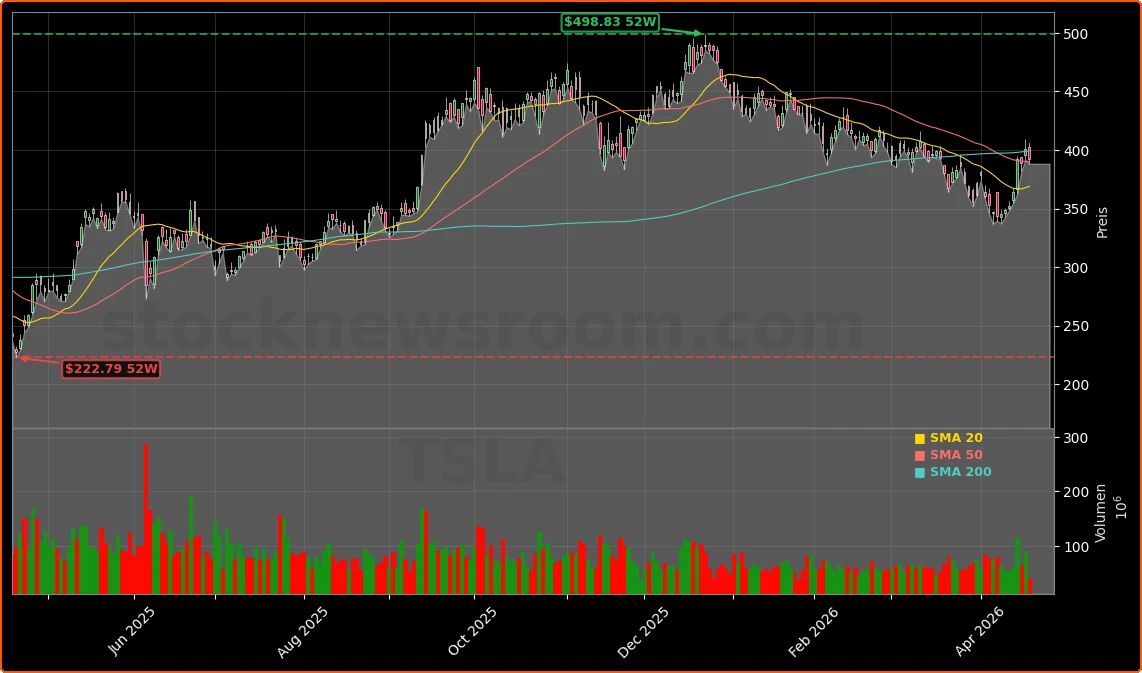
Tesla (TSLA) heads into Wednesday’s after-hours Q1 release as one of the most consequential reports of the season, not only for EVs but for the NASDAQ and S&P 500 as a whole. The stock, now at $392.44 versus a prior close of $401.05, has rallied sharply off its lows, helped by short-covering and a break of a months-long downtrend, but remains below recent peaks and vulnerable to disappointment. Options markets are pricing elevated implied volatility, with traders positioning via leveraged products and short-term puts for a substantial move in either direction.
Street revenue expectations cluster around $21–22 billion, with the focus squarely on automotive gross margin after weak Q1 deliveries and ongoing price pressure. Tesla’s energy storage and services segments are expected to contribute more meaningfully, but the real driver of the narrative is whether management can shift attention from cyclical EV demand to secular growth in AI, robotics and autonomy. That pivot is complicated by the growing Tesla FSD dispute, which calls into question past promises even as the company accelerates its robotaxi rollout.
What does EU FSD approval really change?
Regulators in the Netherlands recently granted approval for Tesla’s supervised Full Self-Driving system on city streets, making Amsterdam one of the first European testbeds for hands-free driving. Early users describe a system that can steer, accelerate and brake independently, while still requiring an attentive driver ready to intervene. The move marks a significant regulatory milestone and gives Tesla a high-profile European showcase for its software-led strategy.
In the U.S., Tesla has simultaneously expanded its geofenced robotaxi service from Austin to Dallas and Houston, signaling confidence in the technology’s commercial readiness. That expansion supports bullish narratives from firms like Zacks Investment Research, which argues that autonomy, energy storage and robotics could offset near-term EV softness. Yet the same week that Elon Musk celebrated the “first FSD approval in Europe,” the Tesla FSD dispute erupted among early adopters whose vehicles use older HW3 computer hardware, which cannot run the newly approved software.
Why is the Tesla FSD dispute escalating?
Between 2019 and 2023, Tesla sold roughly four million vehicles with its HW3 computer, marketing them as having all the hardware needed for future Full Self-Driving. Many customers paid significant upfront fees — up to about EUR 7,500 in Europe and $15,000 in the U.S. — for FSD capability that was promised to arrive via over‑the‑air software updates once regulators signed off. With the first European approval now limited to newer HW4 hardware, HW3 owners are organizing around the claim that their cars cannot realistically support the approved FSD software due to insufficient compute and memory.
A Dutch Model 3 owner has launched a dedicated website to bundle claims from HW3 + FSD buyers, quickly attracting thousands of sign‑ups spanning nearly 30 countries and drawing interest from mass-litigation law firms. U.S. plaintiffs’ attorneys are also exploring avenues as part of a broader Tesla FSD dispute that already includes suits over alleged misrepresentation of Autopilot and FSD capabilities. For now, most analysts see the risk as reputational and executional rather than an existential balance-sheet threat, but a large, coordinated class action could become a material overhang on the stock’s valuation.
How are analysts and Wall Street reacting?
On the sell side, views remain split. UBS analyst Joseph Spak recently upgraded Tesla from “Sell” to “Neutral” and lifted his price target to $352, arguing the stock has fallen back to a “more reasonable level” that better balances short-term demand issues with long-term AI and robotaxi opportunities. Jefferies analyst Philippe Houchois maintained a cautious stance but raised his target from $300 to $350, warning that Q1 will highlight how far Tesla’s aspirations have drifted from current fundamentals. Stifel’s Stephen Jangaro continues to rate Tesla a “Buy” with an aggressive $508 target, basing much of his valuation on FSD subscriptions and a future robo‑taxi network rather than on the core auto business.
Fresh commentary from U.S. brokerages on Monday underscored that division. Jefferies reiterated Tesla as a Hold in a broad analyst call roundup, while Zacks flagged the stock as a potential earnings surprise candidate in its Q1 preview. Meanwhile, some options-focused desks highlight heavy put activity, with traders looking to fade the recent rally on any disappointment in guidance, margins or clarity around the Tesla FSD dispute and related legal risks.
Is competition closing in on autonomy and China?
Strategically, Elon Musk has downplayed Chinese rival BYD, arguing that the company is only dominant “until supervised FSD is approved in China.” In his view, Tesla’s main constraint is manufacturing capacity in Shanghai once software restrictions ease. To support that thesis, Tesla has set up a dedicated FSD training center in China to adapt its models to local traffic conditions, and a broad approval for supervised FSD there later this year is seen as plausible by many observers.
Yet competition is intensifying. BYD remains a far larger player when hybrids are included, and tech groups such as Xiaomi and Huawei are pushing advanced driver-assistance systems into mid-range vehicles, often without hefty software premiums. In robotaxis, Uber is investing heavily, and EV peer Lucid is partnering on autonomy as it tries to stabilize its own premium strategy. Domestically, Tesla also faces rising expectations around Optimus humanoid robots and the Cyber‑Cap platform without steering wheel or pedals — expensive, capital-intensive bets that have yet to materially contribute to earnings but are central to many bullish models.
Related Coverage
Investors focused on autonomy and AI should also read how a short squeeze around Tesla’s AI ambitions unfolded in “Tesla Robotaxi +3% Rally: Is the AI5 Chip a Game-Changer?”, which examines whether the company’s next‑gen AI5 chip and robotaxi roadmap can justify higher multiples. For a contrasting view on EV risk, “Lucid Strategy -5.2% Plunge Tests Lofty Valuation” explores how another premium EV maker is grappling with cash burn, recalls and a sharp share‑price decline, underscoring the sector’s volatility.
In summary, the Tesla FSD dispute adds a new layer of uncertainty just as Tesla prepares to report Q1 numbers that could reset expectations for its EV, autonomy and robotics strategy. For U.S. investors, the combination of EU FSD approval, China ambitions and potential mass litigation will likely magnify post‑earnings swings in a stock already central to many NASDAQ and S&P 500 portfolios. The next few quarters will show whether regulatory wins and software revenue can outgrow legal and execution risks and keep Tesla at the forefront of the autonomy race.