Can the Tesla Robotaxi vision and the new AI5 chip really turn a short squeeze into a lasting comeback for TSLA?

Is Tesla’s rebound more than a short squeeze?
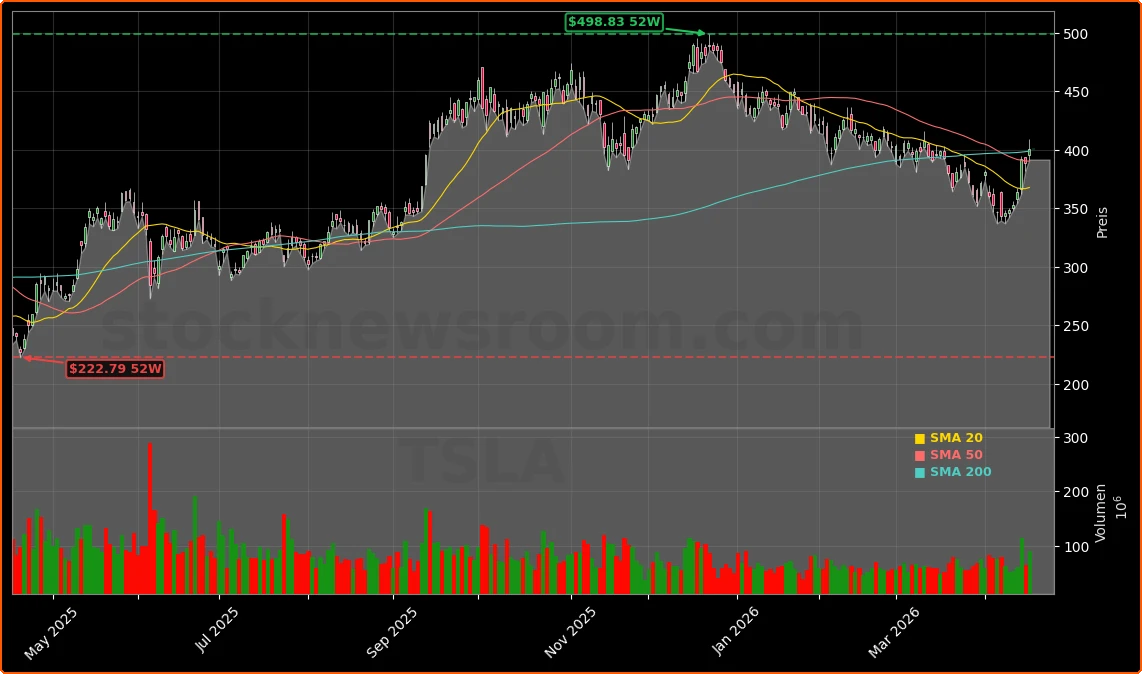
On Friday, Tesla closed at $400.62 on the NASDAQ, up 3.01% for the day and modestly higher after hours at $401.09 (+0.12%). The move caps a powerful comeback week with roughly 15% gains, making Tesla one of the strongest performers among the “Magnificent 7” alongside mega‑caps like Apple and Microsoft. Even after the rebound, the stock still trades well below its 52‑week high of $498.82 and above the 52‑week low of $222.80, leaving room for bulls and bears to argue over the next leg.
The immediate catalyst has been a combination of macro tailwinds for growth stocks and company‑specific news around the Tesla Robotaxi roadmap and the new AI5 Autopilot chip. Traders are also positioning ahead of Q1 earnings on Wednesday, April 22, when Tesla reports after the close at 4:00 p.m. ET. Wall Street currently expects adjusted EPS of roughly $0.35–$0.38 on revenue just over $22 billion, a sharp jump from about $0.12 EPS a year ago if management can hit the numbers.
At the same time, eight straight weeks of share price weakness have left positioning cleaner and short interest elevated, amplifying the impact of positive headlines. The question now is whether autonomy news—especially around a scalable Tesla Robotaxi business—can sustain the rally beyond the earnings print.
How big is the AI5 chip upgrade for Tesla?
The other major piece of the Tesla Robotaxi und AI5-Chip narrative is technical: Tesla has completed the “tape‑out” of its next‑generation AI5 Autopilot chip, meaning the final design has been locked and sent into manufacturing preparation. CEO Elon Musk has indicated that a single AI5 will deliver around five times the compute performance of the current dual‑SoC AI4 setup used in today’s vehicles.
AI5 integration into production cars is planned from 2027 onward, setting the hardware foundation for more advanced Full Self‑Driving (FSD) capabilities and, ultimately, a wider Tesla Robotaxi rollout. With more than 9.2 billion miles already driven on supervised FSD, Tesla has a data advantage versus rivals like Waymo or Cruise, but it needs the next chip generation to process larger neural networks in real time at automotive power and cost constraints.
Beyond automotive, Musk’s broader Terafab chip initiative has reportedly reached out to suppliers such as NVIDIA partners and semiconductor equipment heavyweight Applied Materials, underscoring Tesla’s ambition to vertically integrate more of its AI compute stack. For now, however, investors are most focused on what AI5 means for the unit economics of an eventual robotaxi fleet and subscription‑based FSD revenues.
What is changing in the Tesla Robotaxi rollout?
Operationally, the Tesla Robotaxi story is moving from concept to early pre‑production. Observers at the Giga Texas plant have spotted roughly 14 “Cybercab” units without steering wheels, pedals, or side mirrors—clear signs that the dedicated robotaxi vehicle is advancing beyond one‑off prototypes. Musk has previously suggested the Cybercab could cost under $30,000 to build and operate at around $0.20 per mile, dramatically below cost estimates for Waymo’s current models, which some estimates place between $75,000 and $100,000 per vehicle.
Today, fully unsupervised Tesla Robotaxi operations are limited to a small area in Austin, Texas, and the service is far from the massive global network originally envisioned. Still, Tesla plans to extend robotaxi service to Dallas, Houston, and Phoenix during the first half of 2026, subject to regulatory approvals. That staged rollout will be closely watched by investors, because it could transform Tesla from a one‑off hardware seller into a platform company with recurring, high‑margin software and mobility revenues.
The near‑term financial picture is more mixed. Tesla delivered about 358,000 vehicles in Q1, below consensus expectations of 365,000–370,000, while producing over 408,000 units, which points to rising inventory. In contrast, the energy segment continues to accelerate, with 8.8 GWh of storage deployed in the quarter. Higher gasoline prices in North America are also helping support demand for EVs, including both new and used Teslas in markets like Canada.
How are Wall Street analysts reacting?
The latest rebound has also been fueled by a shift in analyst sentiment. UBS upgraded Tesla from “Sell” to “Neutral,” setting a price target of $352 and arguing that the risk‑reward profile is now more balanced after the stock’s earlier correction. The bank highlighted progress on the AI5 chip and robotaxi roadmap as key reasons to move off a bearish stance, even while acknowledging near‑term headwinds in EV demand and rising competition from lower‑priced Chinese brands such as BYD.
Other firms are more cautious, with some on Wall Street flagging the slow pace of real‑world Tesla Robotaxi expansion beyond Austin and the San Francisco Bay Area as the main reason Tesla shares remain down about 14.5% year to date before this week’s bounce. For many institutions, the core debate is whether Tesla should still command a premium growth multiple when its EV delivery growth is slowing and the high‑margin software story is not yet visible at scale in the income statement.
Even so, consensus forecasts point to Tesla exiting 2026 with over $28 billion in net cash, giving the company ample capacity to keep investing in battery plants, lithium refining, AI compute, and robotaxis while weaker legacy automakers like Ford and Volkswagen trim back their EV ambitions. Tesla also clawed back U.S. EV market share in Q1, accounting for about 54% of industry sales, well ahead of rivals from Toyota, GM, Hyundai, and others.
Related coverage on StockNewsroom
Investors who want a deeper dive into how AI is shaping Tesla’s valuation can read our analysis in “Tesla AI Strategy +3.0% Rally: Boom or Bubble Ahead for TSLA?”, which examines whether the company’s AI narrative can justify its current market cap. For a closer look at the financial impact of autonomy subscriptions and insurance discounts, don’t miss “Tesla FSD Strategy +7.6% Rally on Insurance Shock”, where we analyze how FSD and insurance could support a future trillion‑dollar valuation if adoption scales.
In summary, the Tesla Robotaxi und AI5-Chip combination is giving investors fresh reasons to look beyond short‑term delivery volatility and focus on Tesla’s platform potential. The next few quarters will show whether a faster Tesla Robotaxi rollout, backed by the AI5 chip, can translate into meaningful high‑margin revenue rather than just headlines. For U.S. and global investors alike, Q1 earnings and subsequent autonomy updates could be pivotal in deciding whether Tesla’s latest rally is the start of a new uptrend or just another bounce in a volatile market leader.