Is the latest PayPal Forecast hinting at a deep-value comeback story or just another value trap in fintech disguise?

Is the PayPal Forecast signaling value or a trap?
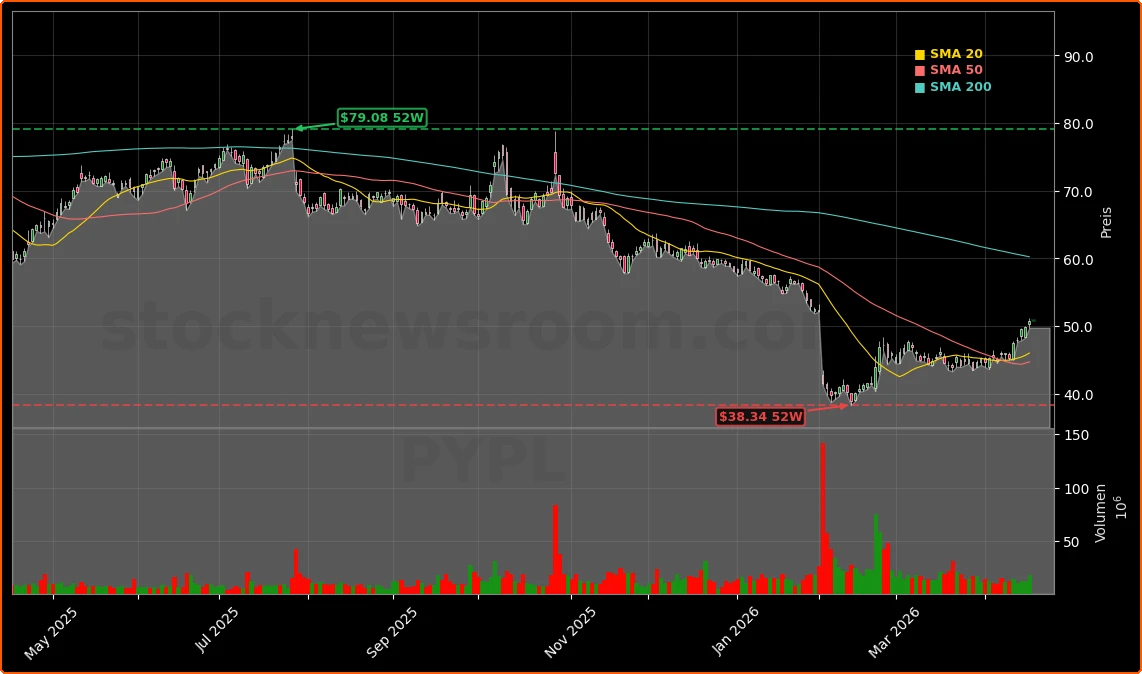
At about $50.81 at Friday’s close (after-hours $50.86, +0.10% ET), PYPL has rebounded slightly but remains down roughly 23% over the past 12 months. That underperformance versus the NASDAQ and S&P 500 sits at the center of the current PayPal Forecast: the market clearly doubts the company’s ability to reaccelerate growth and expand margins in a crowded fintech landscape.
Consensus estimates for 2026 call for revenue growth of only about 2.9% year over year, with management guiding to a mid–single digit decline in earnings per share. That combination—muted top-line progress and shrinking profit—would normally command a discounted multiple, and that is exactly what has happened. PYPL now trades around 8.9 times earnings, the lowest price-to-earnings ratio since its 2015 spin-off from eBay, aside from a brief dip earlier in 2026. Value-oriented investors, including high-profile names like Michael Burry, have reportedly taken notice of this compressed multiple.
However, recent history offers a cautionary lesson. One year ago, PYPL traded near 14 times earnings and already looked cheap. Since then, shareholders have still lost more than a fifth of their capital, underlining that a falling multiple can stay low—or move lower—when fundamentals and sentiment deteriorate.
Can PayPal leadership reverse slowing growth?
The strategic challenge facing PayPal Holdings, Inc. is structural, not just cyclical. The end of its once-exclusive partnership with eBay earlier in the decade triggered a visible deceleration in revenue growth, which inflationary pressures, softer consumer spending and rising competition have only reinforced. New CEO Enrique Lores, who stepped in after Alex Chriss, must now rebuild investor confidence in the company’s growth engine.
Management is channeling capital into areas described as “scaling new experiences, improving presentments, increasing consumer selection, as well as driving adoption of new channels.” That push, detailed on the Q4 2025 earnings call, is aimed at keeping PayPal relevant against rivals in digital wallets, checkout and peer-to-peer payments. Yet such investments tend to weigh on margins in the short term, meaning shareholders should not expect rapid profitability gains even if user engagement improves.
At the same time, PayPal is dealing with notable legal overhangs. Several securities class actions claim the company overstated its revenue outlook and growth potential, particularly around its Branded Checkout segment and related sales execution. Multiple law firms are competing to represent investors with losses above specific thresholds, with an April 20, 2026 deadline for lead-plaintiff motions. While it is too early to quantify potential financial impact, these cases add another layer of uncertainty to the 12-month PayPal Forecast.
How is Wall Street positioning around PayPal?
Institutional behavior around PYPL is mixed. Merit Financial Group LLC recently raised its stake by 14.6% in Q4, bringing its holdings to nearly 189,000 shares worth roughly $11 million. That suggests some professional investors see the risk/reward as attractive at current levels. In contrast, KBC Group NV cut its position by 7.8%, selling more than 90,000 shares, and several PayPal insiders have sold stock in recent months, even if some of the activity is tied to routine equity vesting.
Analyst sentiment broadly sits at a “Hold” consensus, with an average price target near $56.60 according to recent Wall Street surveys. That target implies modest upside from current levels, far from a high-conviction growth story but also not a call for material downside. Banks including Citigroup, Morgan Stanley and others have trimmed targets in recent months, citing competitive threats from fast-moving rivals in digital payments and super apps, such as “X Money,” as well as execution risk under new management.
The one clear shareholder-friendly lever is capital returns. PayPal plans to deploy roughly $6 billion on share repurchases in 2026, representing around 14% of its current market cap. All else equal, such a buyback could support earnings per share even if net income stagnates, and it may create a floor under the stock during periods of volatility. In a best-case PayPal Forecast scenario, that buyback amplifies any eventual recovery in earnings and sentiment.
How does PayPal stack up against fintech peers?
For US investors allocating across the NASDAQ and broader fintech space, the core decision is whether to favor growth leaders or deep value. While megacaps like Apple and NVIDIA trade at richer multiples supported by robust earnings momentum, PayPal sits closer to the “broken growth” category: a once-premium franchise now priced like a cyclical financial stock. It is also battling newer rivals in online checkout, wallets and social payments, some of which are backed by giants such as Tesla founder Elon Musk through the X ecosystem.
Compared with pure-play high-growth names, PYPL’s single-digit P/E and aggressive buyback are rare. But so is its combination of slow organic growth, legal disputes and execution questions. The next few quarters will be critical in determining whether the PayPal Forecast shifts toward stabilization—perhaps with low- to mid-single digit revenue growth and flat margins—or toward further disappointment, which could keep the multiple depressed.
Related Coverage
Investors looking for additional context on shifting Wall Street sentiment can read “PayPal Forecast Warning: Mizuho Slashes Target to $50”, which explores whether recent target cuts point to a structural downshift or a contrarian opportunity. That analysis takes a closer look at execution risks and how they compare with the valuation reset now facing PayPal.