Can record Taiwan Semiconductor Earnings really justify a 58% options yield, or are income-hungry investors walking into a trap?

How strong were Taiwan Semiconductor Earnings?
Taiwan Semiconductor Manufacturing Co. posted blistering Q1 2026 results that underscored how central it has become to the global AI build‑out. Net profit jumped 58% year over year to a record roughly $18.2 billion, beating market expectations and setting a new high-water mark for the company’s bottom line. Revenue climbed to about $35.9 billion, up more than 35% versus the prior year, as demand for leading‑edge 3‑nanometer chips and high‑performance computing accelerators surged.
On a per‑share basis, earnings of $3.49 topped consensus by roughly $0.16, confirming that Taiwan Semiconductor Earnings momentum is running ahead of analyst models. Management raised its full‑year sales outlook to more than 30% growth in U.S. dollar terms and guided Q2 revenue to the $39–$40.2 billion range, implying around 10% sequential growth. Gross margin reached an exceptional 66.2%, while net margin crossed 50%, levels that stand out even in a buoyant semiconductor cycle.
Advanced nodes are doing the heavy lifting: 3nm and 5nm technologies together generated 61% of wafer revenue in the latest quarter. High‑performance computing, including AI accelerators for hyperscale data centers and cloud providers, also contributed 61% of total revenue, highlighting how directly TSMC is tied into the AI investment wave that has powered giants like NVIDIA and pushed the broader semiconductor complex higher.
What do record profits mean for US investors?
For U.S. portfolios, the latest Taiwan Semiconductor Earnings report reinforces TSMC’s position as a cornerstone of the global tech supply chain and a critical bellwether for the NASDAQ and S&P 500’s AI leaders. The company makes chips that sit inside iPhones for Apple, GPUs for NVIDIA and infrastructure used by cloud platforms like Amazon AWS and Microsoft Azure. Stronger‑than‑expected results from TSMC therefore tend to validate bullish AI‑capex assumptions across Big Tech.
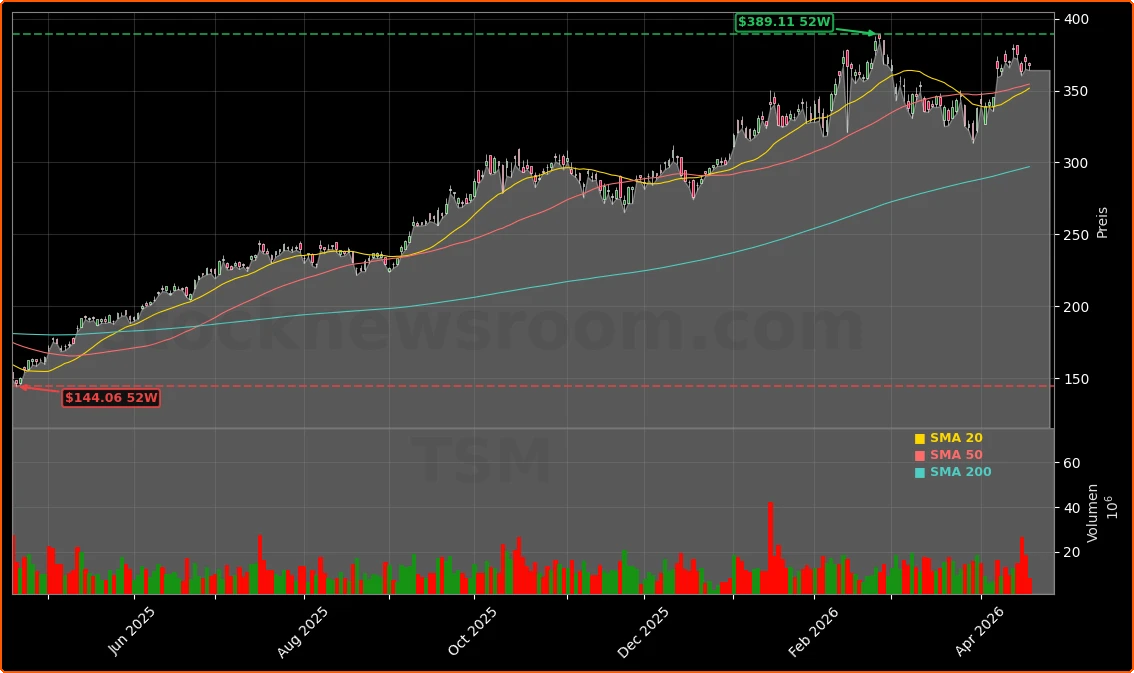
On Wall Street, institutional positioning reflects that conviction. One example: Cwm LLC recently lifted its TSMC stake by just over 5% in Q4 2025, while another large holder, Hudson Edge Investment Partners, only marginally trimmed its position and still keeps TSMC as its single largest holding at over 10% of its portfolio. Analyst sentiment is broadly constructive, with a consensus “Buy” rating and average price targets clustered around the low $400s, implying upside from Monday’s close near $368 even after a roughly 147% 12‑month run.
At the same time, valuation debates are intensifying. Some discounted cash‑flow models now flag the stock as potentially more than 50% above conservative fair‑value estimates, while earnings‑multiple comparisons versus peers like Broadcom and Tesla-like high‑growth stories in other sectors point to TSMC still being reasonably priced for its growth profile. That tension—between spectacular Taiwan Semiconductor Earnings and already‑elevated expectations—is one reason the stock has not shot to new highs immediately after the report.
Taiwan Semiconductor Earnings vs. the 58% options yield
Parallel to the fundamental story, the YieldMax TSM Option Income Strategy ETF (TSMY) has grabbed attention with a headline distribution rate of around 58%, annualizing its recent weekly payouts. The fund uses a synthetic covered‑call structure linked to TSMC rather than holding shares directly, seeking to harvest option premium from the stock’s volatility and distribute cash weekly.
However, investors drawn in by that figure should recognize that recent distributions have been overwhelmingly classified as return of capital—about 96% of the cash paid out, versus only 4% genuine option income. Return of capital is essentially investors’ own money being handed back to them; it reduces net asset value and lowers tax cost basis, creating deferred liabilities rather than sustainable yield. In other words, the eye‑catching 58% number is not backed by Taiwan Semiconductor Earnings, but primarily by capital being recycled.
The upside cap is also real. Over the past 12 months, TSMC shares have gained roughly 147%, while TSMY has advanced about 109%. Year‑to‑date, TSM is up about 22% versus roughly 19% for TSMY. The gap illustrates the structural trade‑off: investors in the ETF collect steady cash flow but surrender a significant slice of the upside when TSMC rallies sharply, while still bearing the downside should the stock correct—particularly relevant after such a strong run.
Can TSMC stay ahead in the AI foundry race?
Even as Taiwan Semiconductor Earnings smash records, competitive and geopolitical pressures are building. Government‑backed fabs in the United States, Europe and Asia are pouring tens of billions of dollars into advanced manufacturing capacity, seeking to chip away at TSMC’s dominance in leading‑edge nodes. At the same time, TSMC itself plans to invest roughly $56 billion in capital expenditures this year, including new 3nm production lines, to stay ahead of rivals and meet relentless AI demand.
Geopolitics remains the hardest variable for investors to quantify. All of TSMC’s most advanced fabs are still located in Taiwan, and both cross‑strait tensions with China and secondary risks—such as disruptions to specialty gases and chemicals from conflicts like the Iran war—hang over even the best Taiwan Semiconductor Earnings print. No covered‑call ETF structure, no matter how generous its distributions appear, can insulate investors from a severe supply shock in that region.
Related coverage on AI chips and earnings
For a deeper dive into how the latest Taiwan Semiconductor Earnings surprised a market already priced for an AI supercycle, including why the stock briefly sold off despite record numbers, read this detailed analysis of TSMC earnings and market jitters. It unpacks the expectations embedded in today’s valuation and what could drive the next move.
Investors looking to broaden their AI exposure beyond foundries should also consider how custom data‑center silicon is evolving. Our coverage of the Marvell–Google AI chip deal explains how bespoke accelerators and networking silicon are becoming a parallel way to play the AI boom alongside established leaders like TSMC and NVIDIA.
Altogether, Taiwan Semiconductor Earnings highlight a company firing on all cylinders in the heart of the AI build‑out, but also one whose stock and derivatives products now embed complex trade‑offs. For long‑term investors, the key questions are whether record margins and 30%-plus growth can be sustained and how much portfolio risk they are willing to accept in exchange for that exposure. The next set of quarterly results will show whether TSMC can keep compounding from this elevated base and justify Wall Street’s bullish stance.