Can the Marvell Google AI Chip Deal turn custom TPUs and MPUs into Wall Street’s next favorite way to play the AI boom?

How big is the Marvell Google AI Chip Deal?
The Marvell Google AI Chip Deal centers on two highly specialized accelerators for Alphabet’s cloud division. Google plans a new memory processing unit (MPU) to sit alongside its existing Tensor Processing Units (TPUs), plus a new TPU variant optimized specifically for running AI models in production. Trial production of the MPU is targeted for next year, underscoring that this is not a distant science project, but a roadmap item that could start contributing to Marvell’s data center revenue over the medium term.
For Marvell, any multi‑year, custom chip win with a hyperscaler tends to translate into high‑visibility, recurring revenue once designs move into volume. AI‑driven data center sales already account for the majority of Marvell’s top line, and management has guided to continued double‑digit growth from AI infrastructure. The Marvell Google AI Chip Deal would add another blue‑chip partner alongside existing relationships with cloud giants like Microsoft and Amazon, and complements a separate, multibillion‑dollar collaboration with NVIDIA on AI interconnect and custom ASICs.
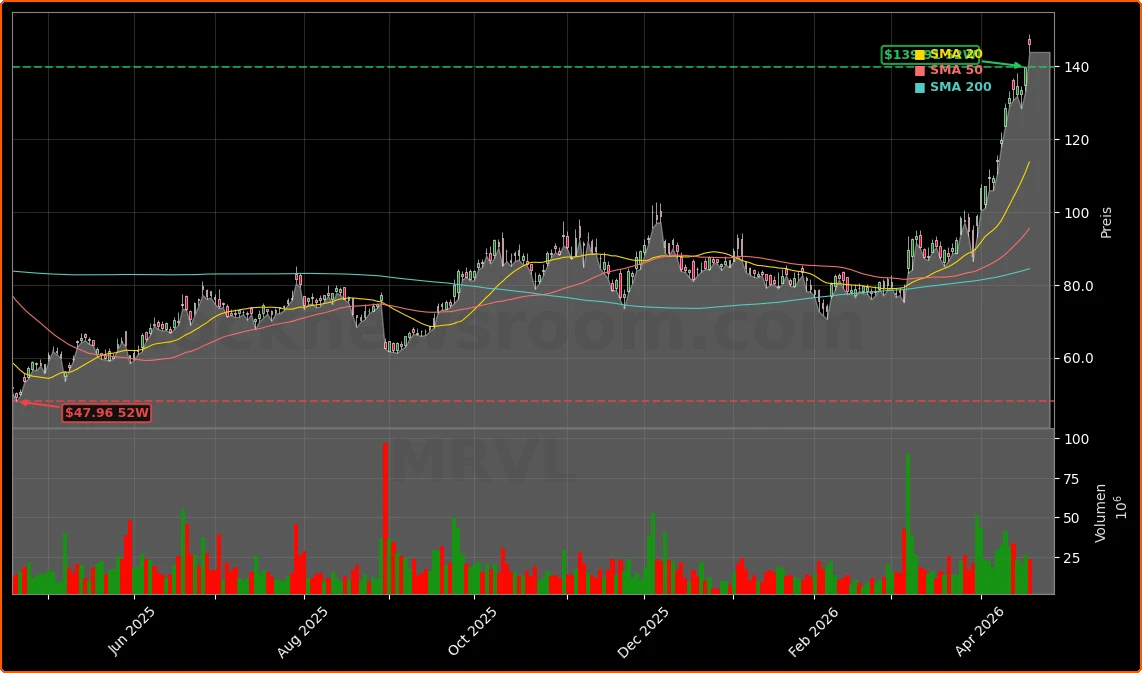
The stock’s move on Monday extends an already powerful rally. MRVL recently notched new all‑time highs in the $138 area before pushing further to the mid‑$140s, helped by strong Q4 results, accelerating data center growth, and a wave of institutional buying. With the broader NASDAQ heavily focused on AI narratives, Marvell has emerged as one of the go‑to names for investors looking beyond GPU manufacturers to the broader infrastructure stack.
Why does Google want Marvell, not just NVIDIA?
Google has been designing its own TPUs for years, but it relies on outside specialists like Marvell or Broadcom to turn those designs into production‑ready silicon. The strategic aim is clear: cut long‑term dependence on NVIDIA’s high‑priced GPUs and secure more control over cost, performance, and supply. Training massive foundation models will likely remain GPU‑intensive for the foreseeable future, but inference—running models at scale for billions of user queries—is where custom TPUs and MPUs can dramatically shift economics.
The chips tied to the Marvell Google AI Chip Deal are expected to focus primarily on inference and memory bandwidth efficiency rather than raw training performance. Inference‑optimized TPUs are typically cheaper and more power‑efficient than flagship training GPUs, making them attractive for hyperscalers that must balance AI growth with energy constraints and capex budgets. If Google can offload more inference workloads to its own chips, it narrows the playing field where NVIDIA currently dominates and builds a competitive answer to in‑house solutions at Apple and Tesla.
For Marvell, this plays directly into its custom ASIC strategy, where it acts as a design and manufacturing partner for hyperscalers seeking bespoke architectures. The company already supplies networking, optical, and custom compute silicon for leading AI data centers, and management has pointed to a pipeline that could push revenue toward the mid‑teens billions of dollars by the end of the decade. The Marvell Google AI Chip Deal, if fully realized, would support that long‑term trajectory and reinforce Marvell’s role at the heart of AI cloud infrastructure.
What does Wall Street say about Marvell now?
Analyst sentiment on Marvell remains broadly positive, even as valuation has pushed above many prior price targets. Oppenheimer recently raised its target to $170 while reiterating an “Outperform” rating, citing surging demand for AI data center networking and custom ASIC solutions. Multiple firms tracked by MarketBeat rate the stock a “Strong Buy” or “Moderate Buy,” reflecting confidence that AI‑related growth can offset cyclical softness in legacy segments like storage and 5G.
Institutional investors have been adding to positions despite concern about the pace of the rally. Cwm LLC, GF Fund Management, and Oak Harvest Investment Services all boosted stakes in recent months, viewing Marvell as a core beneficiary of structural AI spending. At the same time, insider selling—most recently by senior executive Sandeep Bharathi to cover tax obligations—has raised questions about whether near‑term upside is already priced in.
From a technical standpoint, MRVL is testing resistance zones in the high‑140s after breaking out from prior consolidation. Options activity includes notable put buying around the $118 strike, suggesting some traders are hedging against a pullback or betting on a regression toward the mean if momentum fades. With the stock trading at a premium earnings multiple above peers like Broadcom, short‑term volatility around earnings or AI headlines should be expected.
How does Marvell compare to other AI plays?
Compared with GPU leader NVIDIA, which remains the centerpiece of the AI training trade, Marvell offers a different exposure: connectivity, custom accelerators, and data center plumbing. Investors who worry that top GPU names could face eventual pricing pressure or cyclical digestion often look to “pick‑and‑shovel” suppliers like Marvell, networking players, and optical component makers as diversified ways to participate in AI infrastructure growth.
Marvell’s customer list already spans hyperscalers and large tech platforms, including partnerships with companies such as Microsoft and Meta, which are pouring hundreds of billions of dollars into AI‑ready data centers. While those customers occasionally face their own headlines—such as Meta’s ongoing layoffs tied to its AI pivot—the underlying capex trend remains robust. As long as cloud providers continue to re‑architect data centers around AI workloads, Marvell’s switch, optical, and custom chip portfolios should remain in high demand.
For U.S. retail and institutional investors, the key debate is whether the Marvell Google AI Chip Deal and related AI momentum justify today’s elevated valuation. Bulls argue the company is in the early stages of a multi‑year AI cycle with expanding margins and a deepening moat in custom silicon. Bears warn that any delay in Google’s chip rollout, a pause in hyperscaler capex, or a broader tech correction on the NASDAQ could hit high‑beta names like Marvell disproportionately.
Related Coverage
Investors tracking MRVL’s meteoric rise should also consider the role of insider activity. Our recent piece “Marvell Technology Insider Selling Hits Record Levels” examines whether the latest wave of executive stock sales signals caution at the top or simply tax‑driven profit taking in a surging AI name. For a broader sector lens, “Meta Platforms Layoffs: -2.3% Shock as AI Pivot Deepens” looks at how aggressive cost cuts at major platforms feed into massive AI infrastructure budgets—spending that ultimately flows to suppliers like Marvell.
In the end, the Marvell Google AI Chip Deal reinforces Marvell Technology, Inc. as a central player in the build‑out of AI data centers worldwide. For investors, the combination of hyperscaler custom chip wins, strong analyst support, and powerful technical momentum keeps MRVL squarely on the radar, even if volatility and valuation risks remain. The next milestones will be design finalization, trial production, and concrete revenue contributions from Google’s new TPUs—developments that could determine whether Marvell’s AI‑driven rally has even more room to run.